Part 2 --- Skits
Prelude to the skit
This is a work of fiction in which I have taken a bird's-eye view of the pointillism of Teotihuacan and Tikal in Part 4 and connected them with rather forceful lines.
There are four periods in the history of Teotihuacan since 1 AD that seem to be turning points: 1 AD, 120 AD, 378 AD, and 550 AD. Of course, the periods between these turning points were not constant, and various elements of the city appear to have undergone gradual change.
A council system was chosen as the political system, as it fit the results of the tourist walk and did not appear to be a dictatorship. However, when we try to explore what the council's composition was, the details remain hazy. Each district differs in terms of historical age, economic power, location, and architectural quality, so naturally there must have been an implicit hierarchy within the council. Even archaeologists who are leaning towards the council theory are hesitant to answer the question of which central temple/residence or nearby apartment complex the representative council members lived in.
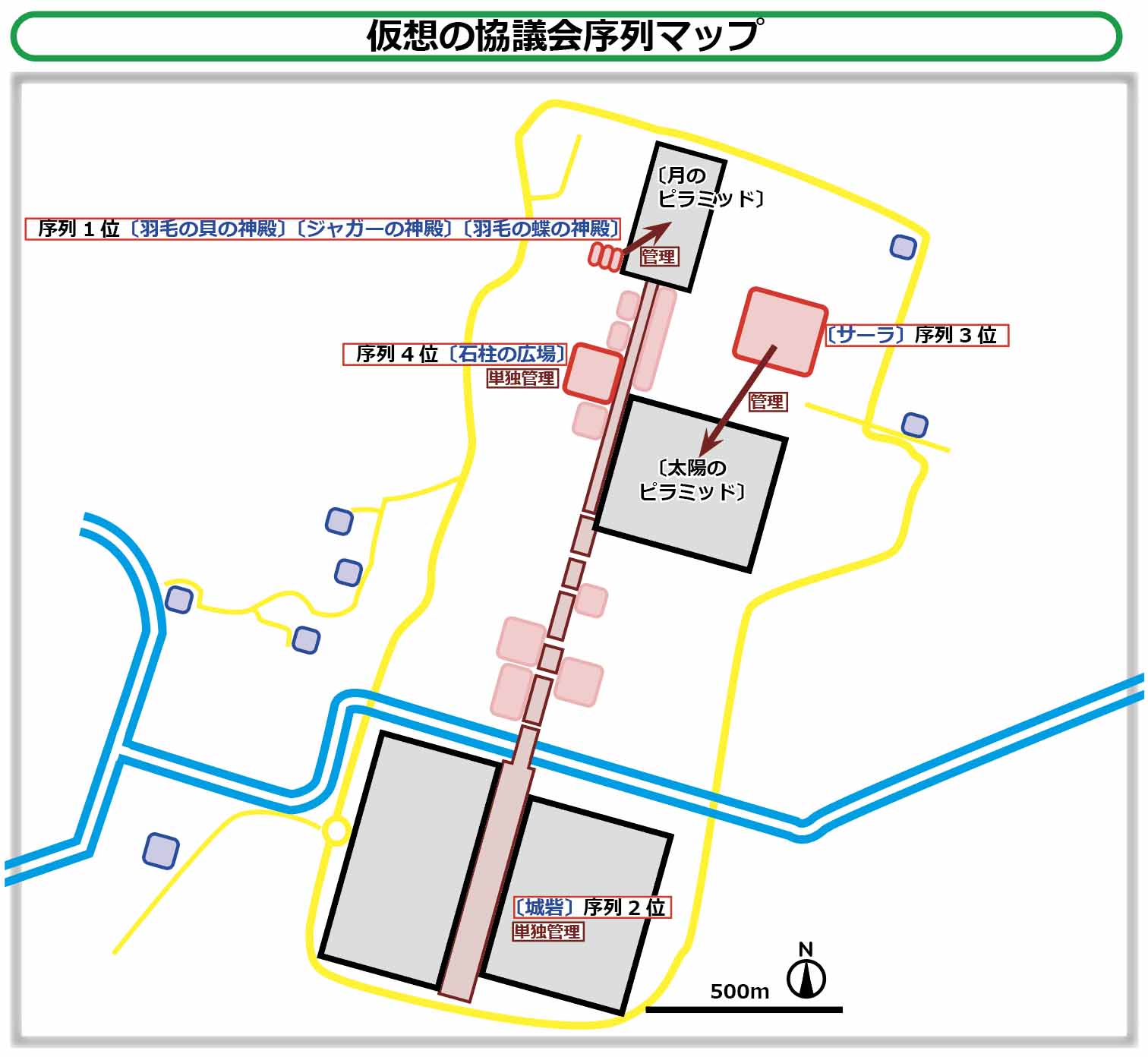
In these skits, I hypothesized that the current Council members number 1 to 4 were located in the Temple of the Feathered Shell, the Ciudadela, Xalla, and the Plaza of the Columns.
The Temple of the Feathered Shell was built between 100 and 250 AD, the Temple of the Jaguar between 350 and 450, and the Temple of the Feathered Butterfly between 450 and 550. It is assumed that a wooden Feathered Shell shrine existed in the same location before 100 AD. Therefore, the leaders of this area have been named according to their era: Shrine Chief, Feathered Shell Chief, Jaguar Chief, and Feathered Butterfly Chief.
The Pre-Ciudadela stood on the site of the Ciudadela until 120 AD, so the position is called the Chief of the Pre-Ciudadela, and after 120 AD the position is called the Chief of the Ciudadela. Other positions include the Chief of the Sala and the Chief of the Plaza of the Columns. The ranking is determined based on the difference in the depth of history and the size of economic power.
First place is the [Chief of the Feathered Shell Shrine], whose occupation was processing obsidian and later managed the [Pyramid of the Moon].
Second place is the [Chief of Pre Ciudadela], whose occupation was stone carving and wide-area trade, and later managed the [Pyramid of the Feathered Serpent].
Third place is the [Chief of Xalla], whose occupation was producing crafts using mica and later managed the [Pyramid of the Sun].
Fourth place is the [Chief of the Plaza of the Columns], who manages the [Pillar Plaza].
These are the top four members of the council.
Skit 1 -- Refugees from the eruption of 1 AD
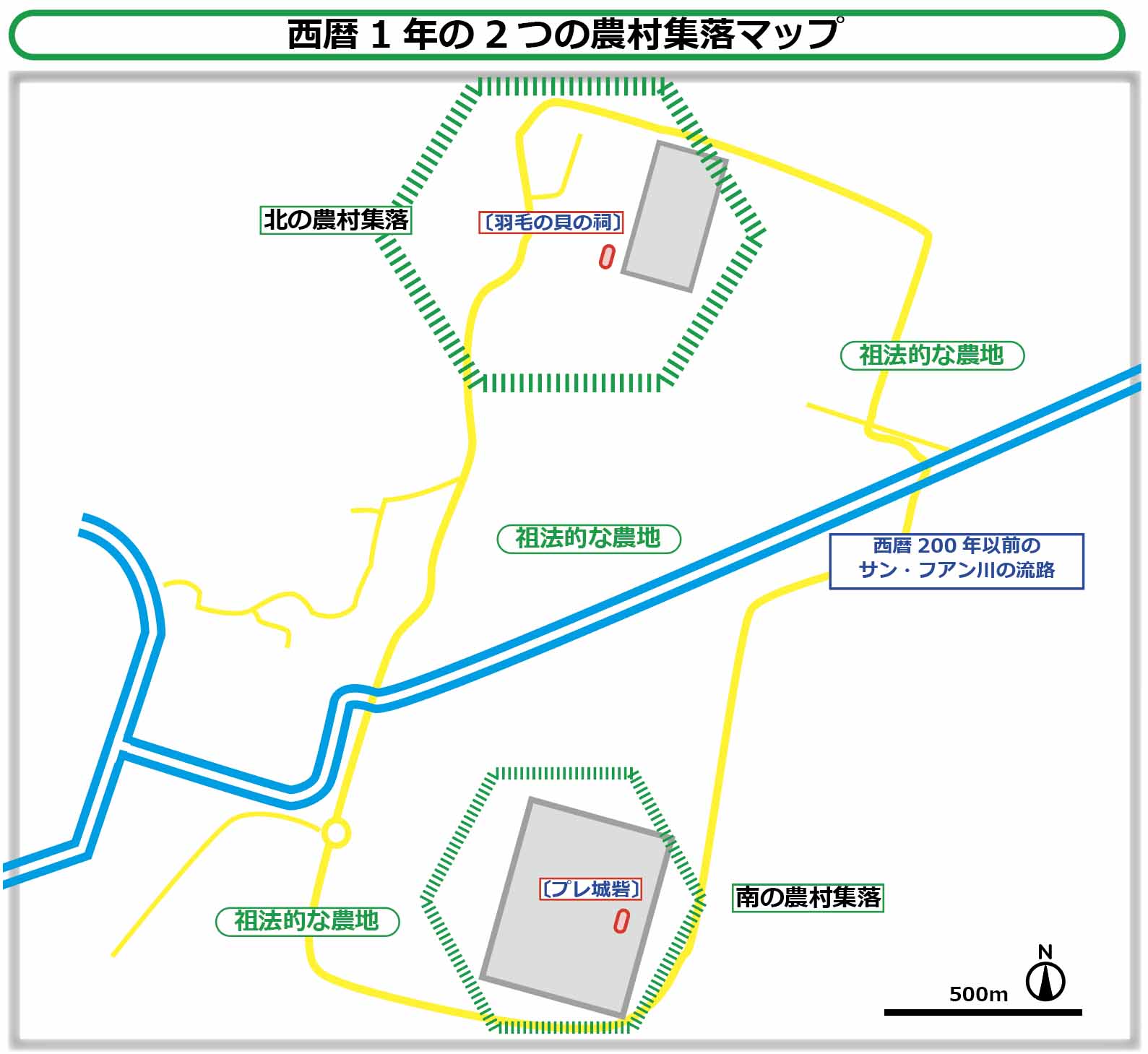
No components of the 1 AD Teotihuacan map have been reported other than the distribution of pottery flakes, springs, faint canals and reservoirs.
[Shrine Master] was cleaning a small wooden shrine.
[Pre Fortress Commander] called out. "Elder, are you cleaning it by yourself?"
[Shrine Master] laughed. "More and more people are coming to offer tribute. We need to keep it clean."
"At my place, we also have a large, flat stone facing south, with a taller stone at the southern end. It must be an altar."
"Maybe it's facing Popocatepetl?"
"I guess so. The taller stone is probably the volcano."
A conch shell with wings is carved into the center of the two wooden pillars in the foreground.
"This symbol is..."
"It combines the sky and the sea. I heard it was displayed in a village to the east, so I borrowed it."
[Pre Fortress Commander] thought to himself. A feathered irrigation system, perhaps, or corn. No, in our case, it would probably be a feathered jaguar or snake.
"I've come to consult with you today."
"Oh, [Head of Pre Ciudadela] has come to me to ask for advice."
"More and more people are flocking here. They're starting to live wherever they want. They're not doing any harm, but it looks like they'll soon be fighting over land and food. What should we do?"
"That's true."
Two of them said, sharing their thoughts.
1. We should not avoid the immigration of refugees. Population growth beyond natural growth leads to economic development, such as agricultural production and pottery manufacturing.
2. We will expand the farmland outside the northern and southern settlements to increase food production, and set up workshops in the central areas to produce obsidian processed goods and pottery, and then expand the wide-area trade network to carry these goods. This should begin to bring in wealth.
3. For now, it's fine to leave it as a cluttered cluster of houses.
4. Agriculture in the Teotihuacan Valley will run out of food. When sending trade groups outside the valley, an escort force will be needed. In normal times, they will also serve as an internal security force.
"The next thing is how we can make the whole thing work smoothly. Maybe we could get a few households to appoint a mediator. How about having everyone gather at this temple regularly? No one would want any conflict. Why don't we just continue to discuss things between the two of us?"
[Chief of Pre Ciudadela] nodded.