Ciudadela
Crossing the San Juan River bridge to the south, the view opens up: the southern part of the Street of the Dead is in the center, the Great Compound is to the right, and Ciudadela is to the left.
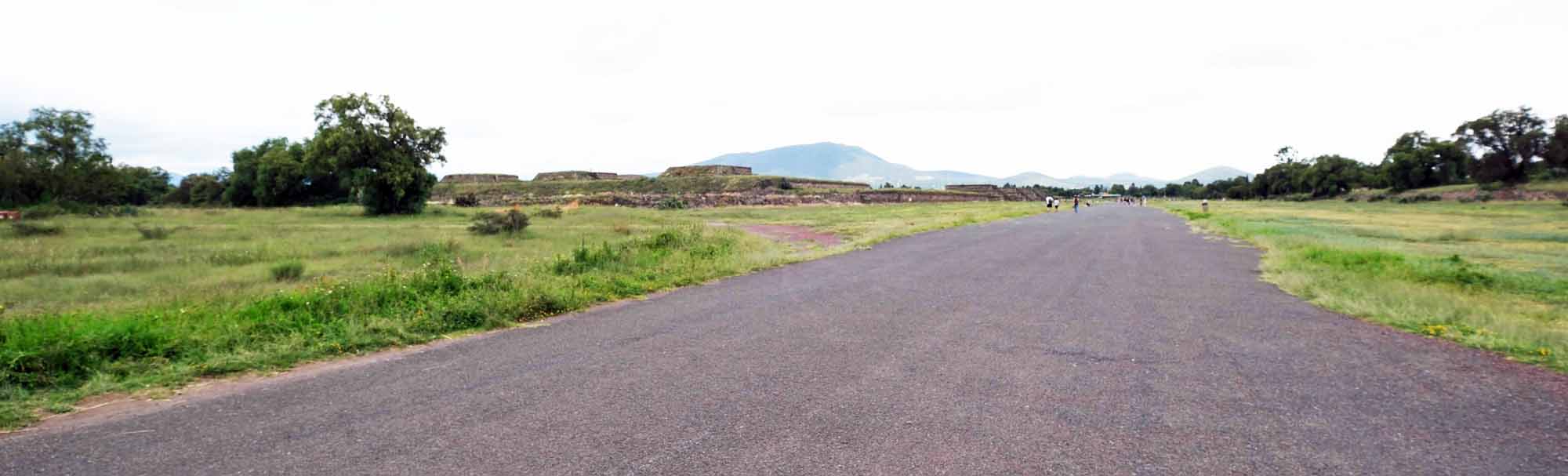
↓You can see the northwest corner of Ciudadela.
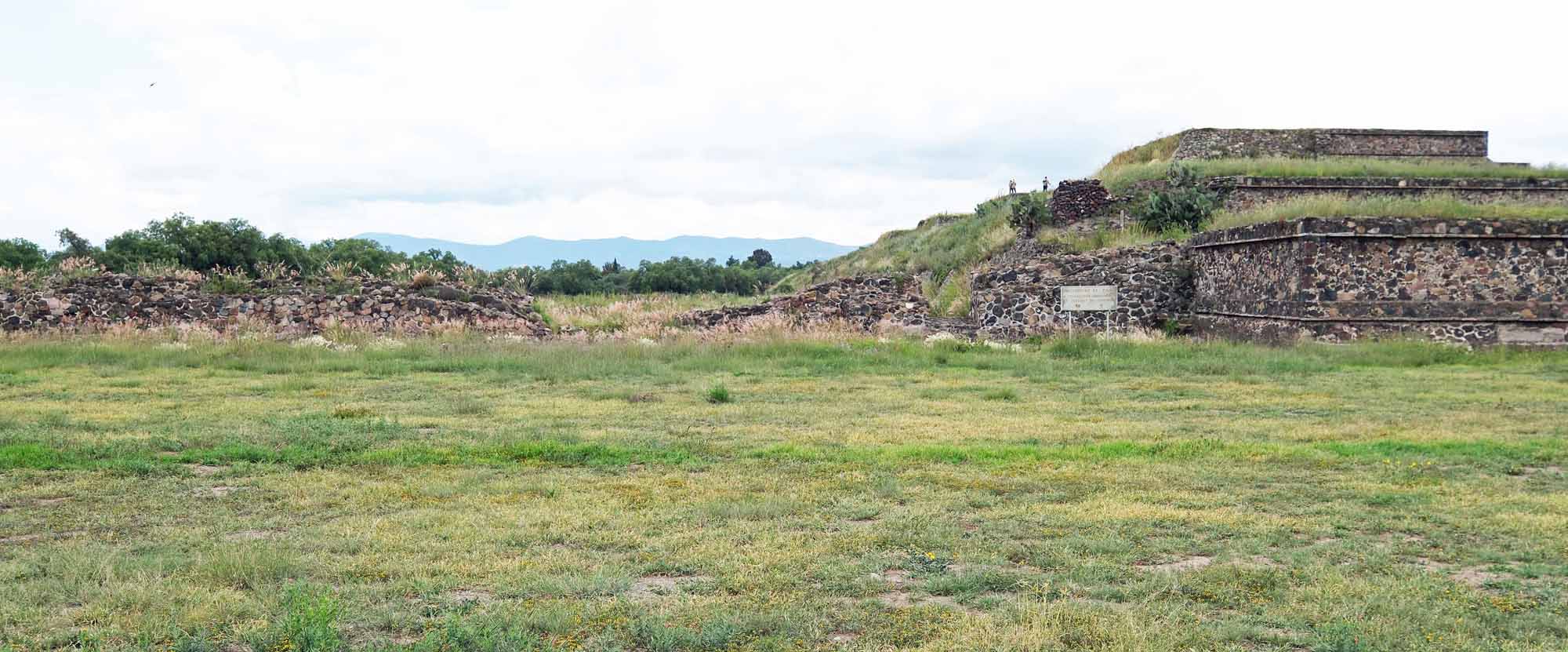
If you continue walking, you can see the outside of the northern platform. The left half of the photo above is the "Craftsmen's Enclosure" which I will mention later. I would like to get closer, but entry is restricted by the pavement of the Street of the Dead.
↓This is the outside of the western platform. In the center is the central staircase. The Street of the Dead crosses just before it, and I stepped back to take the photo with my back to Puerta 1.
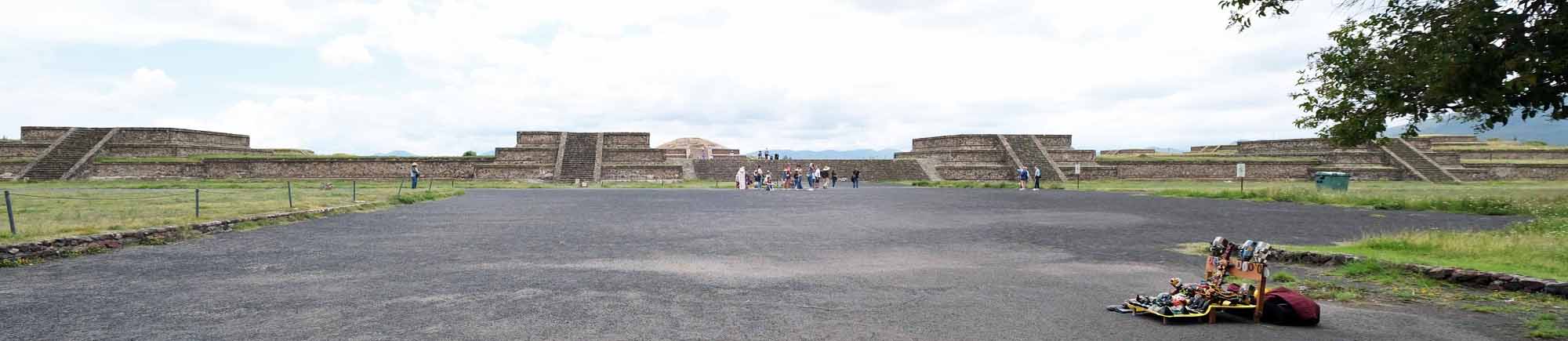
Here too, you're not allowed south (right) from the paved surface, meaning you can't go around the outside of the platform. But looking at the map, it doesn't seem hopeless. Let's go back to Puerta 5. We'll leave there and try to use the outer road.
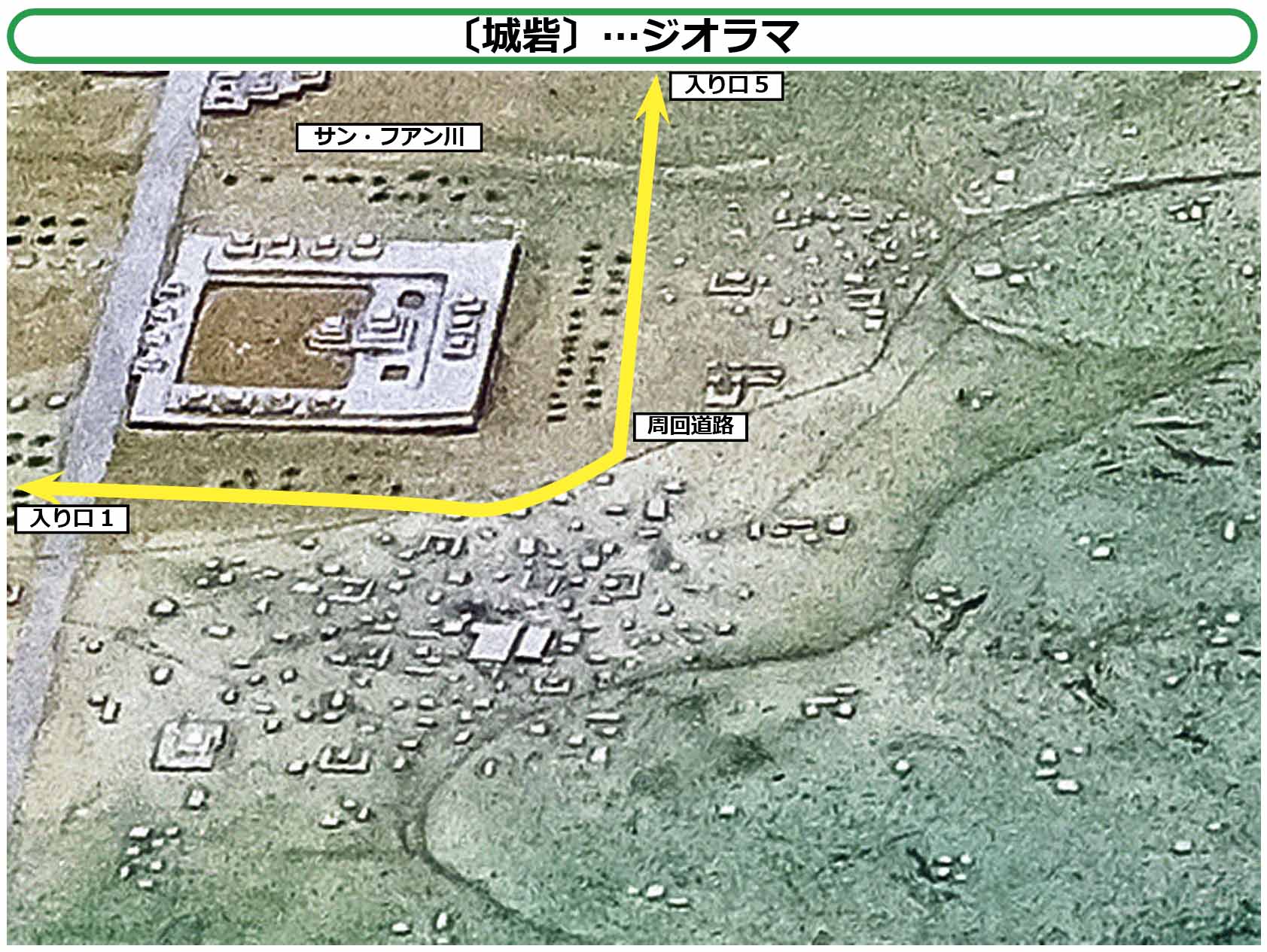
↑At the Anthropological Museum diorama. With the Adosada Platform in place, this shows the site after 378 AD.
If you go about 700m south from Puerta 5, you will see the northeast corner of the circular platform through the mesh fence. The dark hole in the stone wall in the center of the photo is probably a drainage outlet. To the north (right) of that is the eastern end of the "Craftsmen's Enclosure."
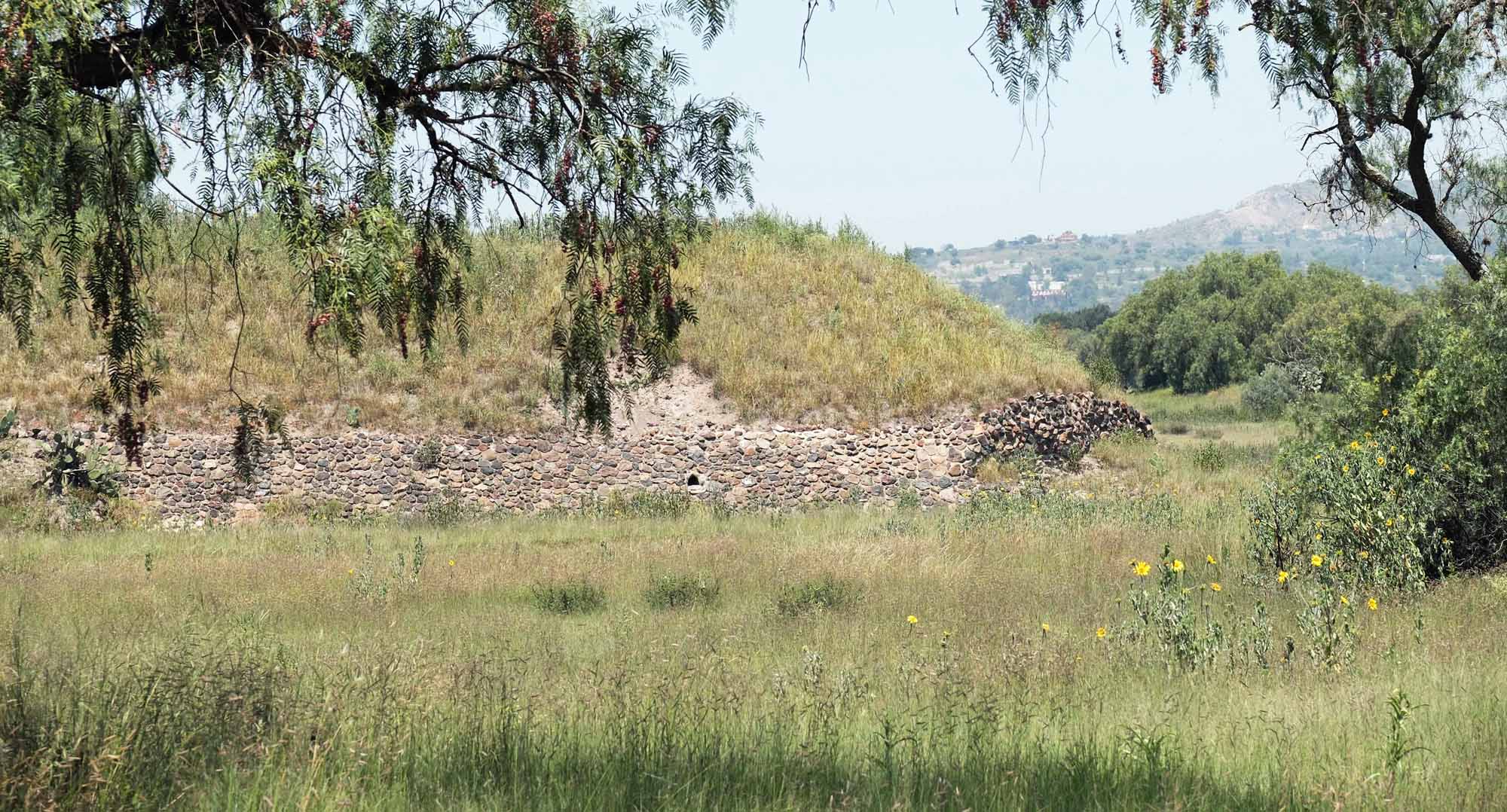
↓You can immediately see the eastern platform and the southeast corner in the distance.
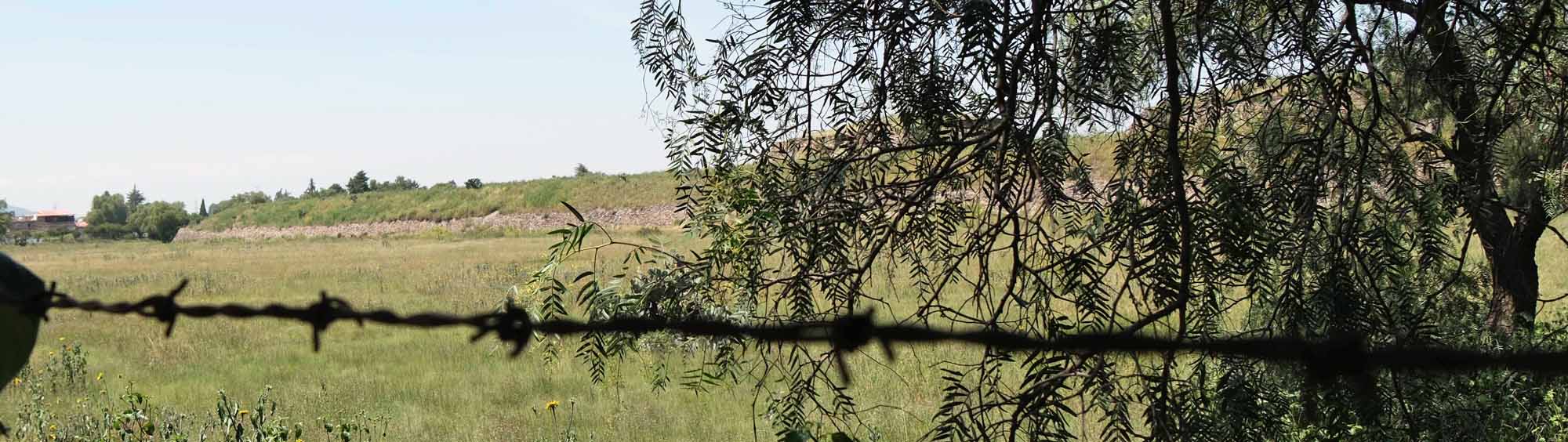
The photo below shows the three temples on the eastern platform. Beyond them, you should see the Pyramid of the Feathered Serpent. If you watch the sunrise from the center of the western platform, the top of the Pyramid of the Feathered Serpent and the two small temples on either side of these three temples will coincide with the position of the sun on the winter solstice, vernal equinox, autumnal equinox, and summer solstice (from left to right).
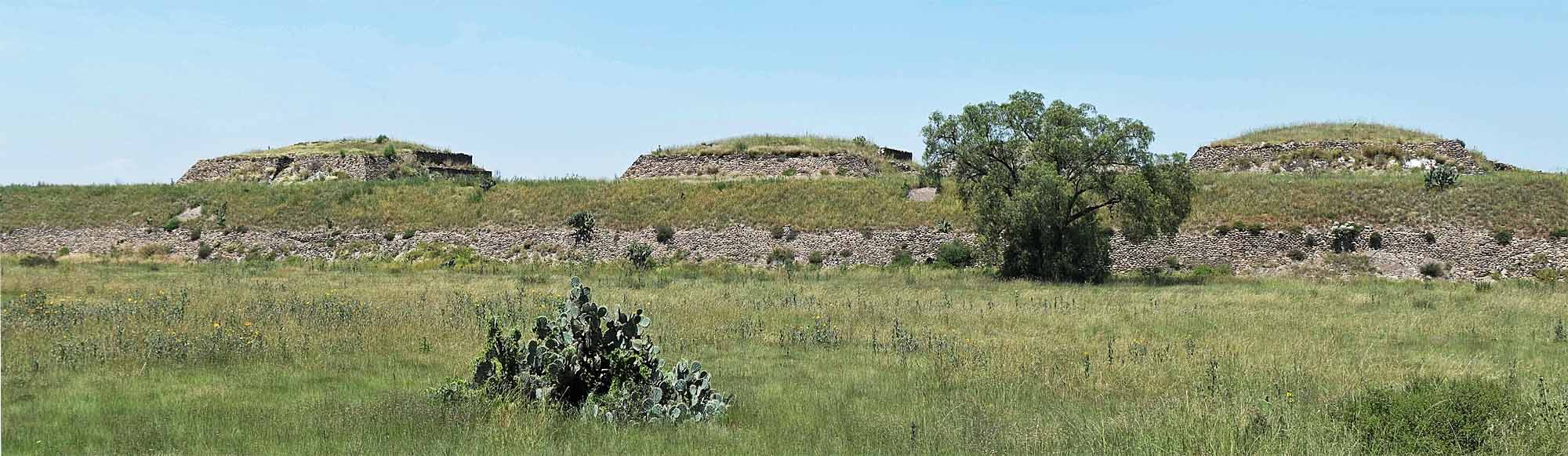
As mentioned in the Lost World of Tikal, this is the Ciudadelal's "E-Group." It is an important indicator of agricultural milestones.
If you go further and look back, you can see the top of the Feathered Serpent Pyramid below, the three temples on the eastern base, and the Pyramid of the Sun to the right.
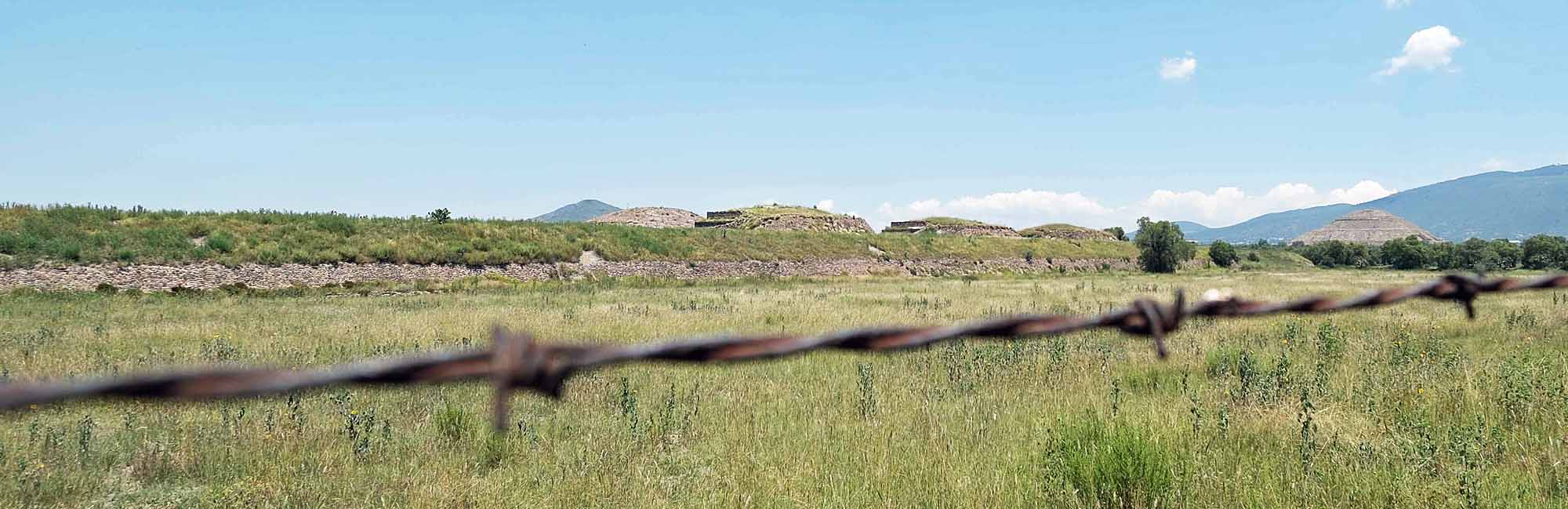
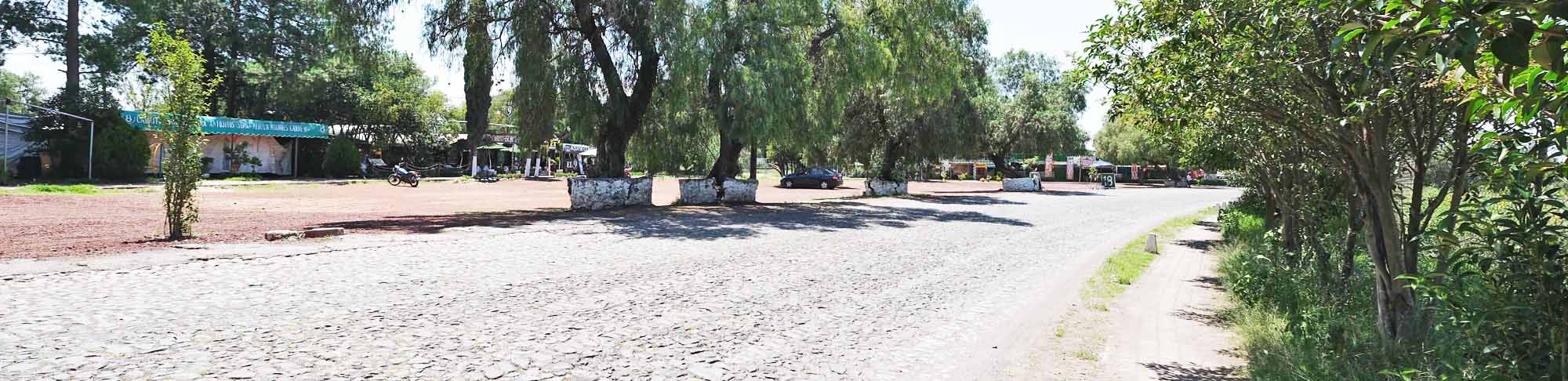
This is the outer road around here. You can seeCiudadelat on the right. The road is rough asphalt. There are restaurants lined up along the road. There also seems to be a hotel.
What was the scenery like in the past?
The current outer road descends from the top center of the photo and turns west at the southeast corner of Ciudadela. The corner is now a restaurant district, with modern buildings clustered around it.
Therefore, although the excavation results were not good, traces of small squares, temples, and some farmland, as well as houses that were much more modest than the central temples and houses, were found. There were almost no houses within Ciudadela, so it is assumed that people, excluding special elites, lived in these outer periphery areas. This could be called Ciudadela community area.
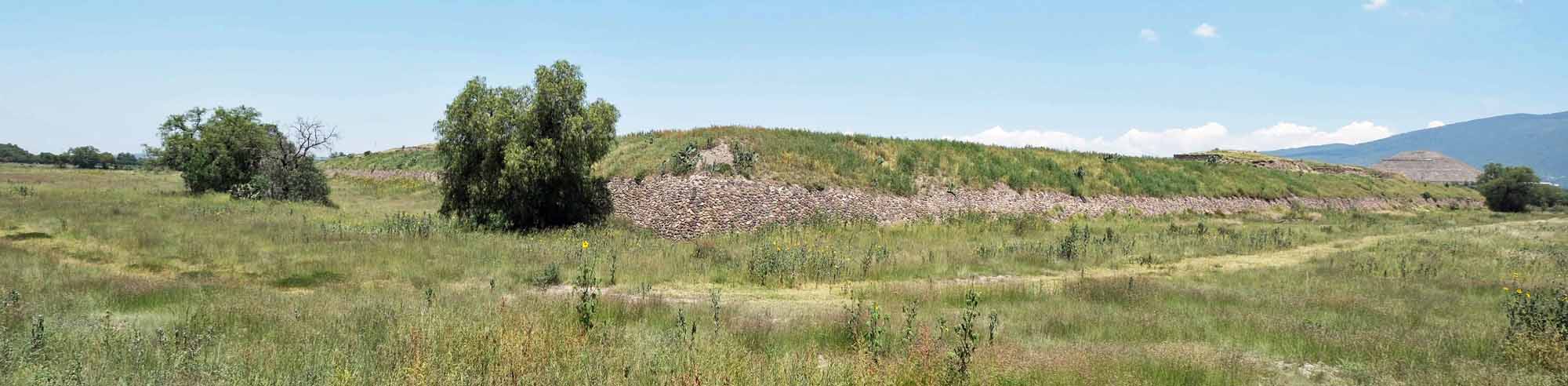
Below is the southeast corner of Ciudadela platform.
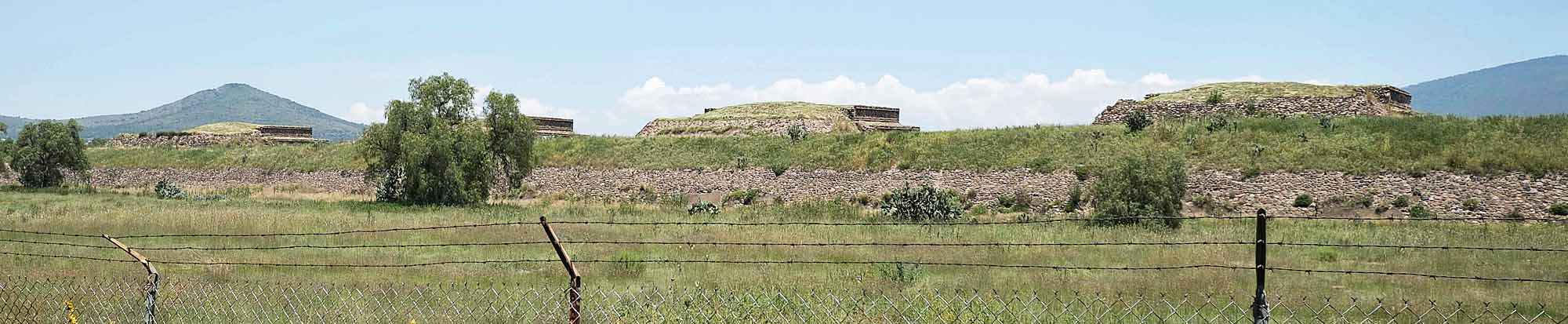
Next are the four temples on the southern platform.
Further west, you will come to the southwest corner of Ciudadela. In the foreground you will see the Pyramid of the Moon, and to the upper right you will see the Pyramid of the Sun.
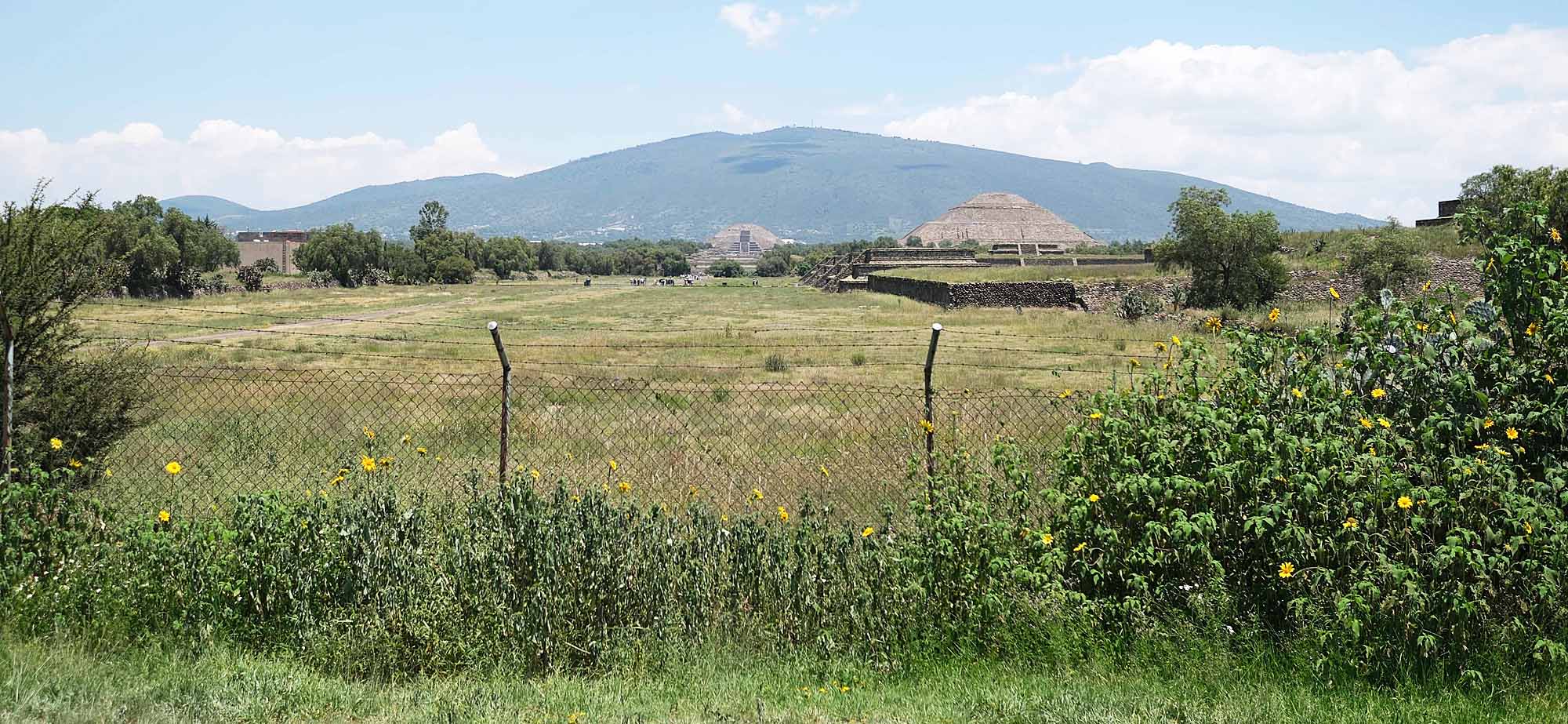
As you can imagine from the elevation relationship, if you climb to the top of both pyramids you can look down on Ciudadela. But if you're on the ground, you can barely see Ciudadela. I wonder, or am I overthinking it, if this positioning has always had some kind of impact on the psychology of the people in the two regions on either side of the San Juan River.
From here, walking along the outer road leads to Puerta 1. If you turn east from there, you will pass through the Great Compound and see the western face of the outer platform. The long walk of just under 2km gave me a real sense of the vastness of Ciudadela. So, what happened in this 400m square area from just before Christ to 550 AD? There were three major events in this area.
The first time...after the year 1 AD...a 400m square was surrounded by a high platform, and others were rejected.
The second time...after 150 AD...most of the structures within the platform were removed and leveled, and a new Pyramid of the Feathered Serpent was built, with more than 200 sacrifices buried beneath it.
The third time...378 AD (350-400)...The decorations of the Feathered Serpent Pyramid were completely destroyed, and the Adosada Platform was built on the western front side to cover it up.
The first and second times were probably the result of choices made by the people who originally lived in this area. However, the third time seems highly unlikely. What circumstances could have led to this? Before formulating any hypotheses, let's look back chronologically, starting with the first time.
Part 1...Before 150 AD
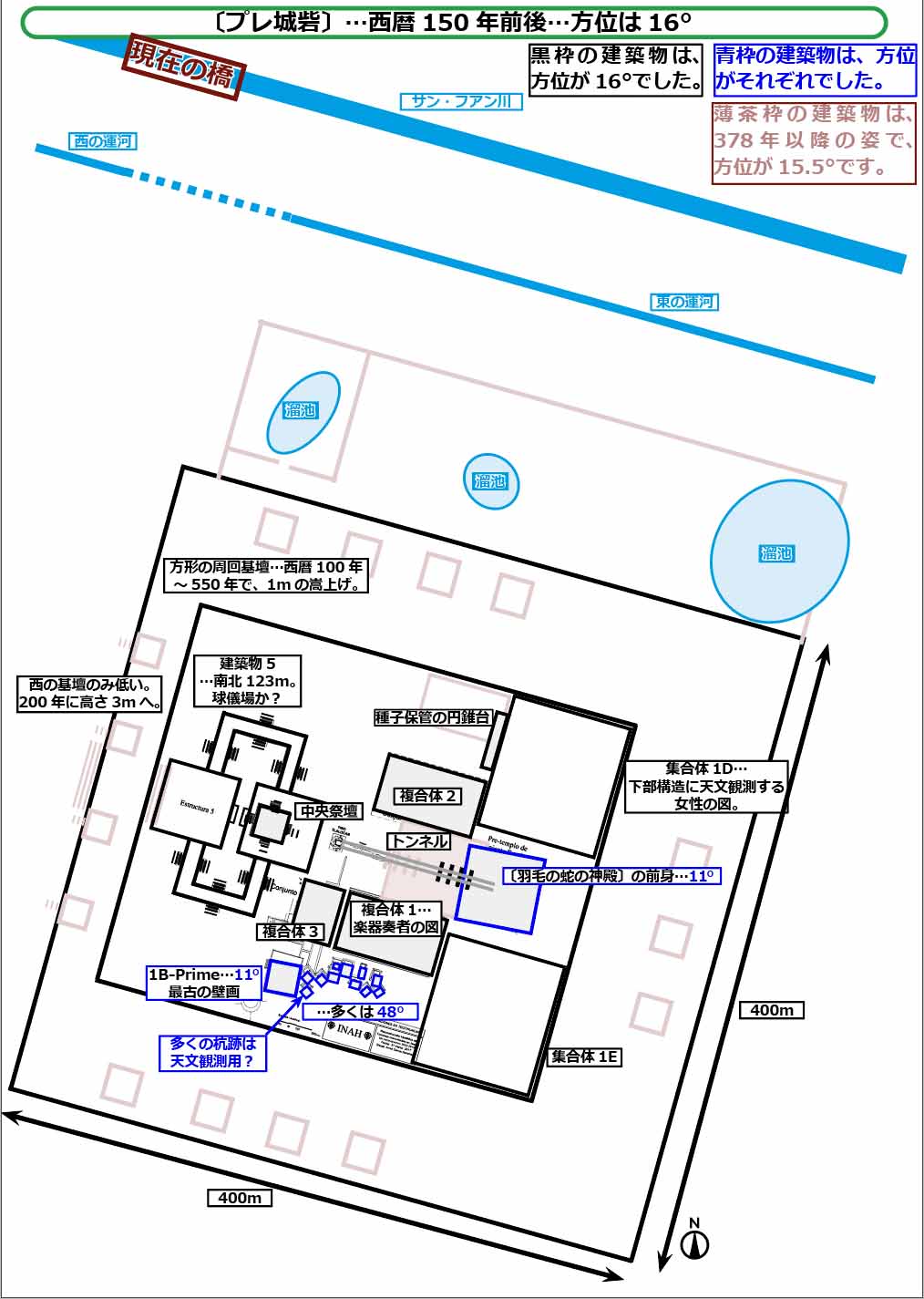
It is said that a small rural settlement has existed on the site of the fort since around 1000 BC. The diagram below shows three depressions that were reported at the time, which are likely to have been agricultural reservoirs. Although it is too old to verify, there was another rural settlement to the west of the Pyramid of the Moon, and it is highly likely that these two locations formed the core of development.
So let's look at what happened in the area called Ciudadela by 150 AD, when agricultural production ceased to be the main handicraft, farmland was moved outside the city, and urbanization took place.
It is believed to have been a ceremonial site between 1 AD and 150 AD. The surrounding platform was about 1m lower than it is today, but was still largely formed.
The vast plaza that we can see today once housed many buildings. Most of these have been destroyed and will not be rebuilt. Around 150 AD, a 15cm thick layer of earth was piled up, leveling the area and leaving a vast plaza. This proved beneficial for excavation, as it allowed for research to be carried out without being disturbed by later buildings.
The soil in the plaza was littered with various fragments, including bone fragments of various animals, shells and fish bones from the Gulf of Mexico and the Pacific Ocean, and pottery flakes likely from the Maya region, evidence that the people of Ciudadela engaged in active trade before 150 AD.
The houses that would have been inhabited by the elite were also demolished. In addition, faint remains of walls and foundations dating back to before 150 AD were discovered beneath the Temple of the Feathered Serpent. It is believed that the predecessor of the current Temple of the Feathered Serpent existed here.
Complex 1
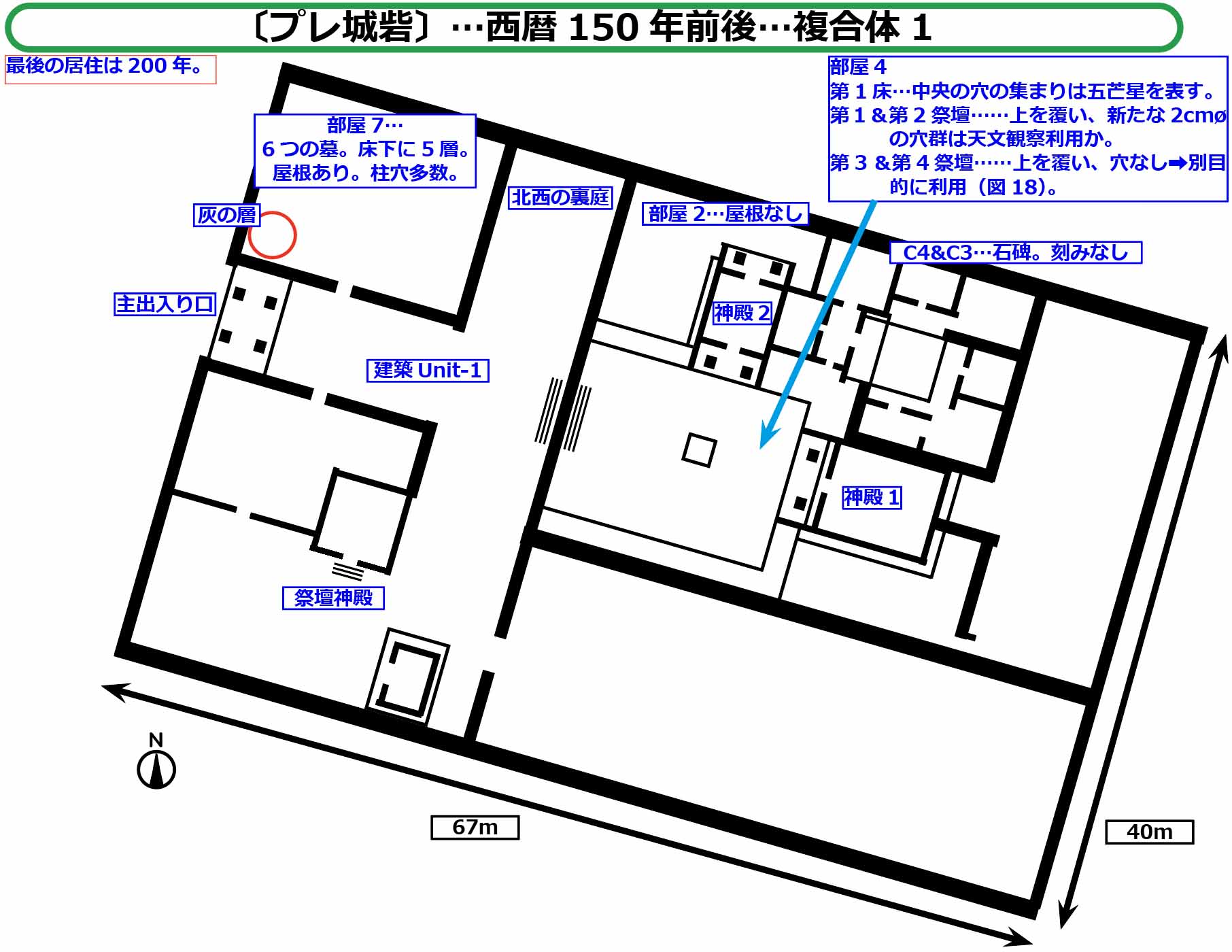
It does not appear to have had any residential function, so it is thought to have been a large ceremonial building.
Construction 5
All that remains visible today is the central altar. Based on the faint traces of the foundation, archaeologists have drawn several black lines. Furthermore, there is no trace at all in the area surrounded by the brown wavy lines. For some reason, it was probably completely removed when the land was leveled before 200 AD. This means that there is evidence for the lines on the eastern half, but no evidence for the western half.
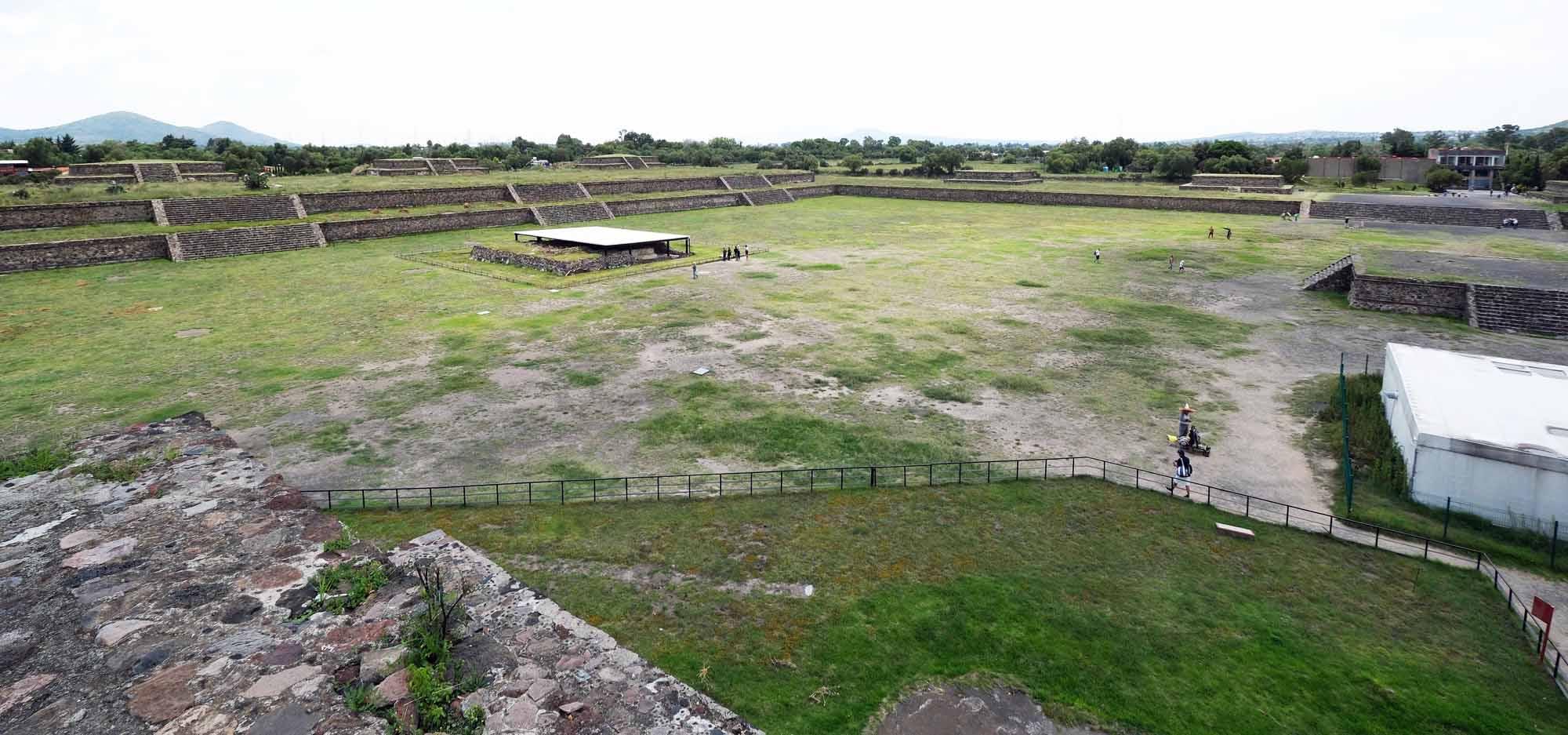
On the other hand, it would be unnatural to assume that nothing existed. When they stood a mirror up and looked at it, lo and behold, a ball game court emerged. It was a huge structure measuring 123 x 108 meters. It was a typical I-shape. Normally, two temples face each other on a platform separated by a central field. The eastern one remained as a central altar for future generations, and the possibility of a western one was too speculative, so it was probably not mentioned in the paper.
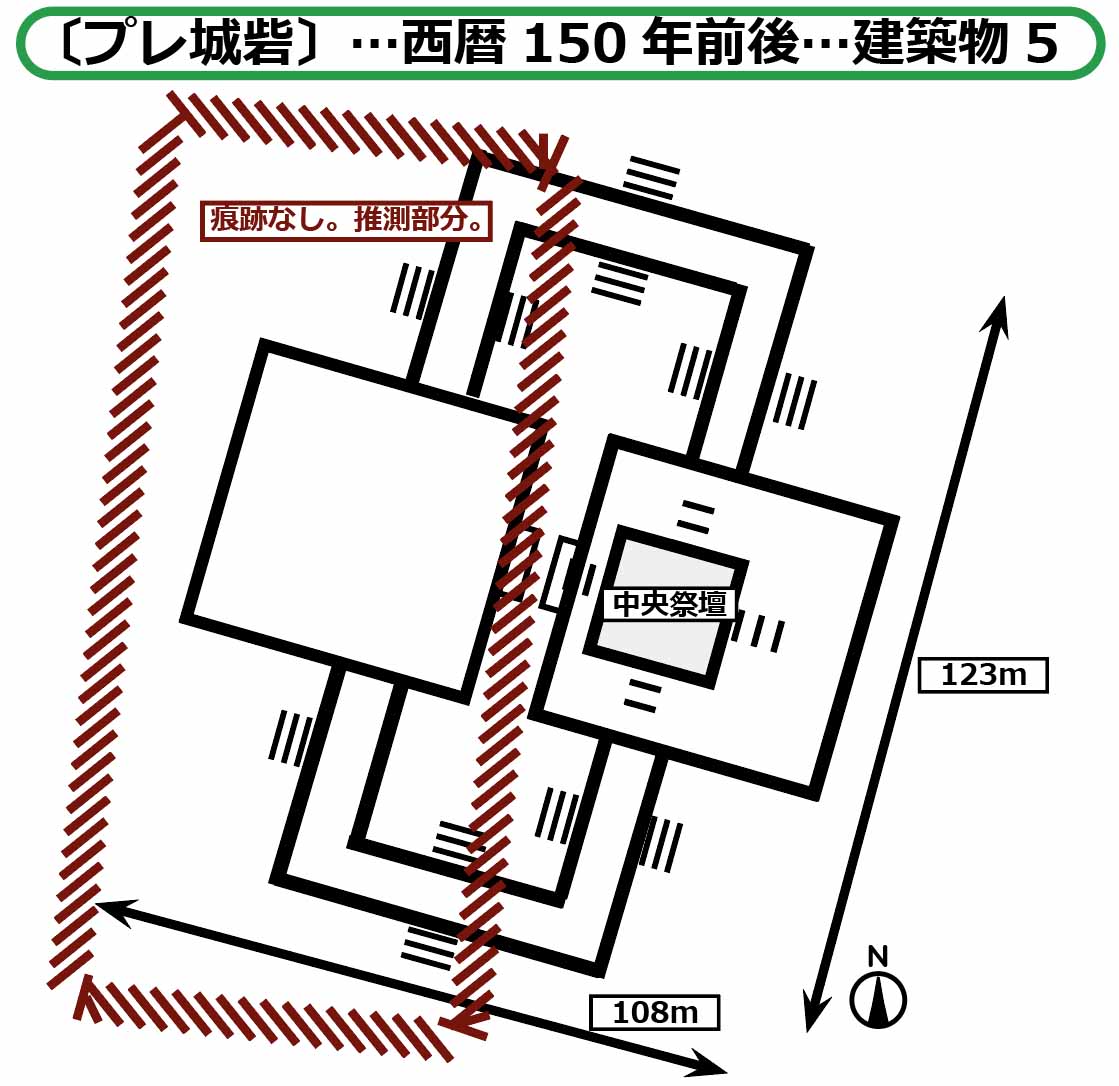
It has long been said that there was no permanent ball court at Teotihuacan, but archaeological evidence supports the idea that one existed at Ciudadela. Supporting evidence includes the discovery of 12 rubber balls in the Pre-Ciudadela tunnels.
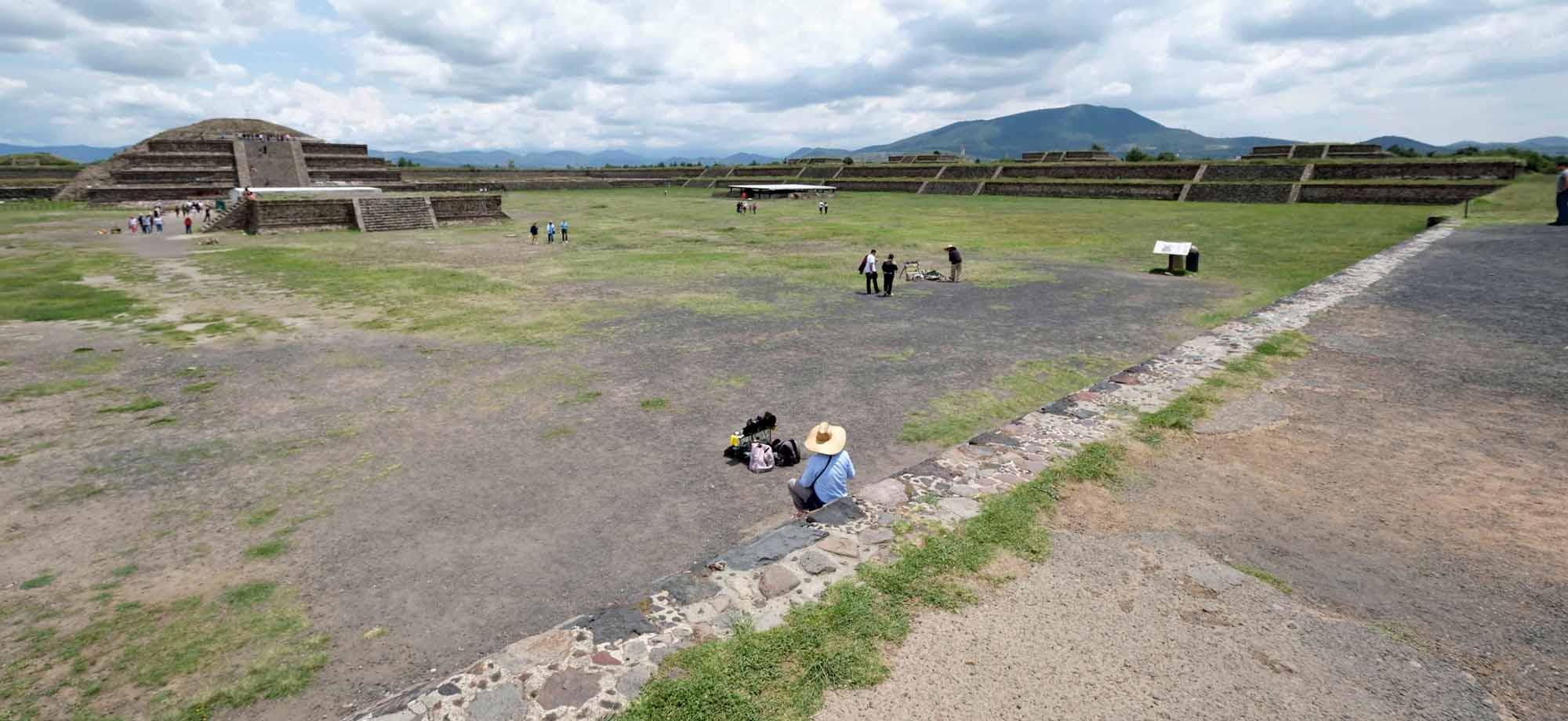
The photo above is looking east from the western platform. The central altar can be seen in the upper left, and construction 5/ball game courtl was located on what is now a large flat area on the western platform.
Central Altar
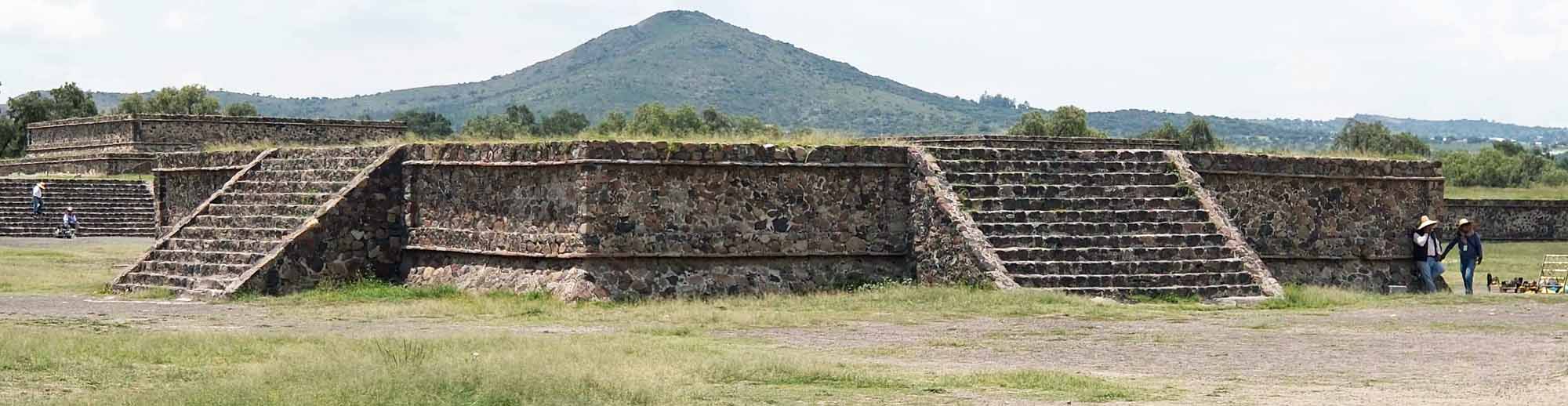
It is 20m square and 3m high.
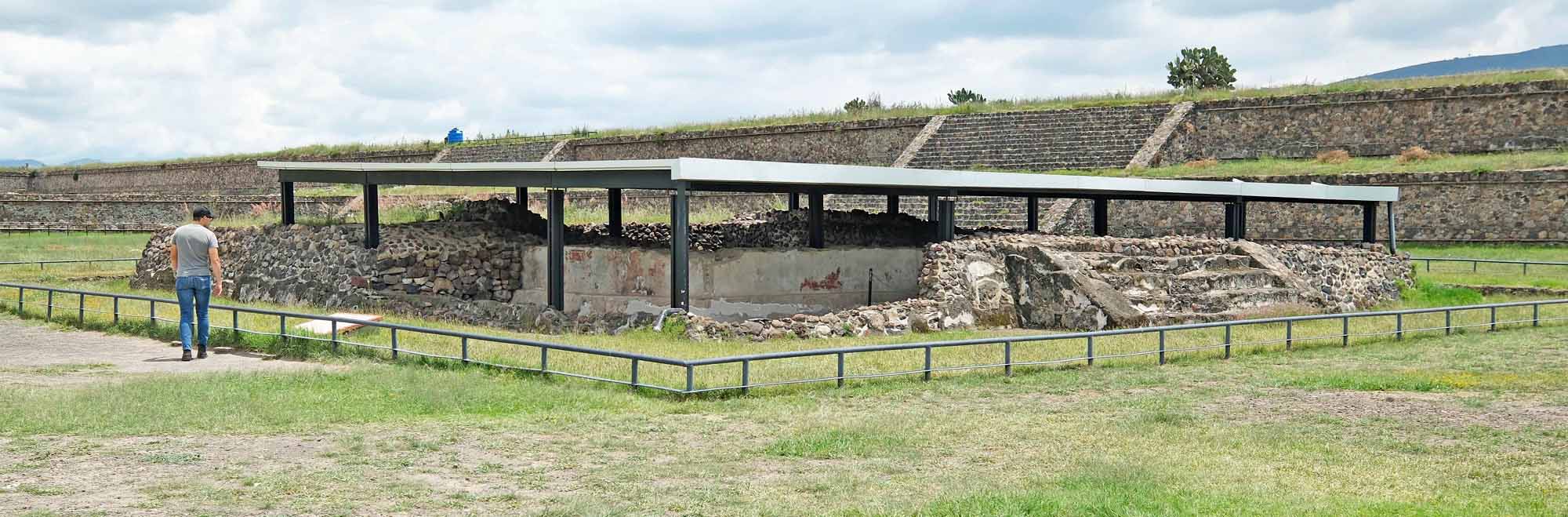
1B-Prime (=Southern Building Sur)
Looking southwest from the Aosada platform, under the white roof in the center of the photo.
The stairs on the right below are part of the final structure, and there must have been a temple at the top.
The whitish wall seen in the center is the second layer of the building. It appears that it was completely covered and expanded in later periods. According to the explanation, the design of the exterior mural is a geometric pattern with a triple circle in the center and rectangles emanating in eight directions.
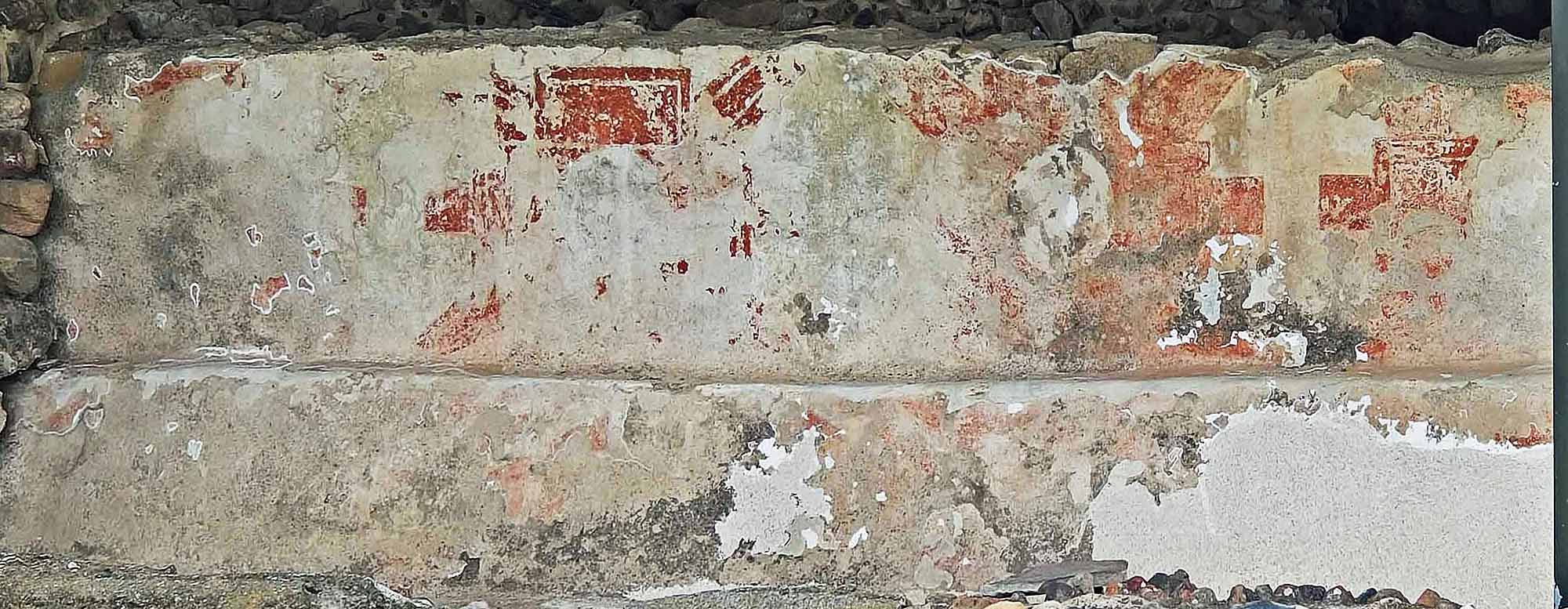
Although the date is unclear, it may be the oldest mural in Teotihuacan.
As a result of the renovation of the Great Plaza, it is thought that the elite of the elites began to live in complexes 1D and 1E, which were developed around 200 AD, while the lower elite moved outside the surrounding platform.
Artificial Tunnel
Construction was carried out three times: at 170, 200, and 250 AD. Each construction was sealed with multiple limestone partitions. Tens of thousands of votive offerings have been excavated from the tunnel. It was discovered in 2003, but the results of analysis of all the artifacts have not been made public. Analysis is still ongoing in a white tent west of Adosada.
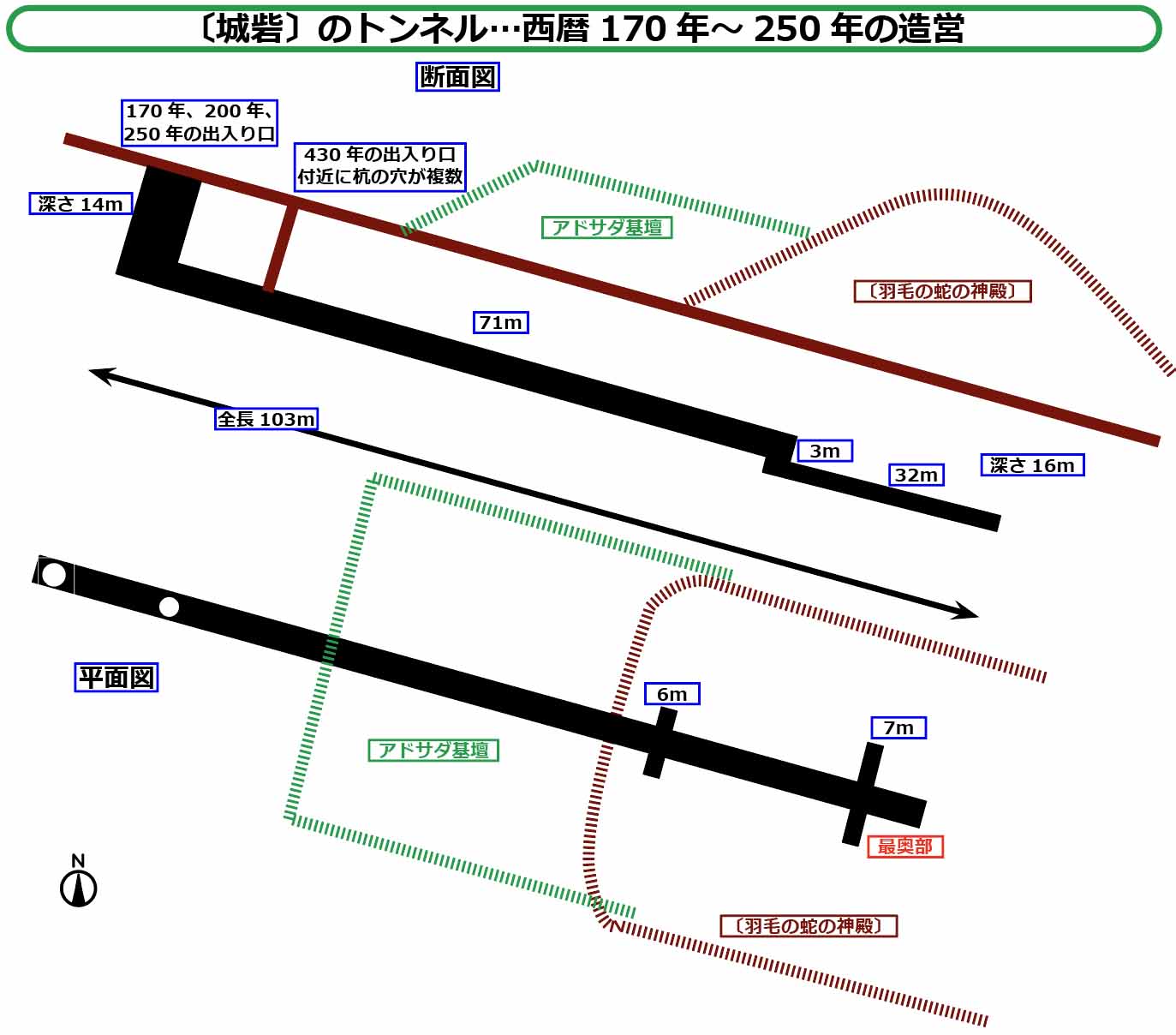
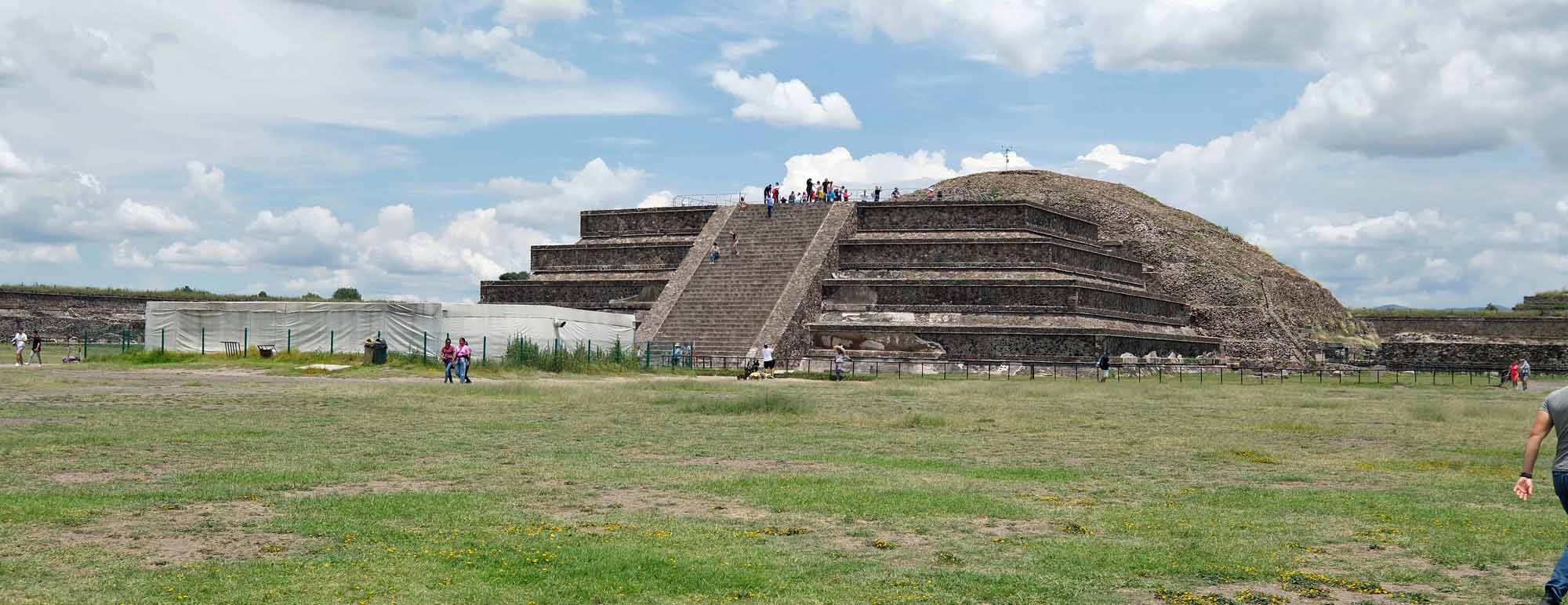
↑Inside the white tent, there is an entrance/exit for 250 AD and an entrance/exit for 430 AD.
Below are some of the items on display at museums, but it is unclear when they were offered. No human bodies were found. Charcoal dating from 1 to 100 AD was discovered at 32 meters point, and it is possible that they were carried in during that period and buried in 170 AD.
At the back of the innermost four-sided cross-shaped room, four green stone figures were protected by a small waterway filled with mercury. These were two of them.
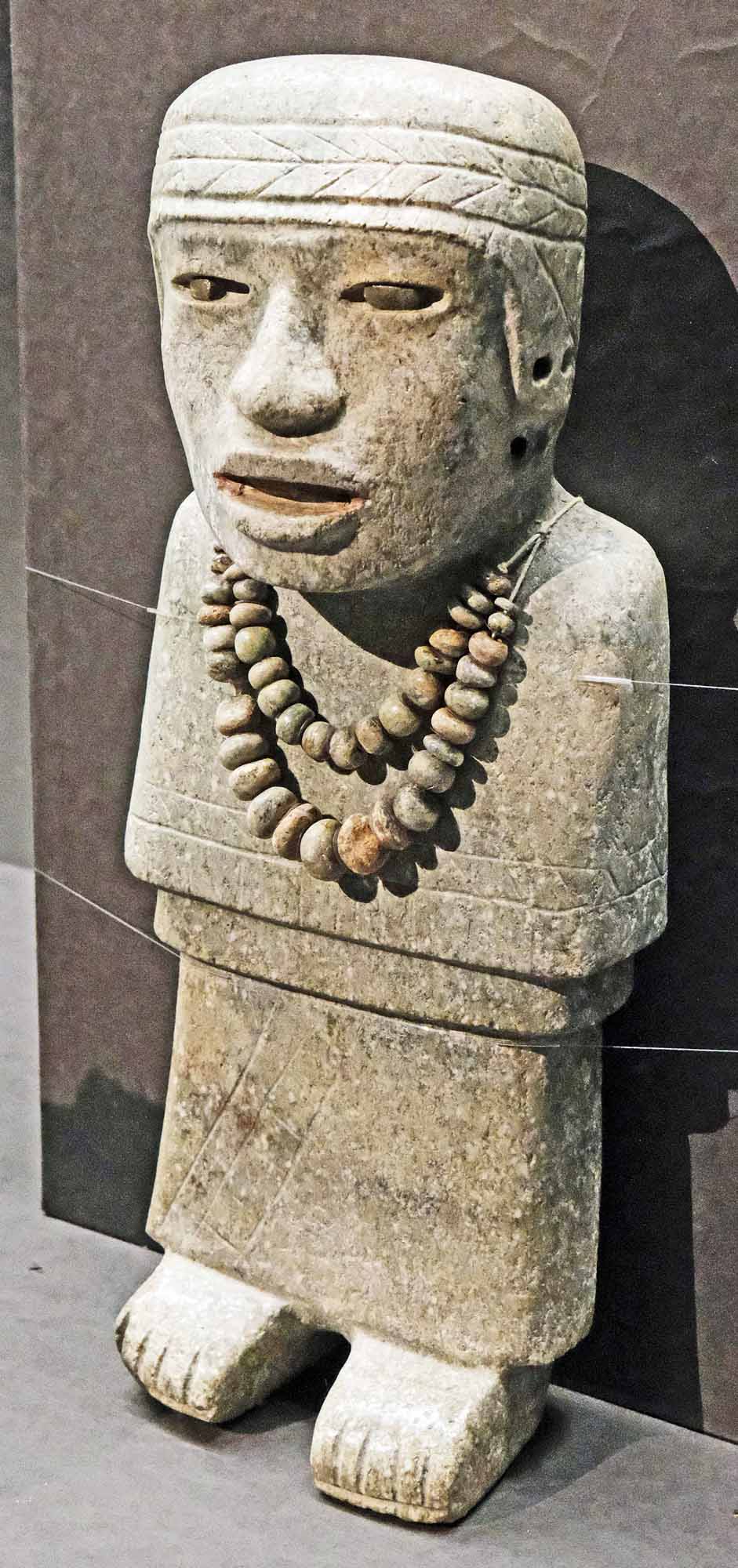
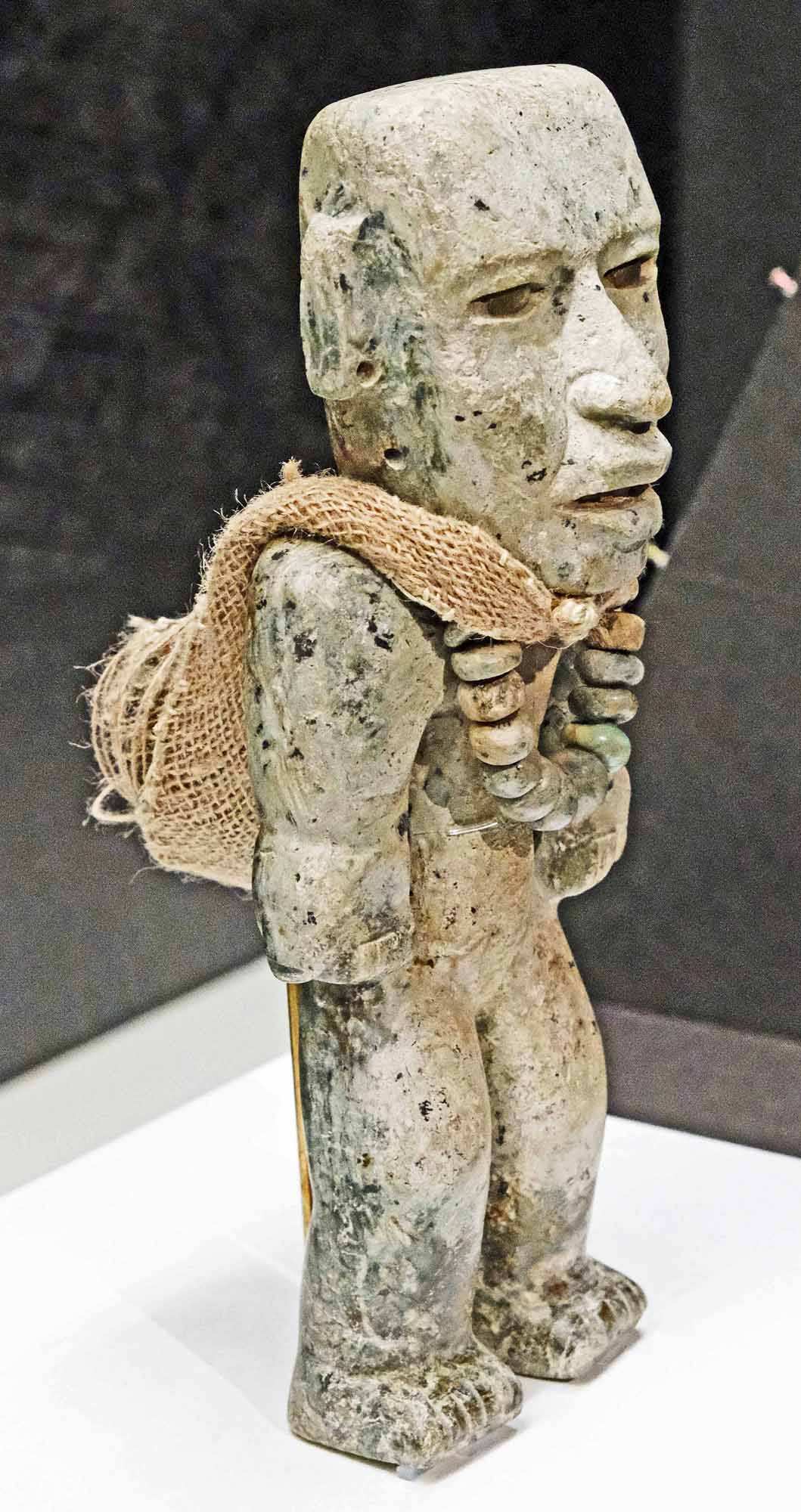
↑↑Ancient Mexico Exhibition 2023. The woman in the skirt is 53cm tall, and the man carrying the load is 36cm.
These four statues likely represent ancestors, and it is thought that the tunnel itself and the numerous offerings were dedicated to these "founders."
These are two of the hundreds of conch shells found at the deepest part of the tunnel. The man on the left is holding an atlatl. On the right is a Mayan god statue.
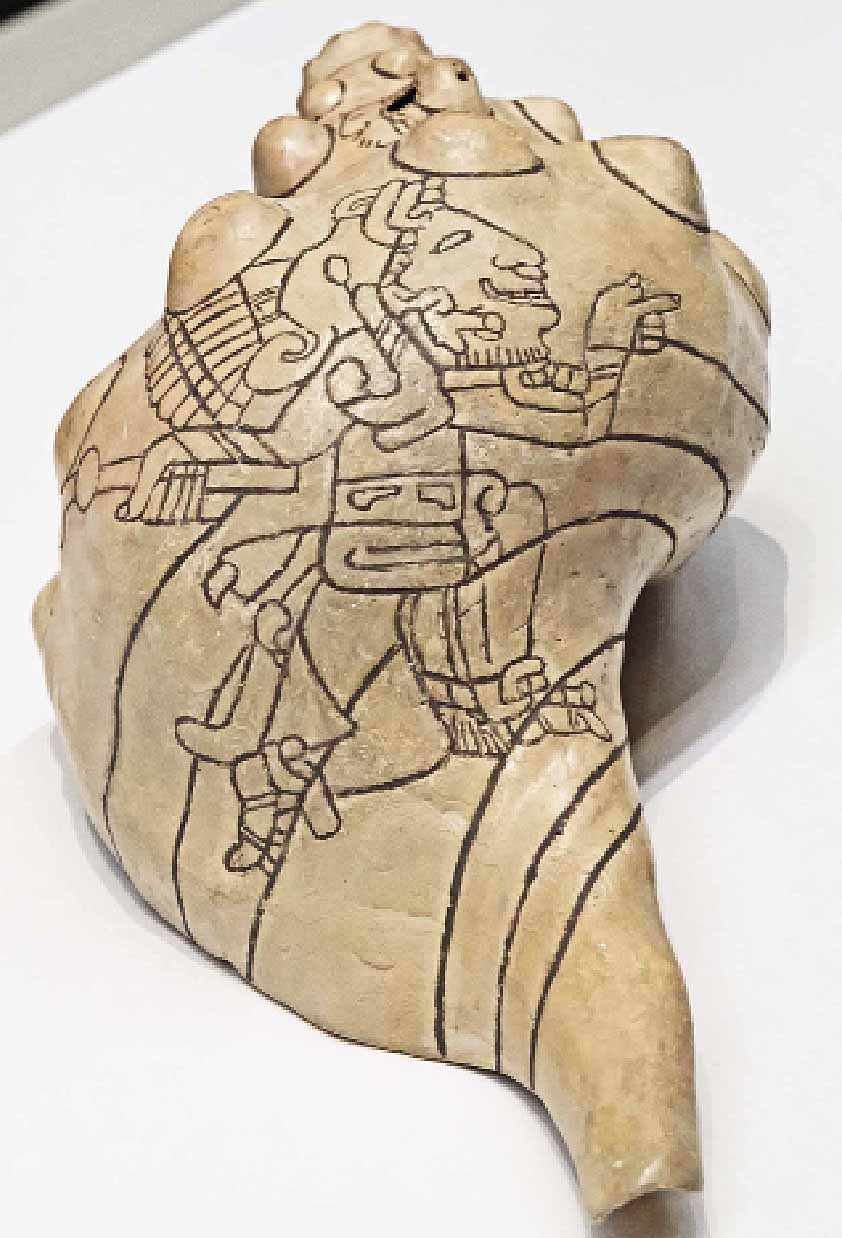
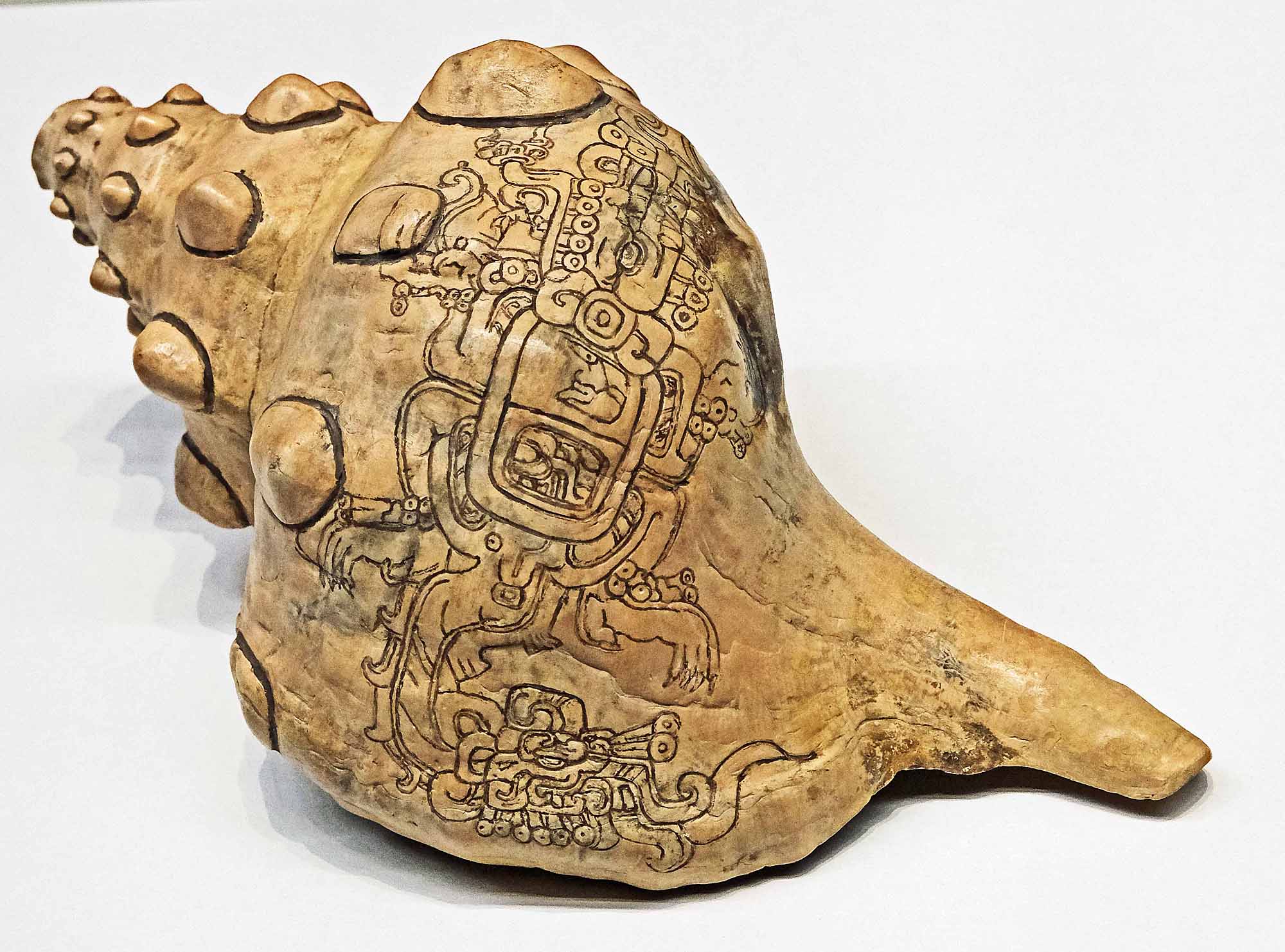
↑↑Ancient Mexico Exhibition 2023.
At the very end of the tunnel were hundreds of orangeware from southern Puebla, as well as older-style Tlaloc vases, including 25,000 intentionally broken flakes from 10 different Tlaloc vases.
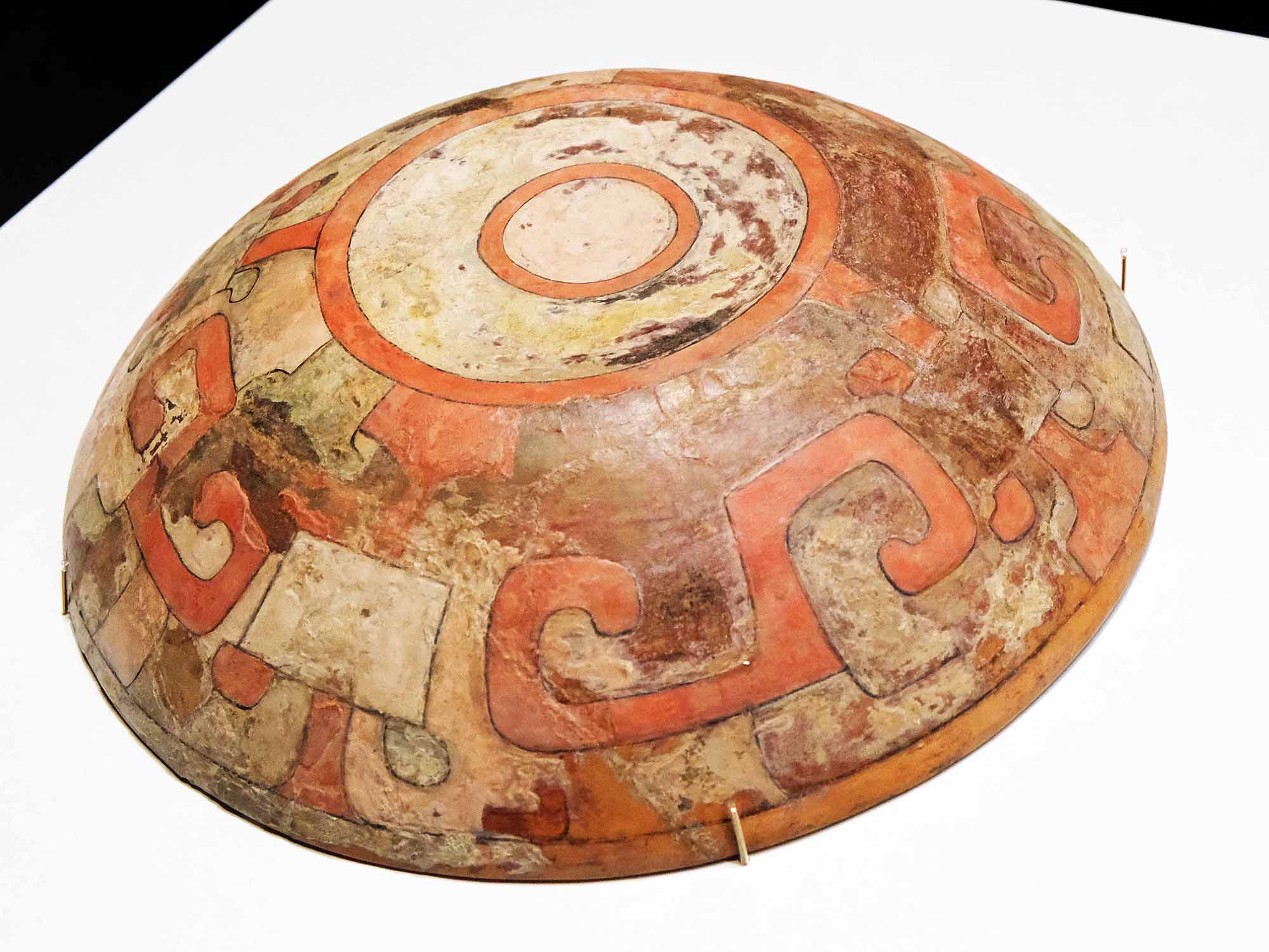
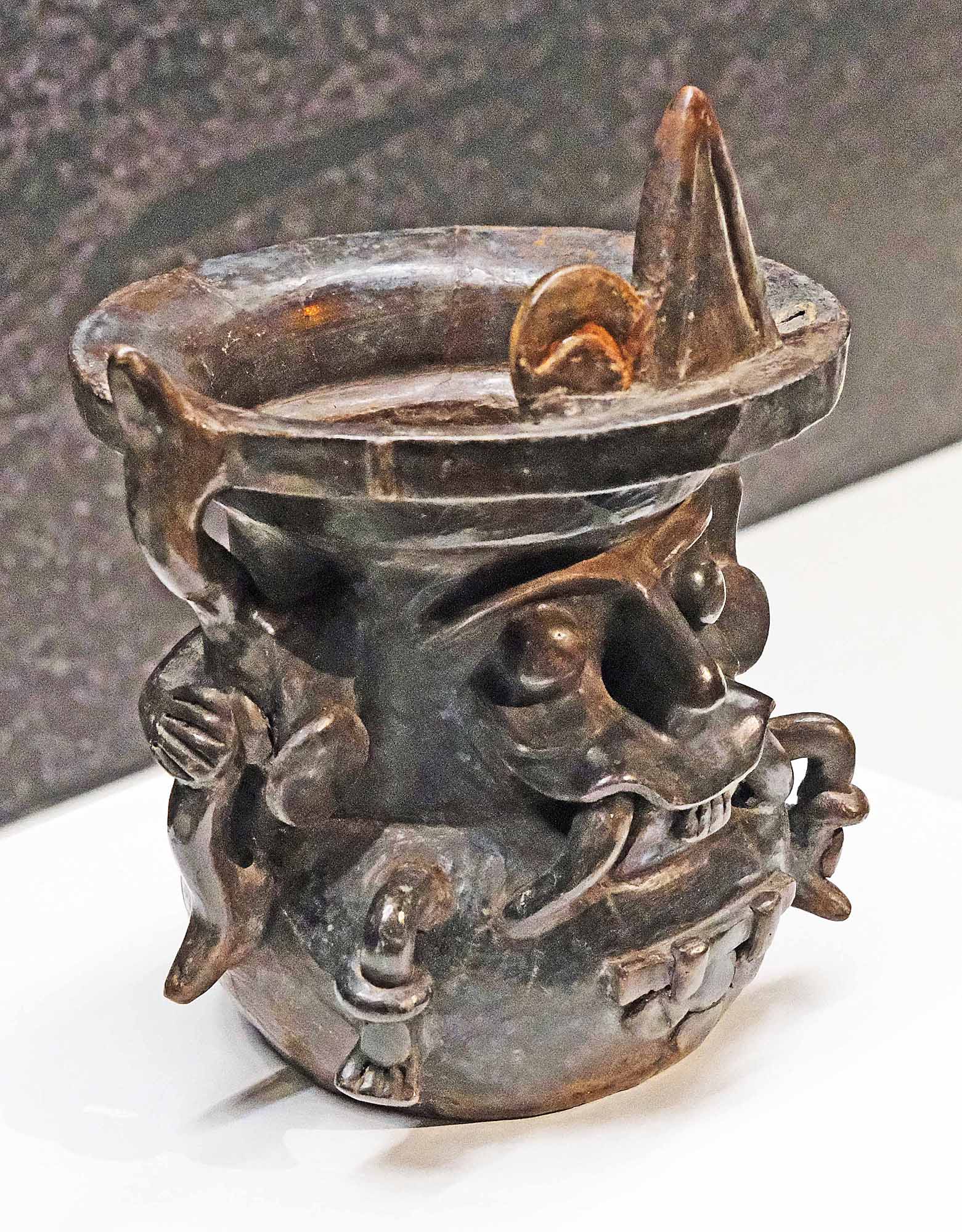
↑Ancient Mexico Exhibition 2023. Diameter 43cm. ↑Ancient Mexico Exhibition 2023. Height 29cm.
Other items reported include 12 rubber balls for the ball game, 5,000 different kinds of seeds, and boxes of rhinoceros beetle wings. The tunnel's inner walls were inlaid with countless tiny particles of pyrite, which, when lit by torches, would have given the tunnel a cosmic feel.
In 430 AD
, 180 years after it wassealed in 250 AD, someone entered through the "430 AD Entrance". It is speculated that this was an astronomical observation using a vertical tunnel. The age was determined by a bonfire lit in the tunnel at that time. Incidentally, the ground covering of the "430 AD Entrance" collapsed due to heavy rain in 2003, and an investigation began.
There were signs of grave robbery, but the robbers proceeded through the upper part of the tunnel, which had been filled by a cave-ceiling-fall, and so they apparently did not notice the tens of thousands of artifacts on the floor below.
Part 2...200 AD-378 AD
Around 200, the diversion of the San Juan River was completed, filling in the unnecessary eastern and western canals. The remains of at least 40 sacrificed bodies were found in the drainage ditch leading to Ciudadela's main plaza.
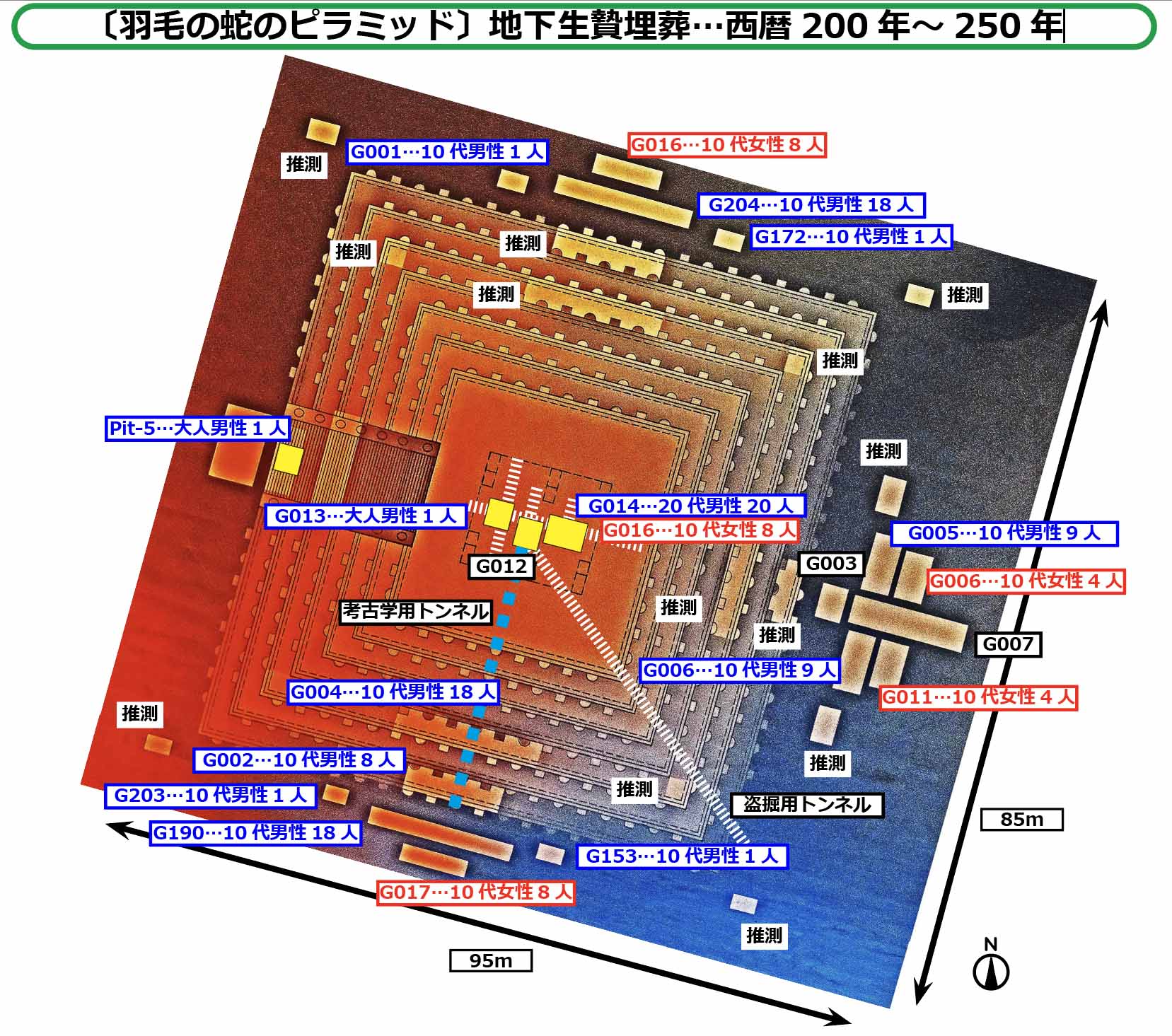
Underground Sacrificial Cemetery
Before the construction of the Temple of the Fethered Serpent, a sacrificial tomb was dug beneath it.
↑at Cultural Museum.
1. 17m deep from the main plaza. There are reportedly 21 burial chambers, but based on the north-south symmetry here, it is estimated that there are 13 more.
2. 137 bodies have been confirmed, mostly boys and girls in their teens. Taking into account the unexcavated remains, the number is thought to be around 260 people. The number 260 corresponds to the 260 days of the religious calendar.
3. All of the bodies had their arms tied behind their backs, and their ankles were bound. There was no external trauma to the bones.
4. The 137 bodies were with their heads or backs facing the center of the pyramid.
5. They were all in good health and wore same clothing.
6. The numbers 8, 9, 18, and 20 correspond to milestones in the religious calendar.
Let's take a look at some of the individual burial chambers.
G-13...A wooden carving said to be a military baton was buried with the deceased.
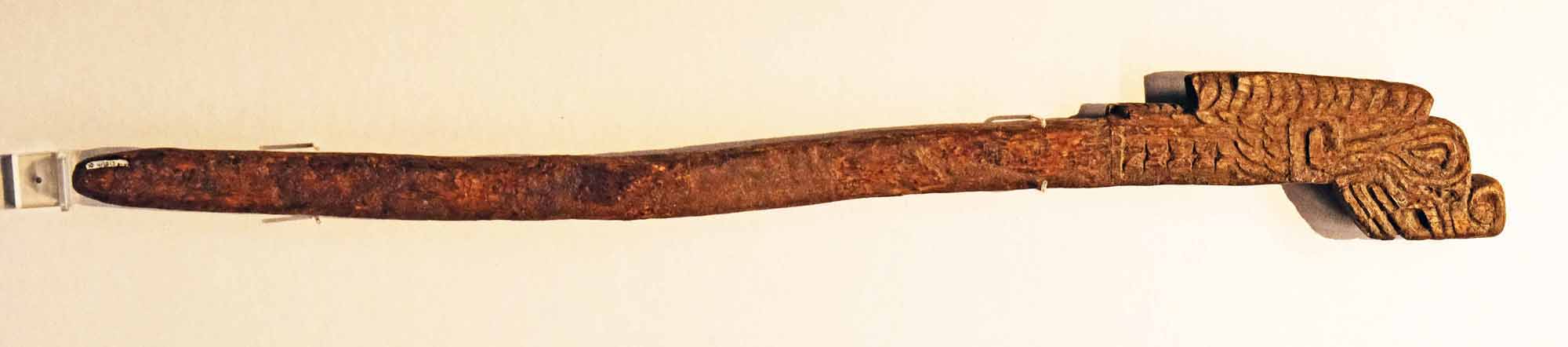
↑At the Ancient Mexico exhibition in Tokyo. 56cm.
G-14...Greenstone nose ornament. Said to be a rattlesnake's tail.
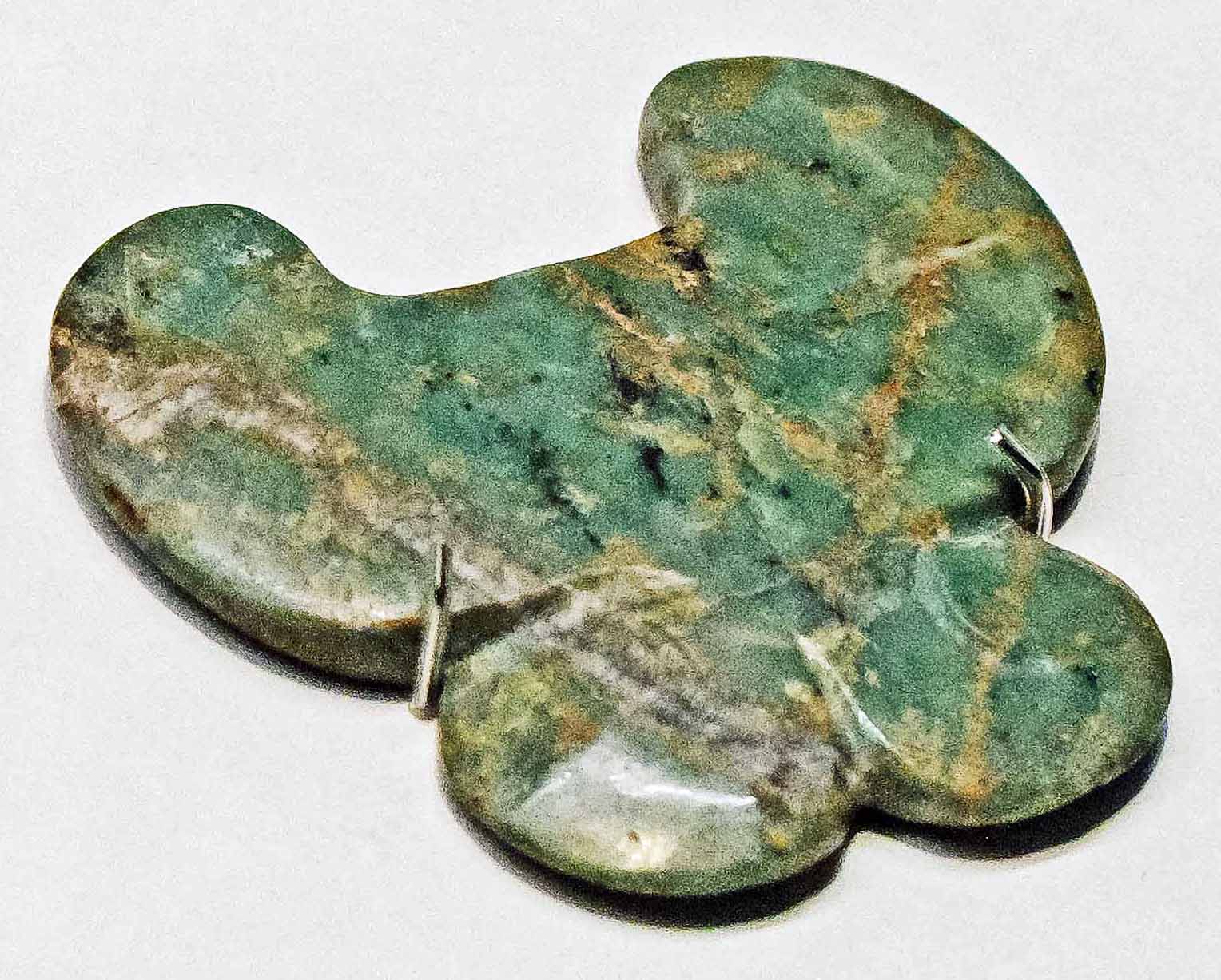
↑At the Ancient Mexico exhibition in Tokyo. 6cm.
G-005
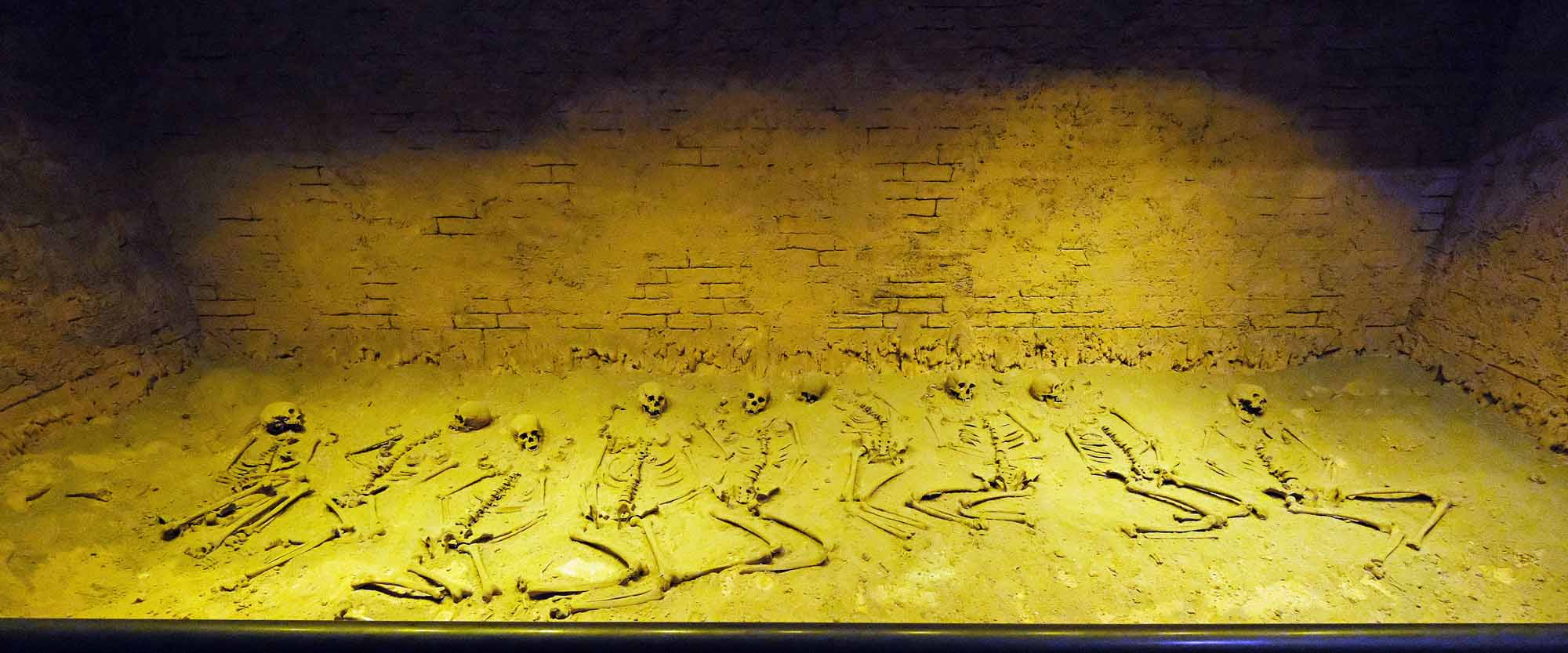
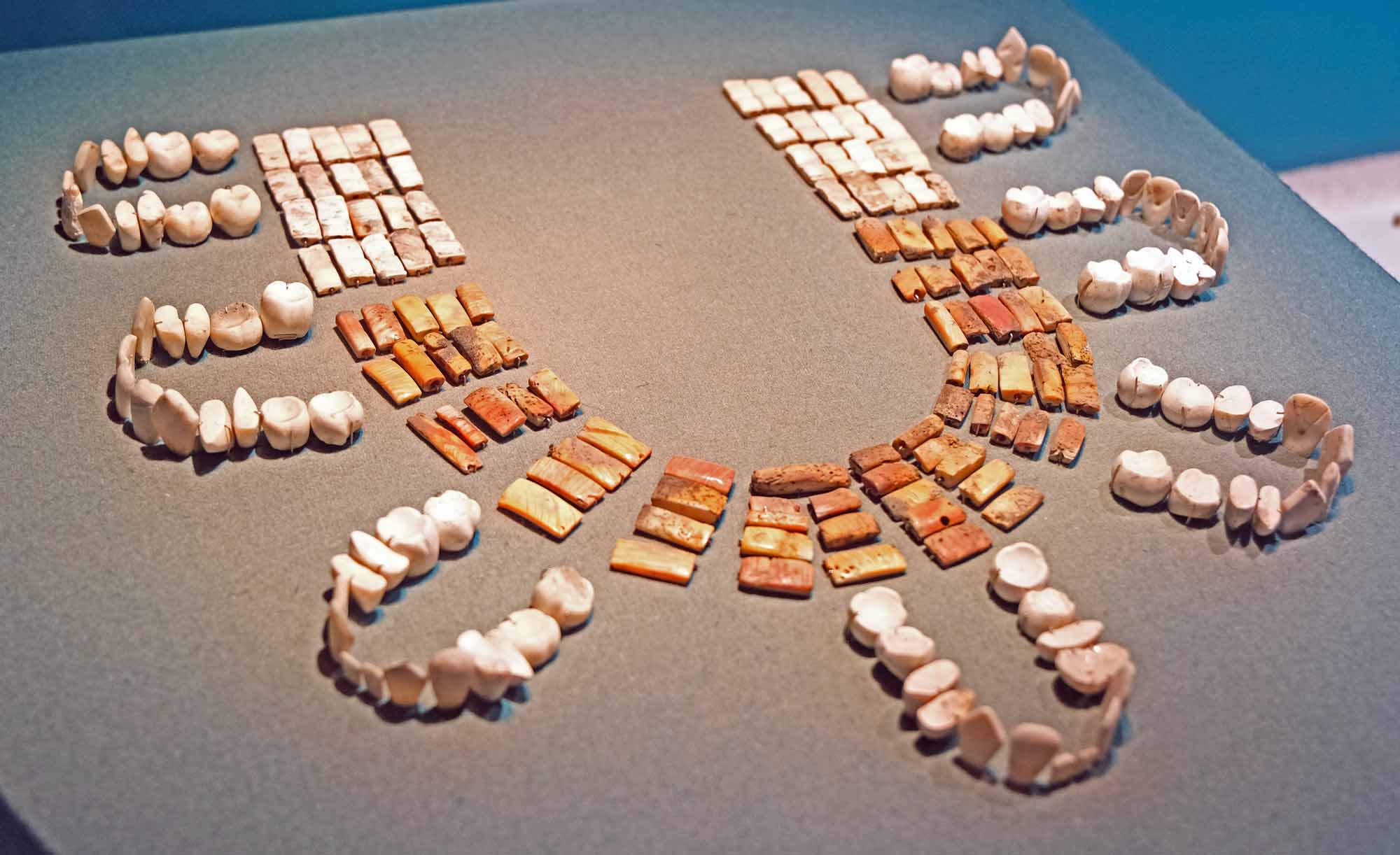
↑At the Museum of Anthropology. Replica. ↑At the Museum of Culture. Original
The second person from the right is G-005-H, and you can see the necklace. The original is shown in the photo on the right. It is made of red scallops and white conch shells. The curved part that looks like a human jaw is also made of seashells.
G-010 or G-011...four girls aged 10 to 15 were buried there.
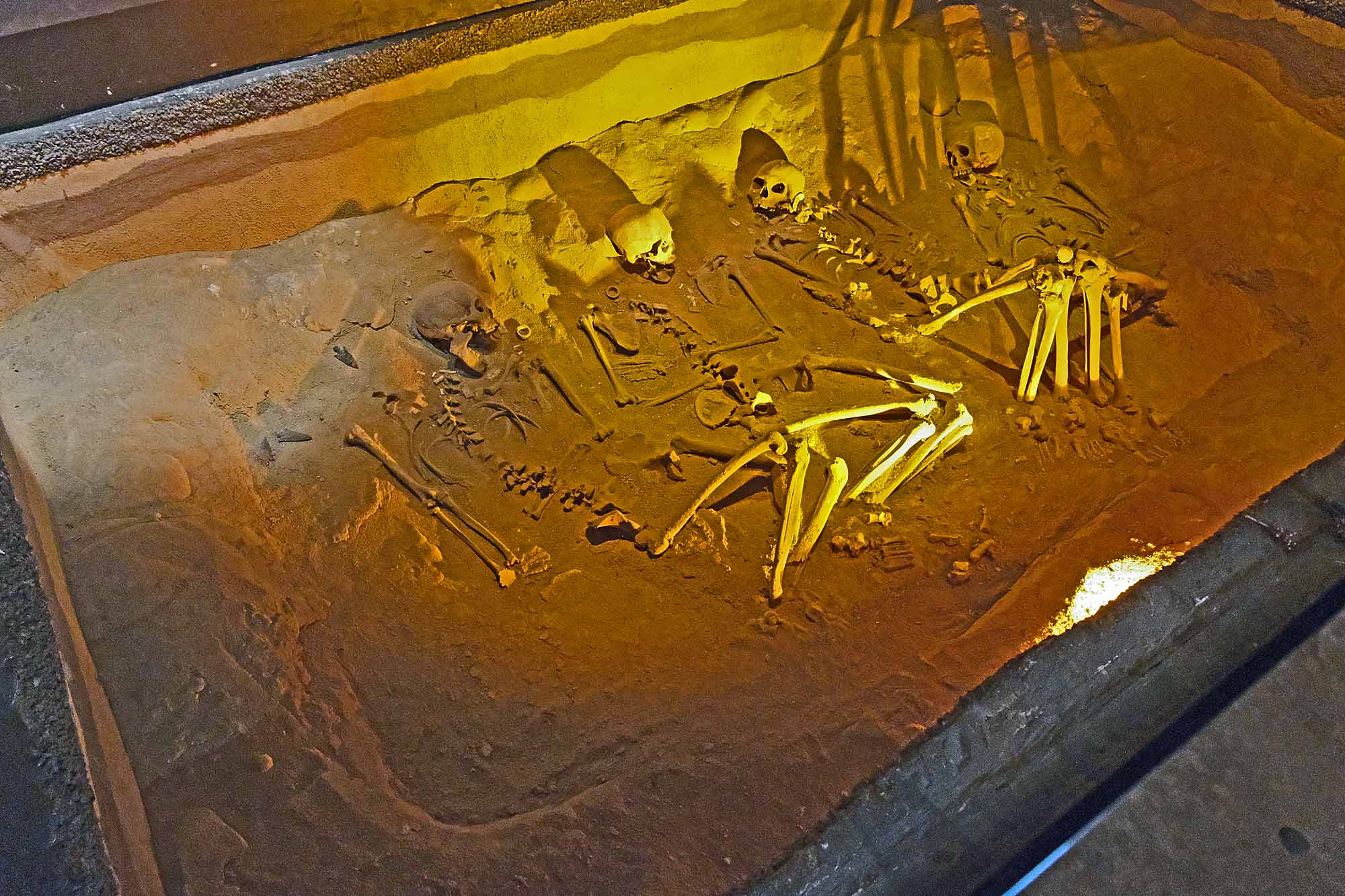
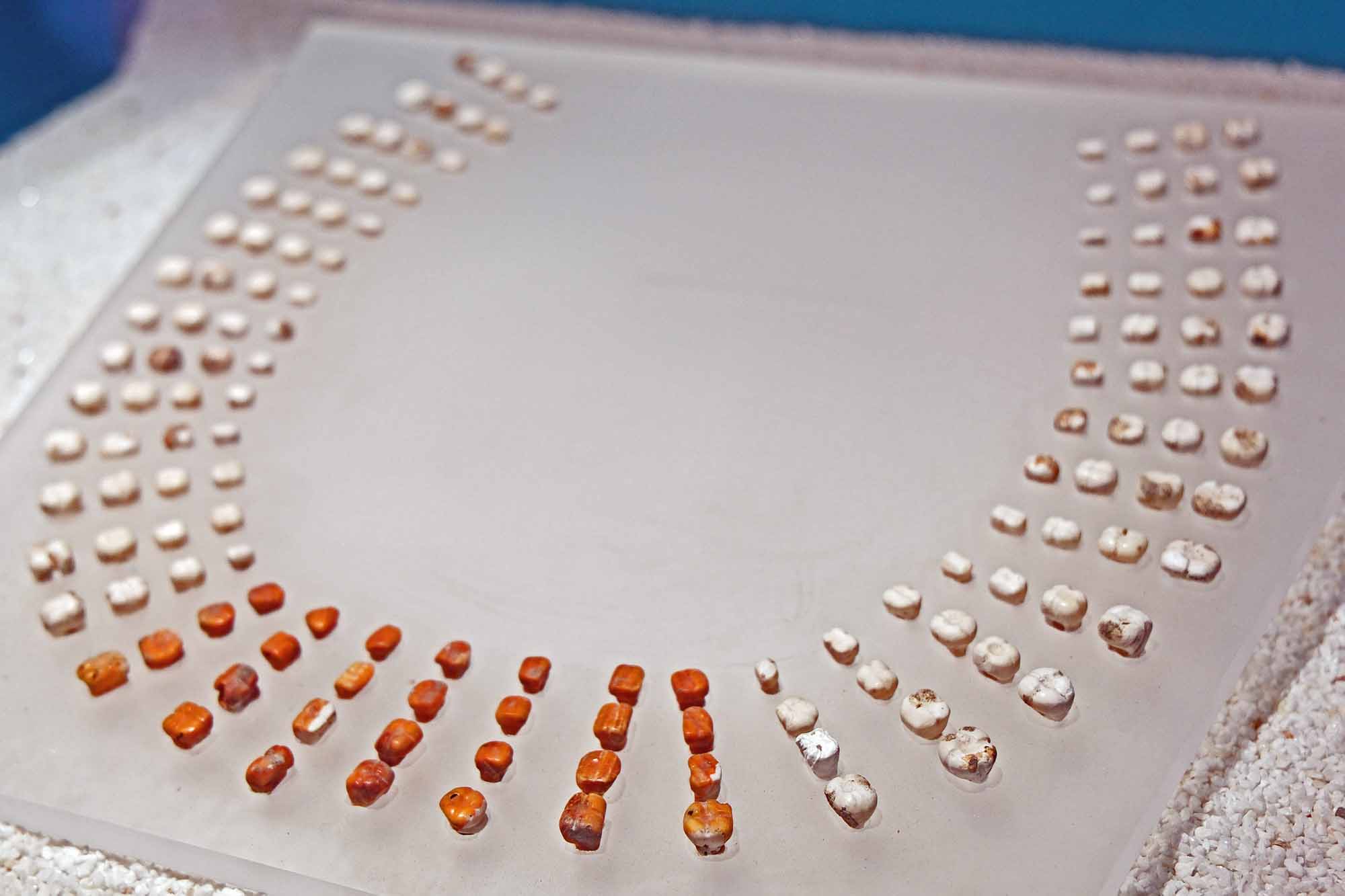
↑At the Cultural Museum. Replica. ↑At the Cultural Museum. Original.
Also found in the grave were shell earrings, an obsidian point and a slate disk.
By the way, what kind of person was sacrificed?
1. No pottery found. No burial chambers have been found in the cemeteries of Teotihuacan families that do not contain pottery. Therefore, the remains are unrelated to the family or life in this area.
2. Most of the victims were boys and girls in their teens. If they were foreign prisoners captured in war, the majority would be older men. This leads us to speculate that they were residents of distant villages under Teotihuacan's control who were taken and sacrificed without fighting.
3. Assuming that the above 2 is true, even though the Teotihuacan government had the authority and power to carry it out, there must have been some reason why sacrifices of the same scale were made at the Pyramid of the Moon and the Pyramid of the Sun, which were built at the same time.
Who was robbing the underground sacrificial cemetery?
The diagram above shows the looting tunnel, indicated by the white wavy line. It is said to date back to 350 AD-500 AD. However, by that time, the Ciudadela had become a large theater-style incense burner workshop, and Complexes 1E and 1D would have been home to the Ciudadela's elite and workshop managers. Given that situation, it is questionable whether it would have been possible to secretly excavate a looting tunnel from the southeast corner of the Pyramid of the Feathered Serpent.
It is my guess that the stories of numerous burials beneath the pyramid have been passed down, and that the truth is that after the sacredness of the pyramid was destroyed and it lost its original meaning, that is, after 378 AD, the residents who lived and worked in Ciudadela wanted to earn extra income.
Incidentally, since the burial chamber was dug to a depth of 17 meters, did it not interfere with the Cuidadela tunnel, which is 16 meters underground in the center of the pyramid? The 1 meter difference in depth measurement could be an error. Even if the floor of the burial chamber and the ceiling of the Cuidadela tunnel were touching, the tunnel was filled with earth and sand and collapsed, so the "grave robbers" above would not have noticed. On the other hand, those who were able to enter the tunnel in 430 AD probably had a legend that it would not be allowed to leave the tunnel.
Now that the "New Pyramid Building Foundation" is complete, let's begin work on the Pyramid of the Feathered Serpent. First, let's examine the two statues.
Feathered Serpent
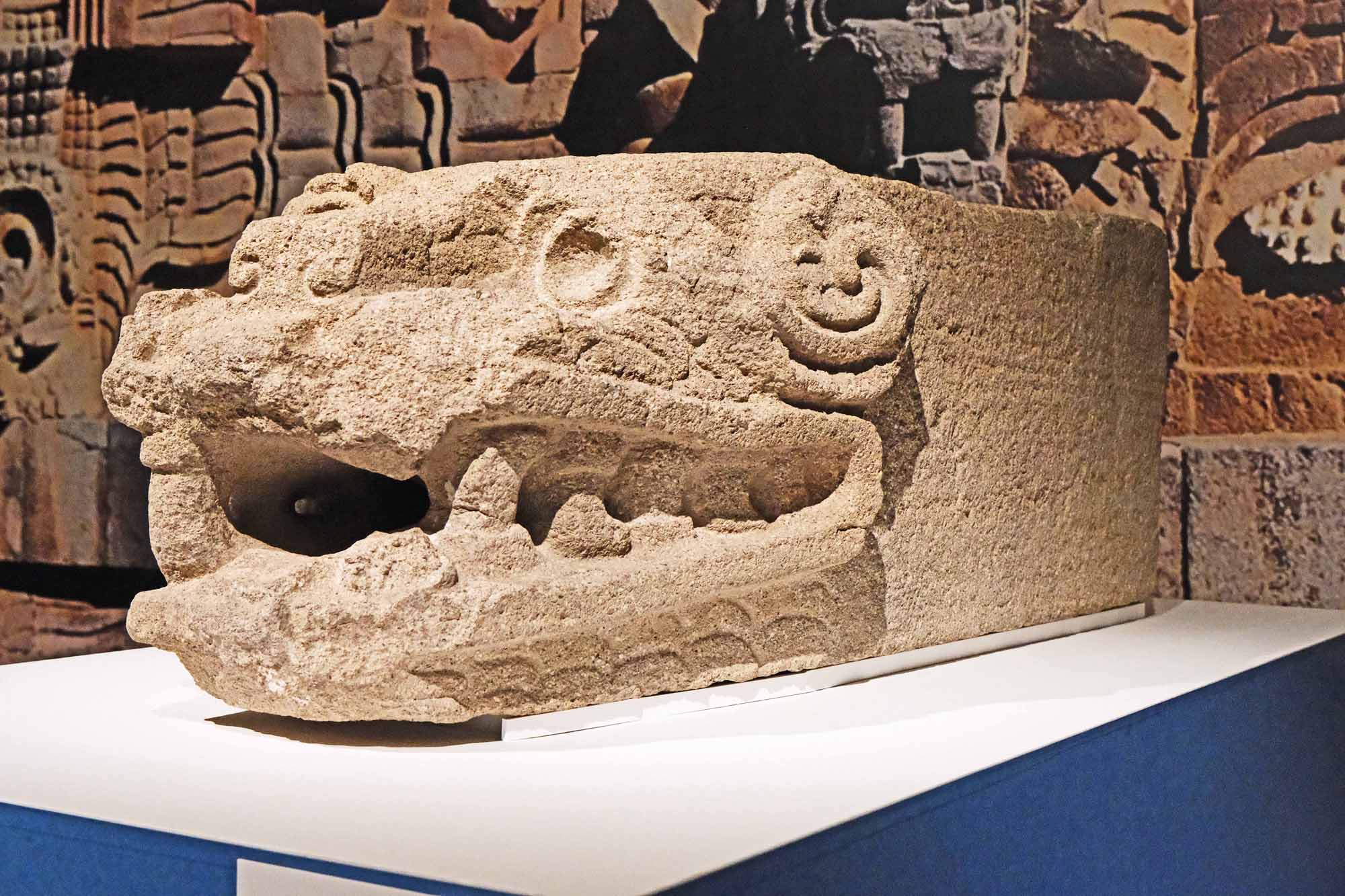
↑at Ancient Mexico Exhibition 2023.
Thick fangs grow from its large jaws. Its nose resembles a forked tongue. Feathers are slightly visible between its eyes and upper jaw. The "feathered serpent" has been seen in various places in Teotihuacan.
This image has existed throughout Mesoamerica since ancient times. For example, Monument 5, which is believed to have been made between 800 BC and 500 BC, is located 150 km south of Teotihuacan. It is located at the Chalcatzingo ruins.
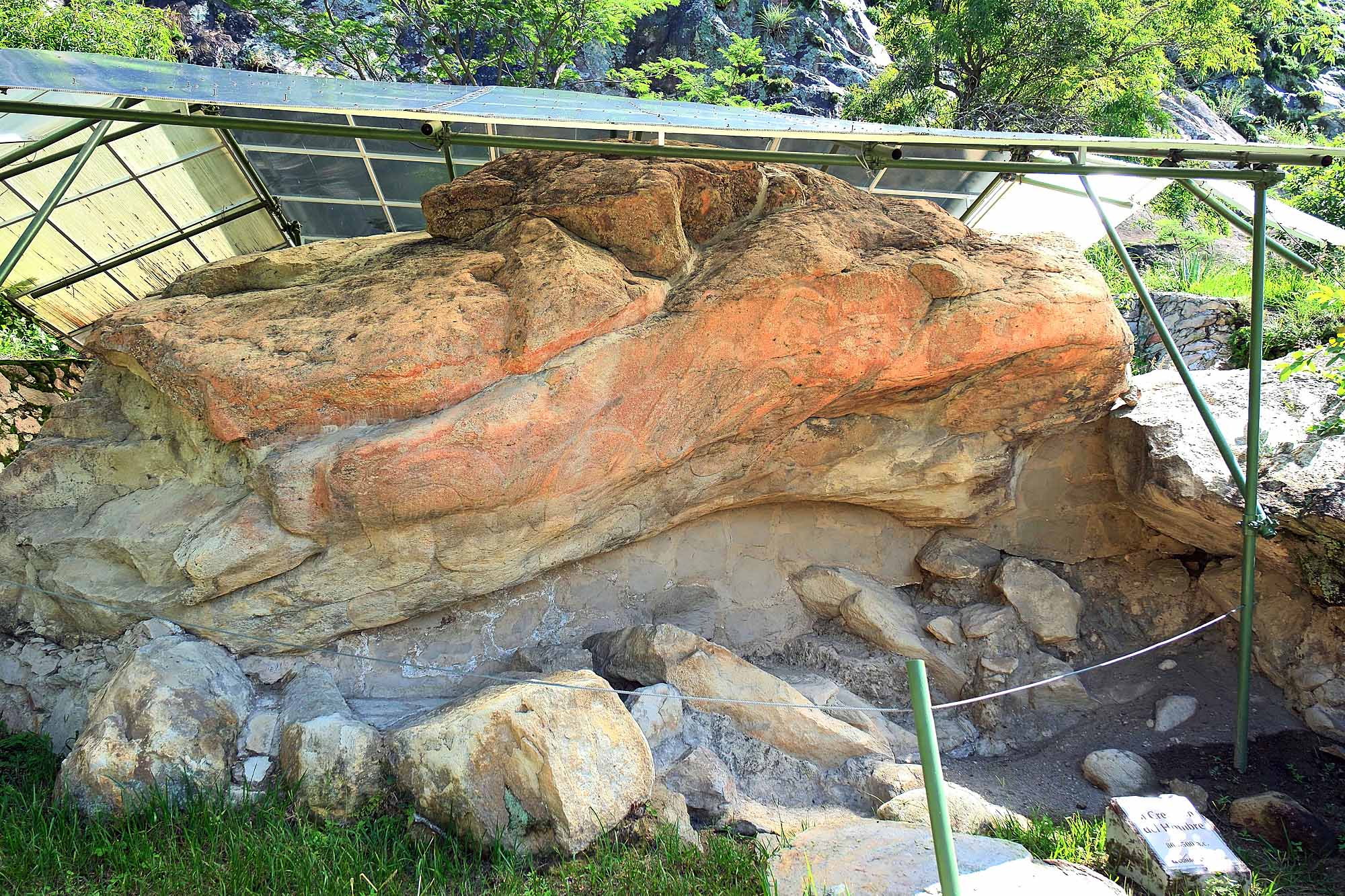
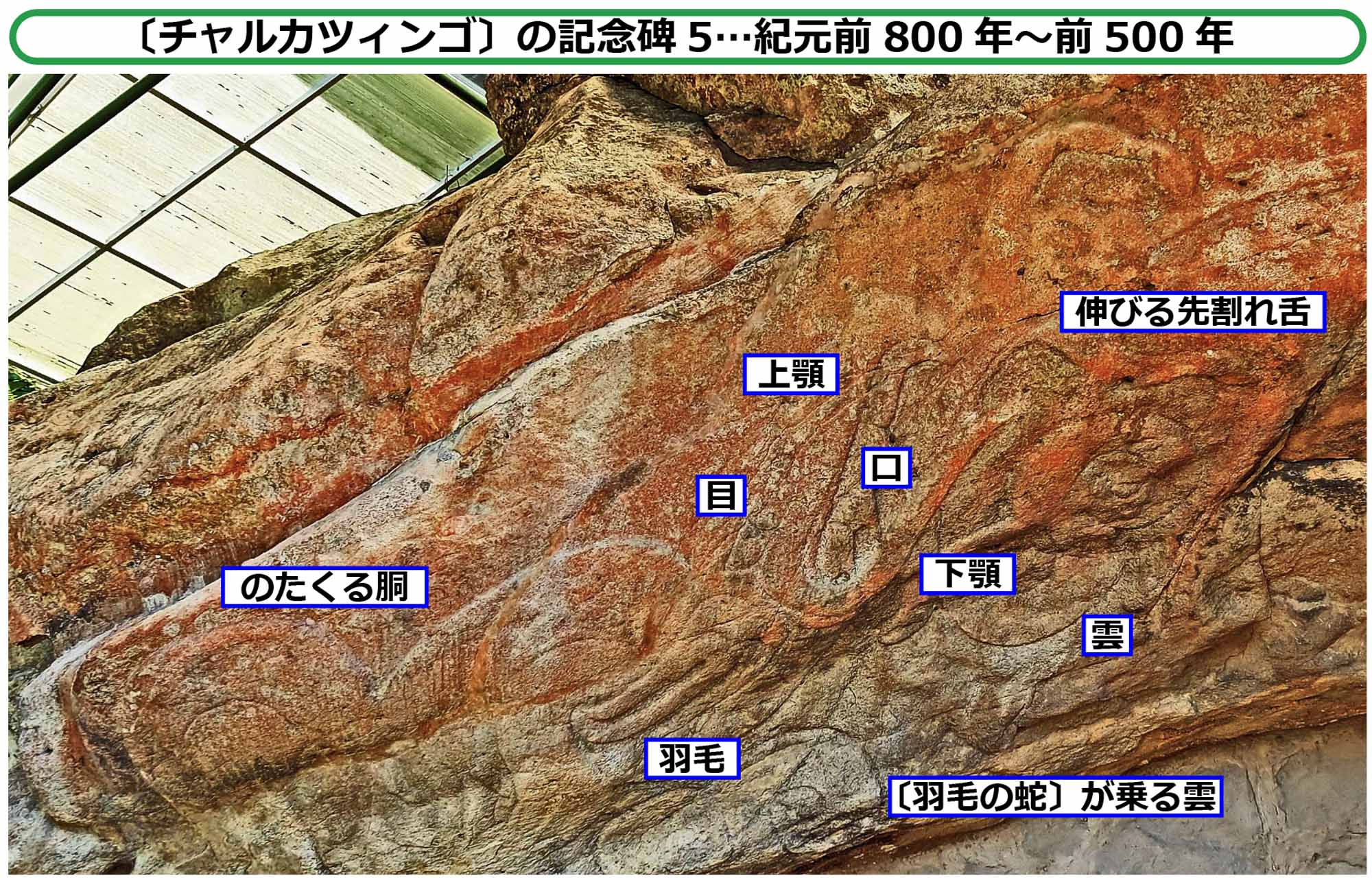
↑↑Full view and enlarged image of Monument 5. Chalcatingo ruins.
Cipactli
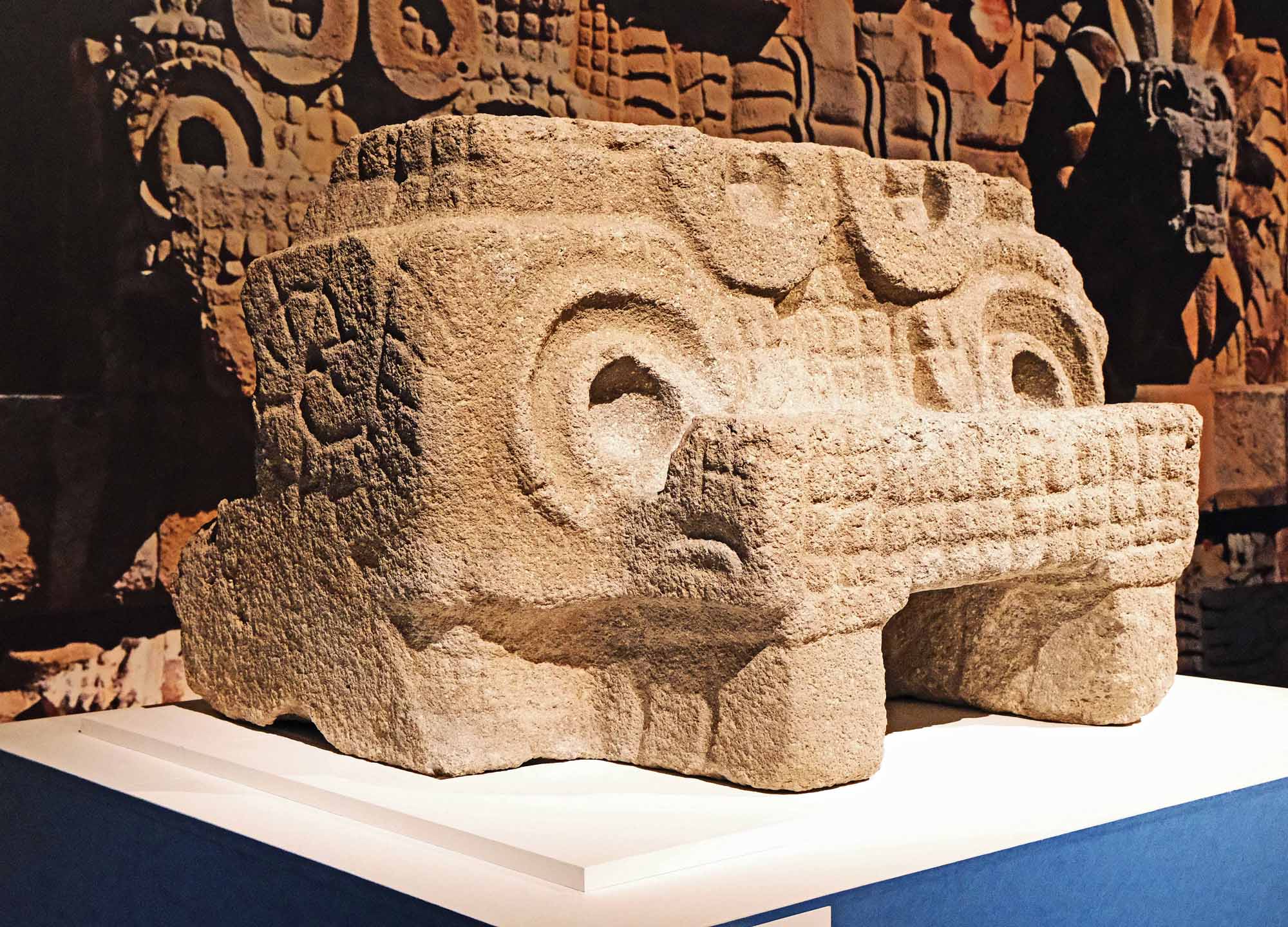
↑at Ancient Mexico Exhibition 2023.
Representations of a primitive crocodile are often seen. The square upper lip/nose above the tusks sometimes looks like scales. Behind them are eyes, and above them are the representations of a Tlaloc. The ears are perhaps representations of snail shells.
This statue does not have a commonly accepted name that is used by many archaeologists. A similar image was found in a Mexica pictorial document from 1,100 years later, and the statue was called "Cipactli." Therefore, it is called "Cipactli of the Mexica culture." In the Mexica culture, it means "the first day of the primitive age."
With this in mind, let's look at the west face of the Pyramid of the Feathered Serpent.
Feathered Serpent Temple
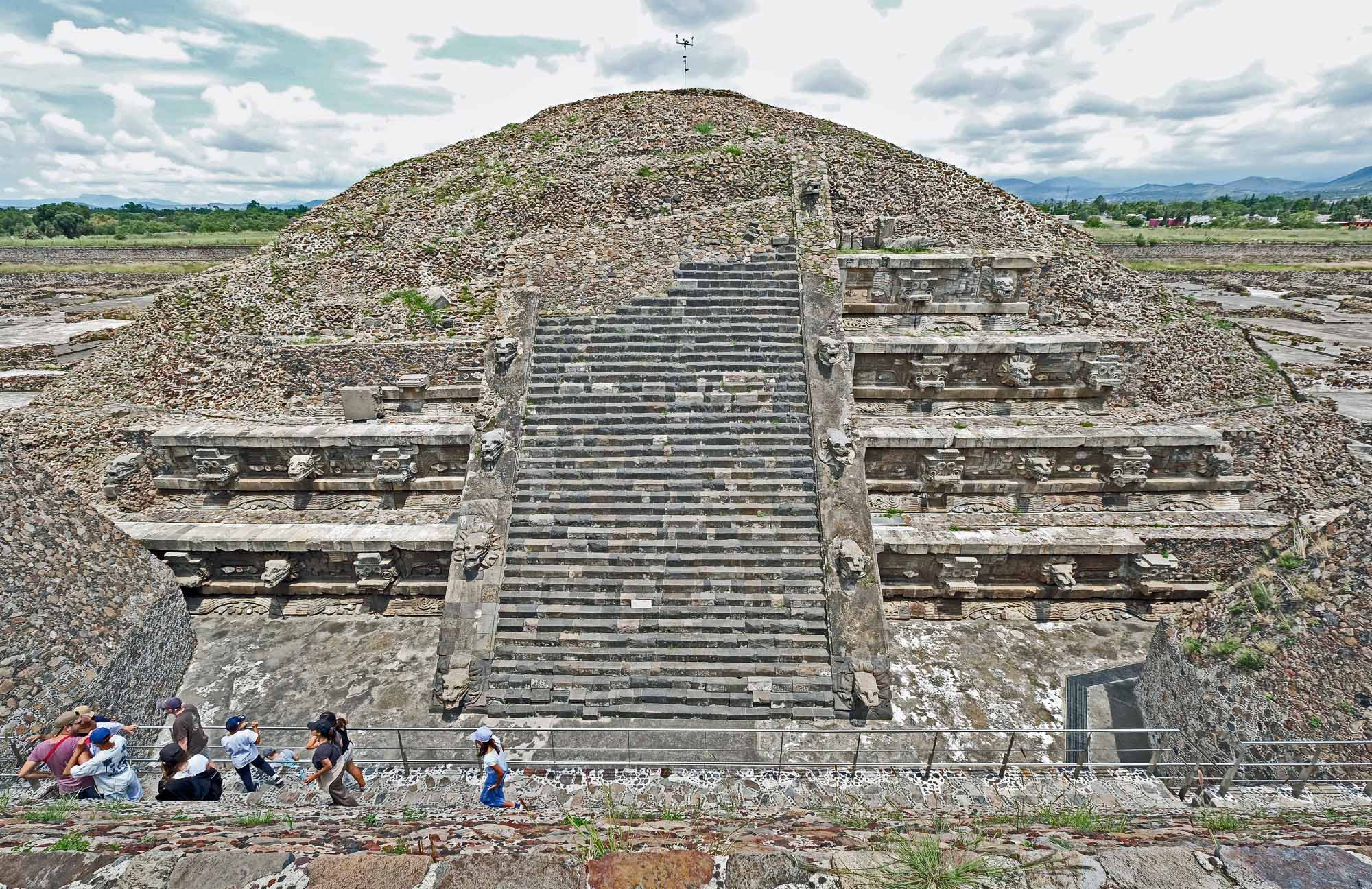
。I could post a detailed photo, but the giant replica at the Museum of Anthropology shows it better.
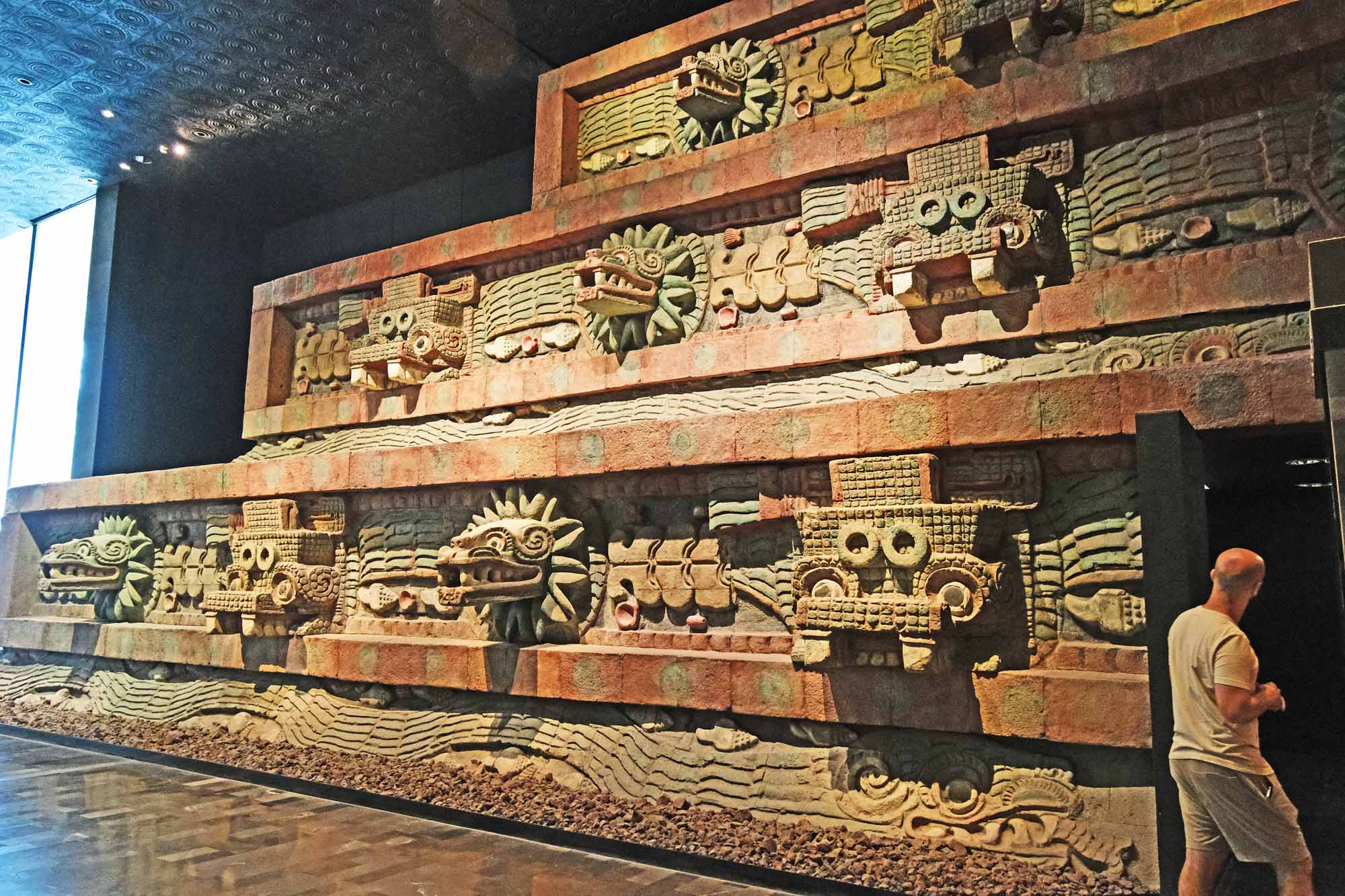
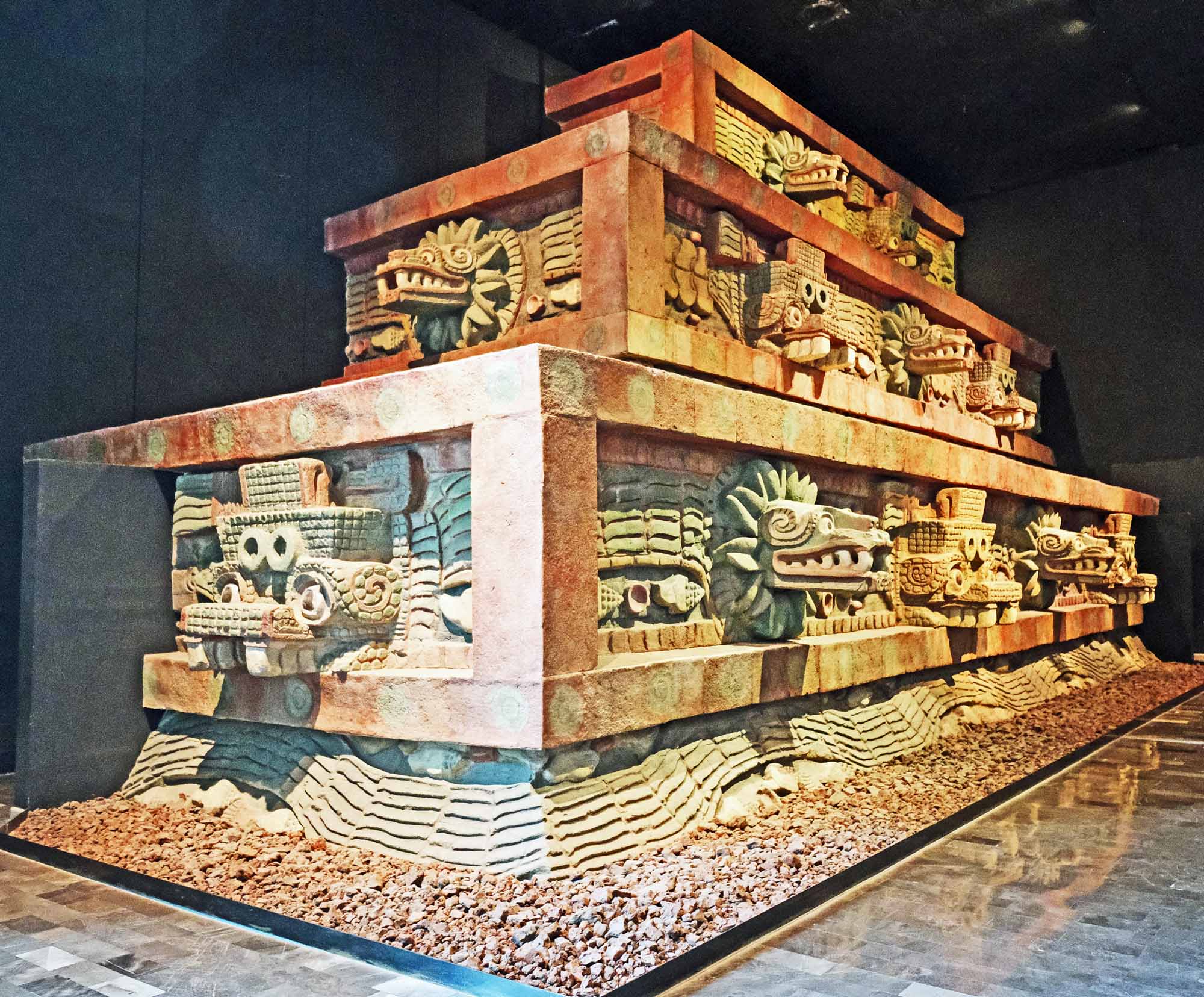
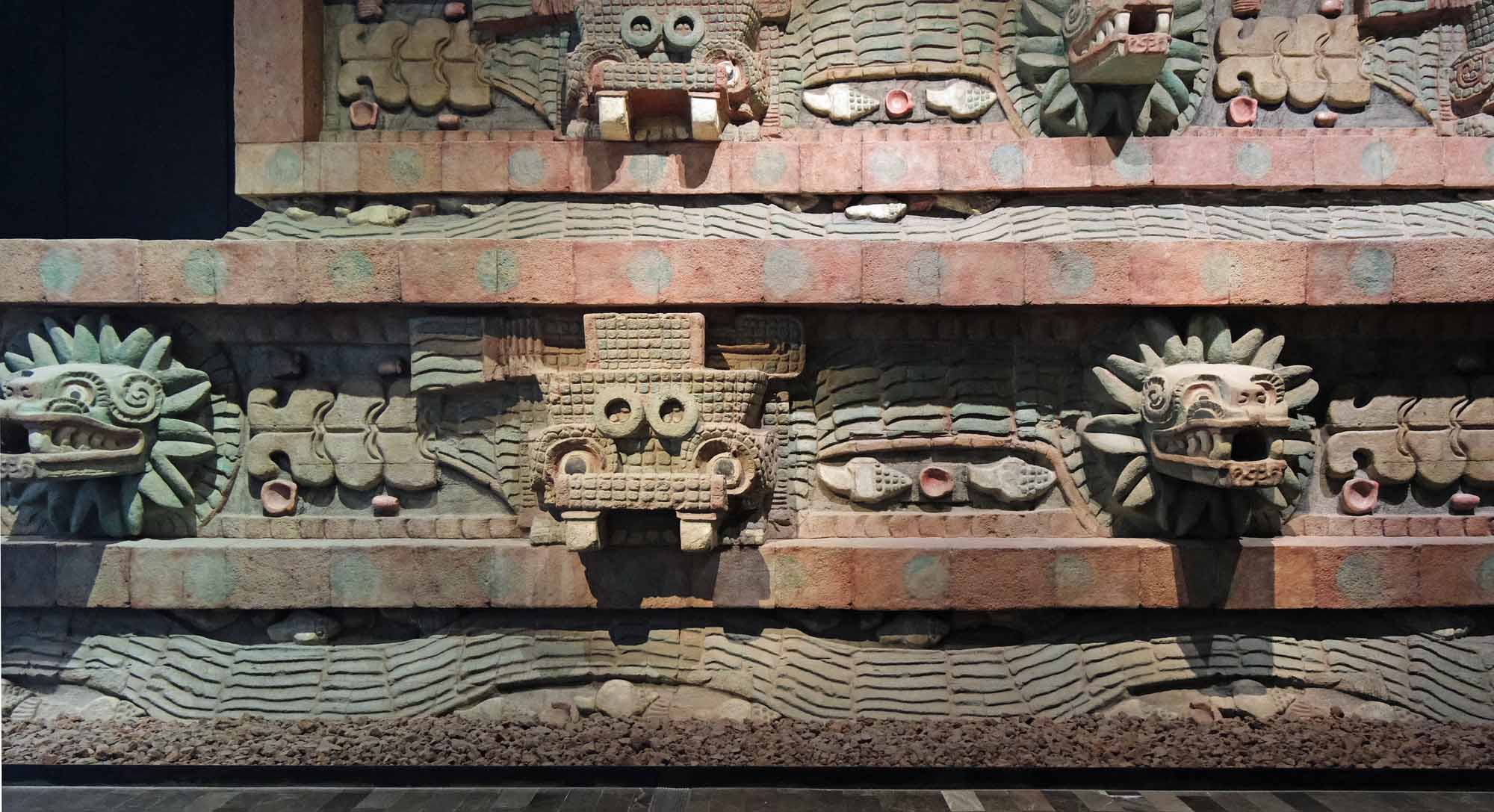
↑↑↑at the Museum of Anthropology. Reconstruction. On its back, reconstruction of sacrificial chamber G-005.
It appears that red, green, and yellow were used. Based on the typical talud-tablero architectural style, the talud part has a waterway painted on it, and the frame of the tablero has a series of thick circular symbols of Tlaloc.
The third tablero consists of, from left to right, a feathered snake, a rattlesnake's tail, a short snake-feathered body, a cipactli, a feathered snake's body and a conch shell, a feathered snake, and a rattlesnake's body.
It looks as though Cipactli is riding on the body of the Feathered Serpent, and there is no Cipactli on the handrail of the central staircase. Therefore, it is thought that the main deity was the Feathered Serpent.
The Feathered Serpent is a snake that crawls on the ground, dives into caves that lead underground, and flies into the sky with its wings. It encompasses the underground, the ground, and the sky. Also included is the Tlaloc, which depicts fish and shellfish in water, and the Cipactli, which means "the beginning of the world" as interpreted during the Mexica period.
These designs are found on the entire surface of the pyramid, which is basically a square pyramid. The squares relate to the four directions. Underneath the pyramid are more than 200 sacrifices, which are meant to nourish the sun, which will rise again. In other words, this building is a powerful piece of architecture that embodies almost all of the cosmological concepts that have been passed down in Mesoamerica since ancient times.
Its dimensions are 62 m square, and the remaining height is 20 m. It is small compared to the other two giant pyramids, but considering the amount of stone carving that was required, it is said that the amount of labor required to build it was roughly the same.
There are theories that the platform had seven or six steps. It is also rumored that there may have been a wooden temple on the top. Similar stones carvings would have been on all four sides of the pyramid, and it is said that there was a high possibility that the total number of "feathered serpents" and "Cipactli" was 360 or 365.
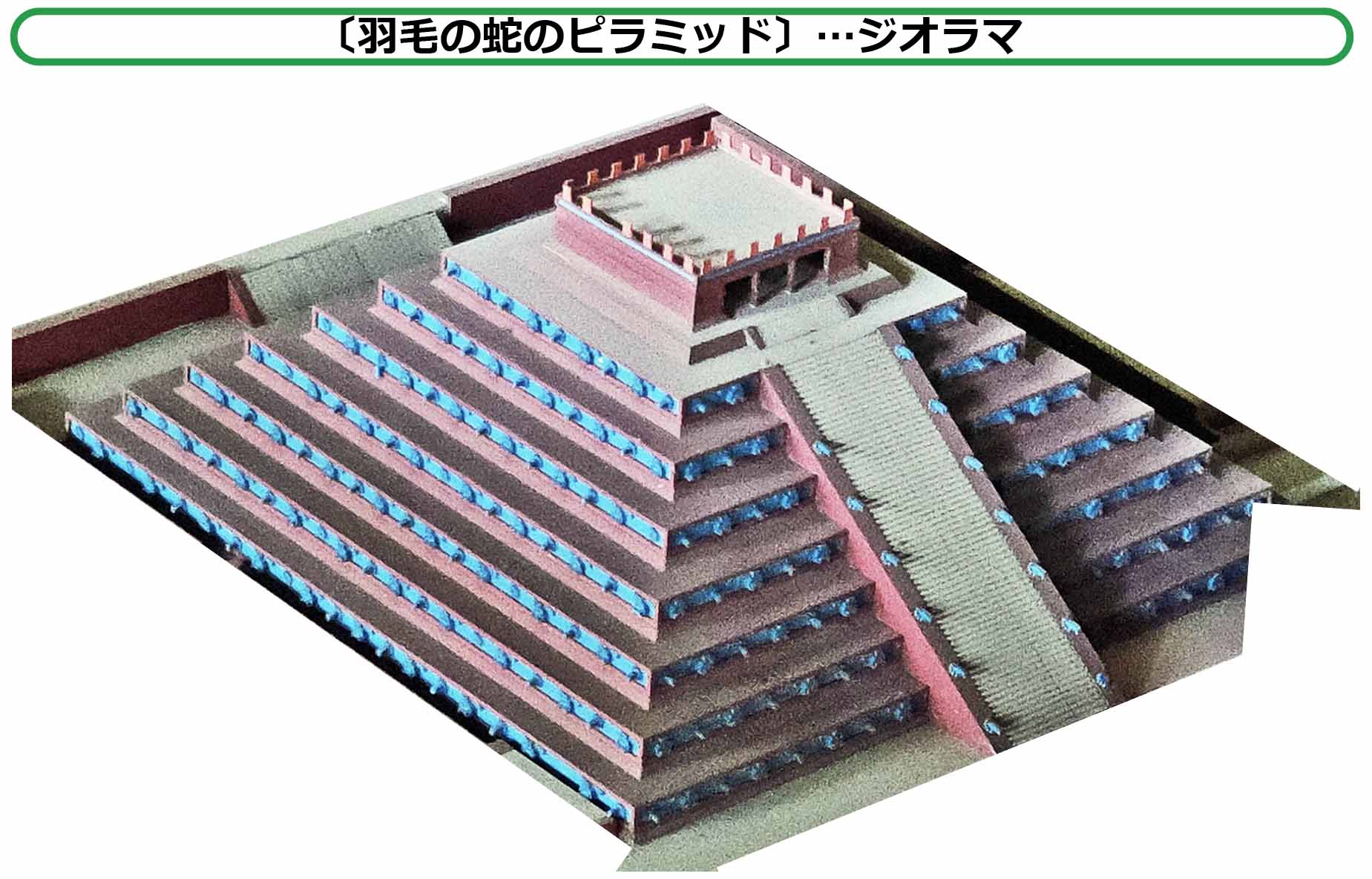
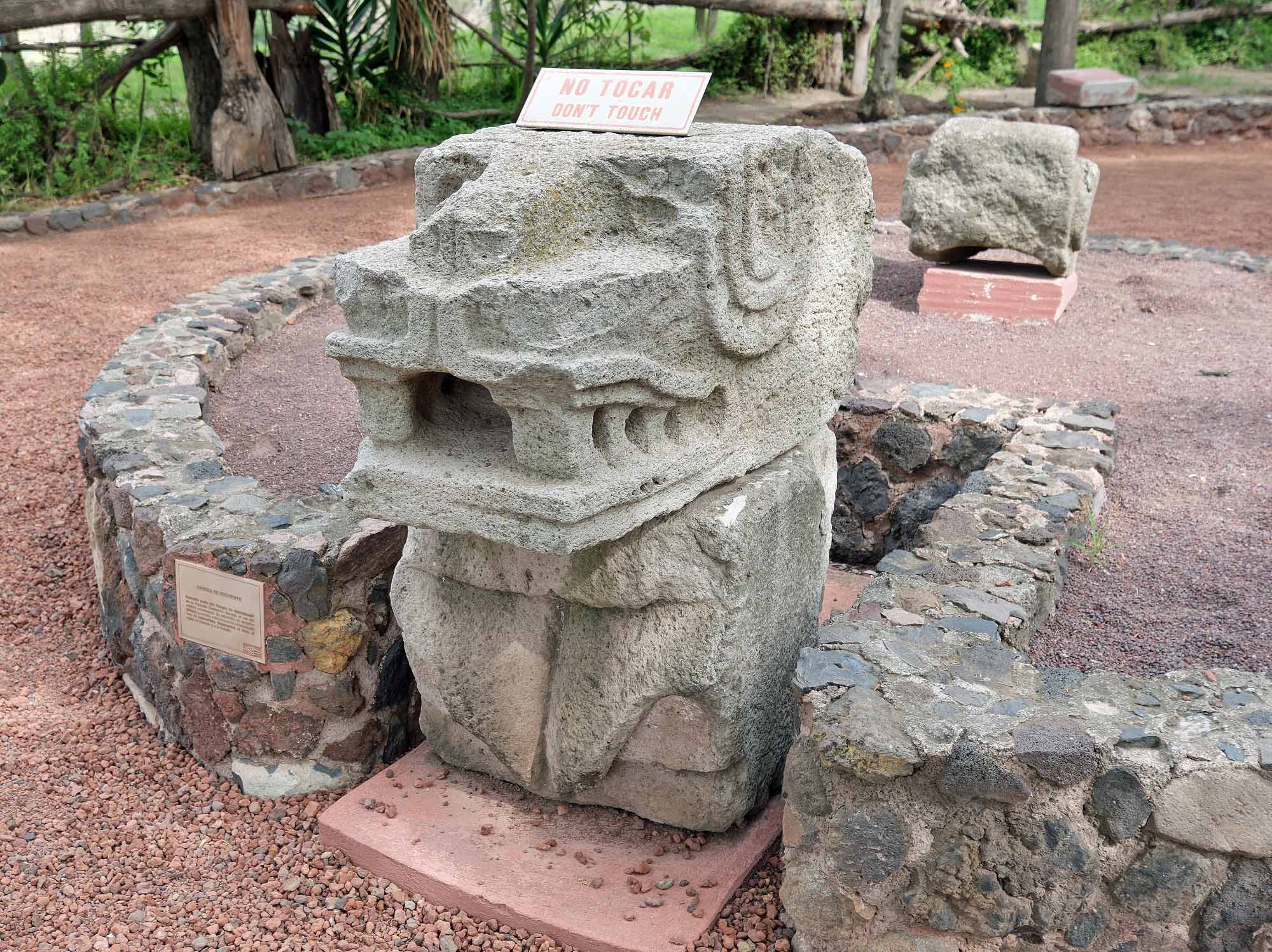
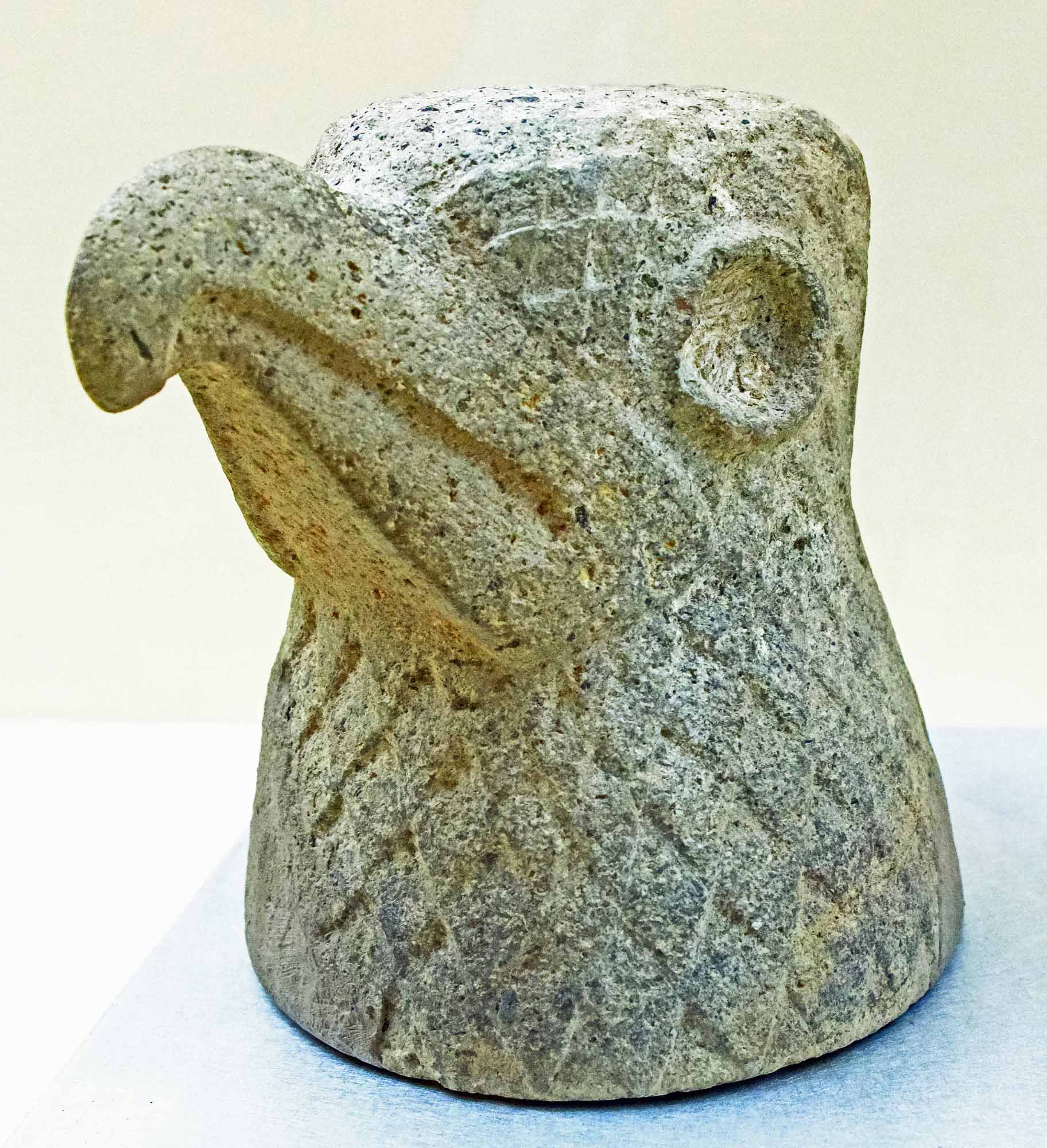
↑↑↑at the Cultural Museum. The two below are stone carvings that are said to have been part of the "Pyramid of the Feathered Serpent." I wonder if they were installed like this. The one on the right was apparently excavated on the north side.
The statue below was located in the northeast corner of the Pyramid of the Feathered Serpent. The flat head has been described as a precursor to Xipe Totec, the flayed god of the Mexica period.
The one on the right is probably Almena. The triangle represents a ray of light, the trapezoid perhaps a tablero, and the circle represents Tlaloc. The idea of Almena in the hypothetical top-tier temple in the diorama above may have come from this artifact.
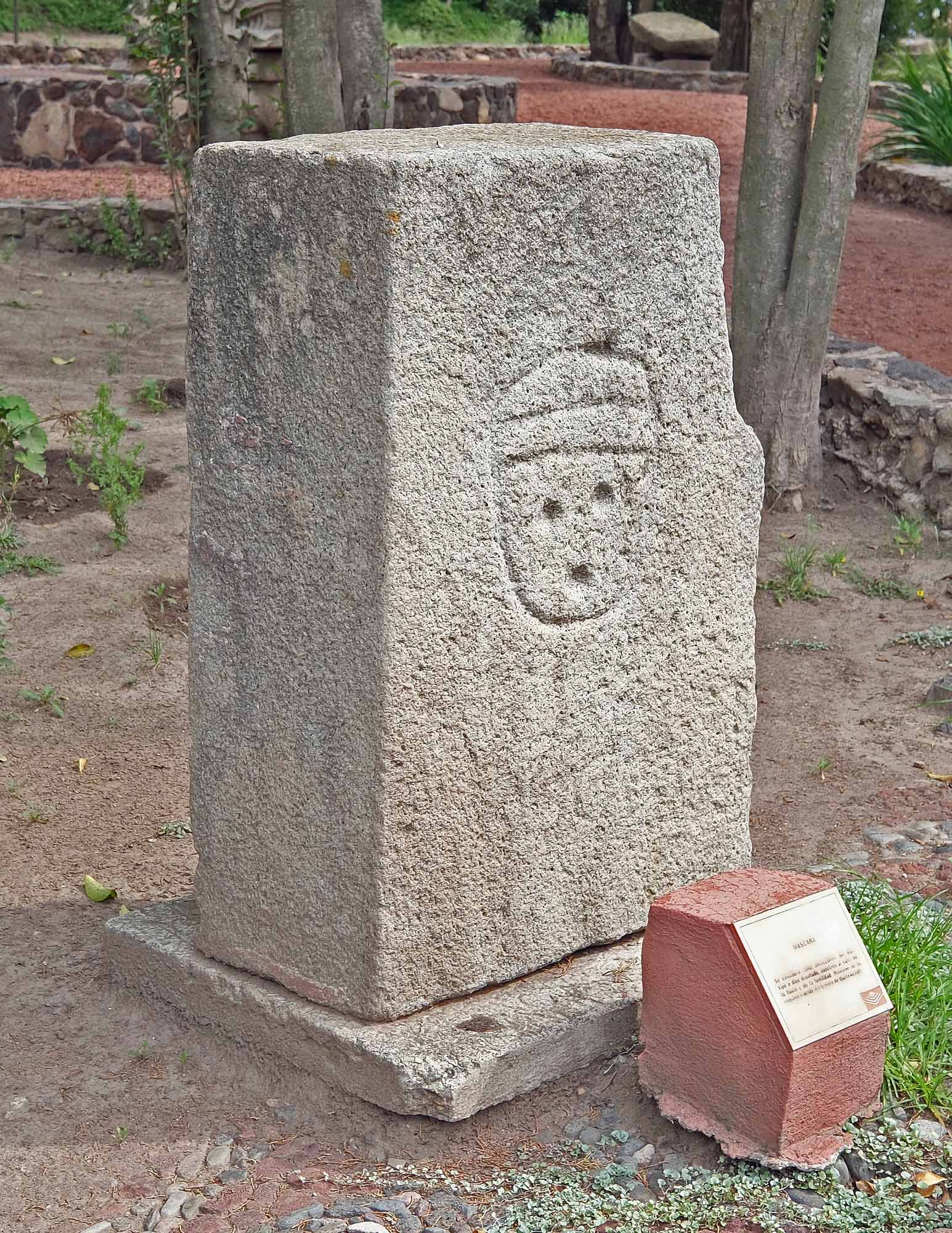
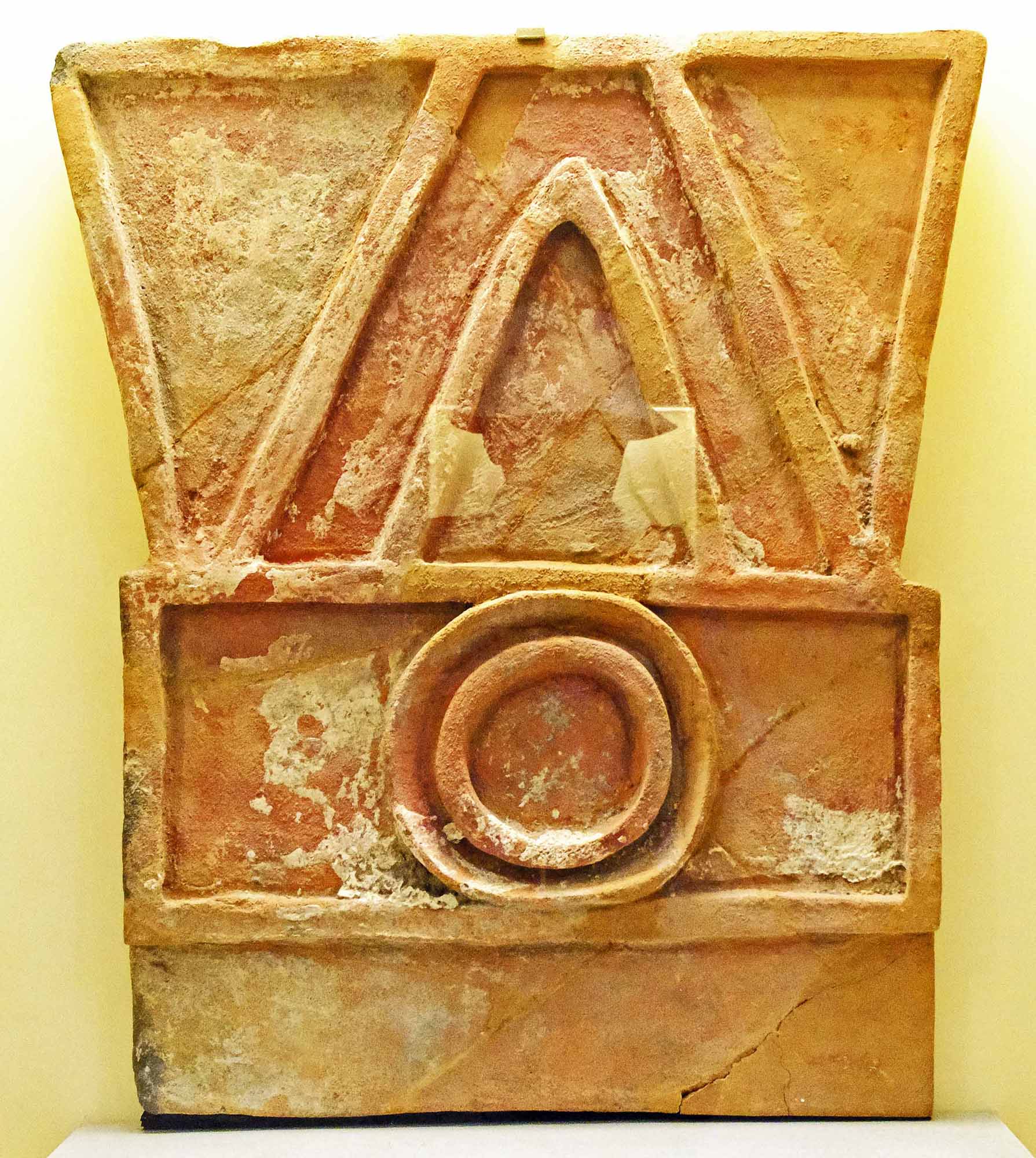
↑↑at Cultural Museum.
These are the obsidian excavated from the Ciudadela area.
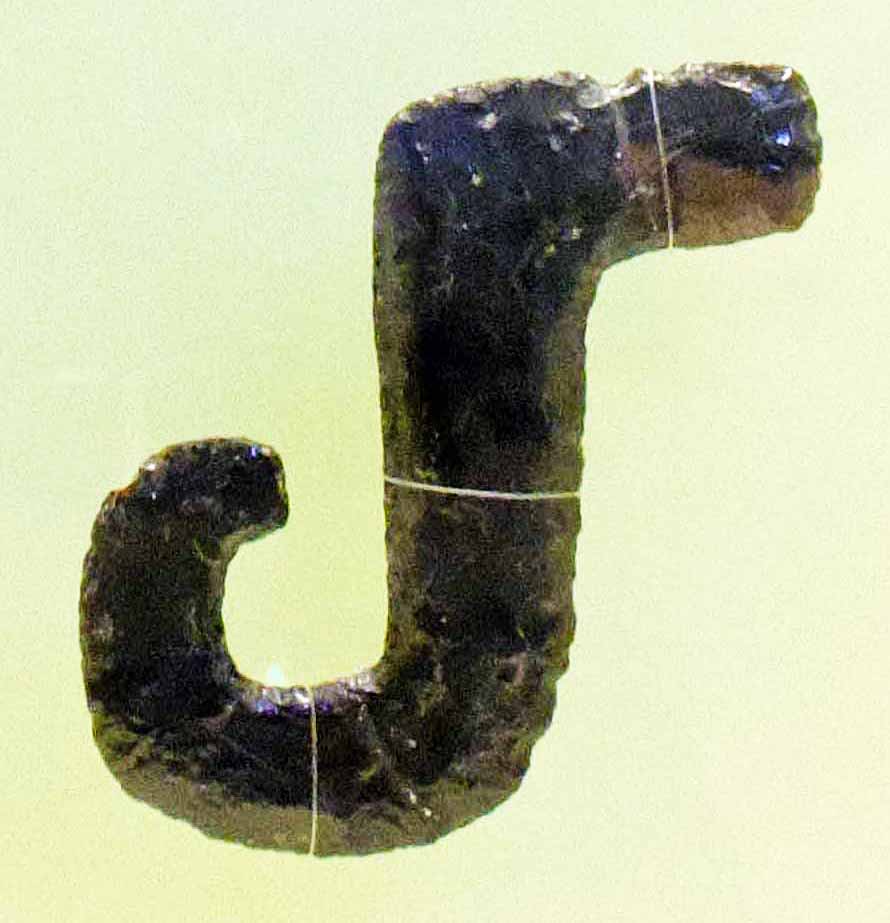
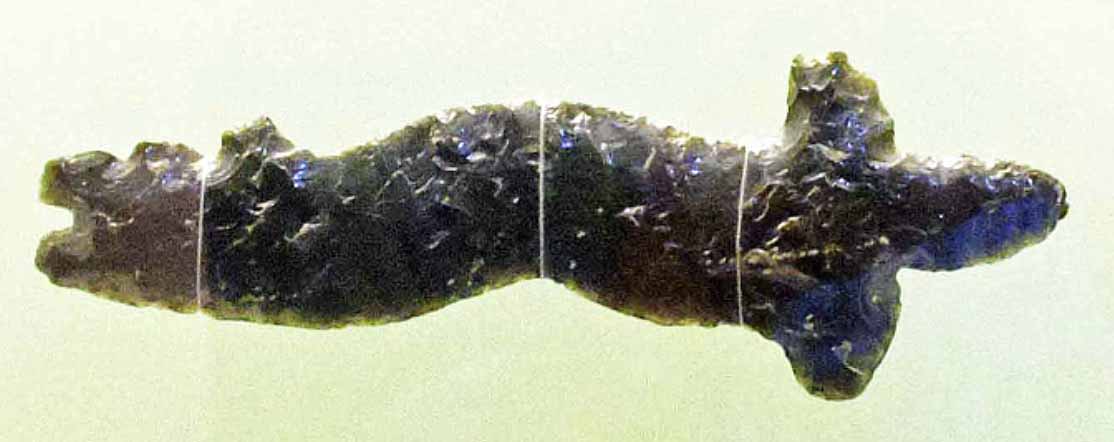
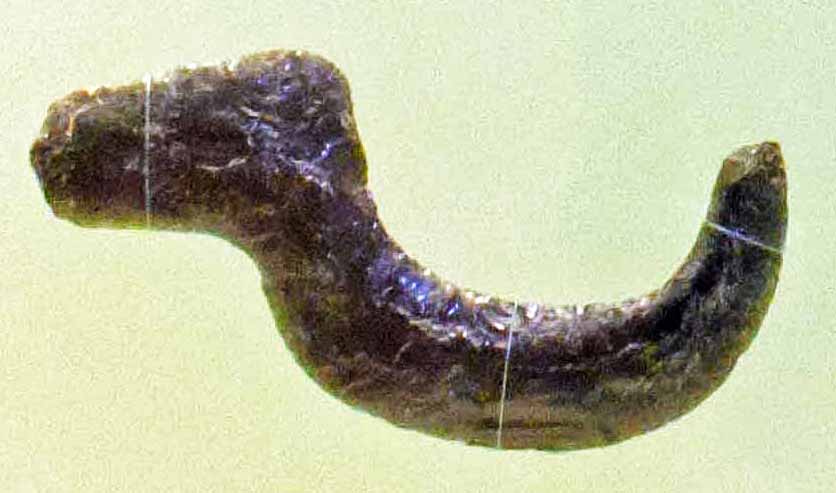
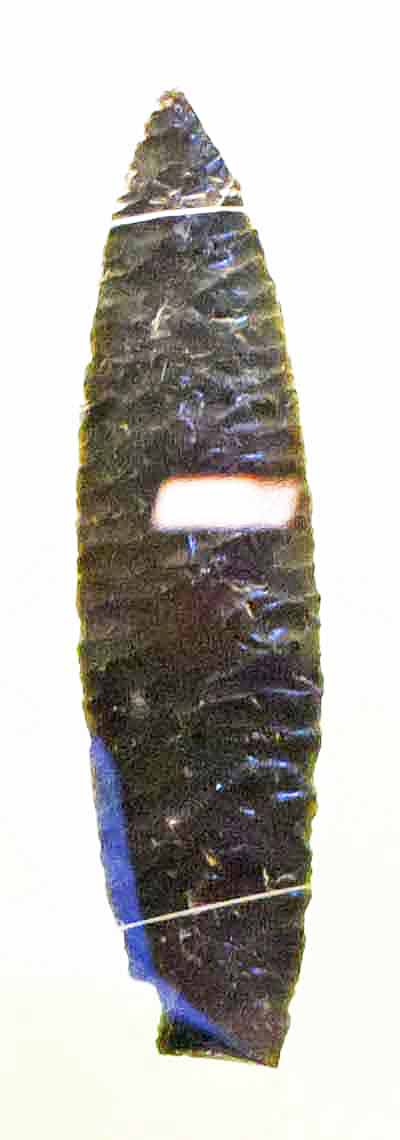
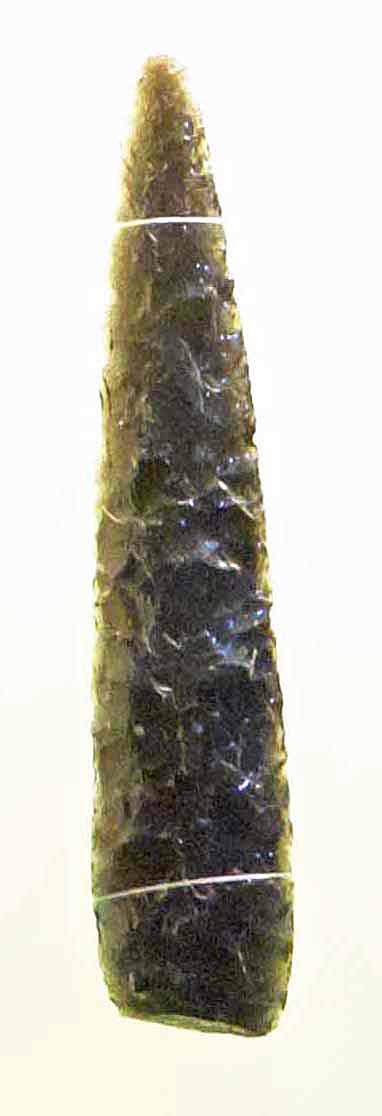
↑↑↑↑↑at Cultural Museum.
These are vessels containing the statue of the god Tlaloc excavated from Complex 1D. From left to right, they are arranged in chronological order.。
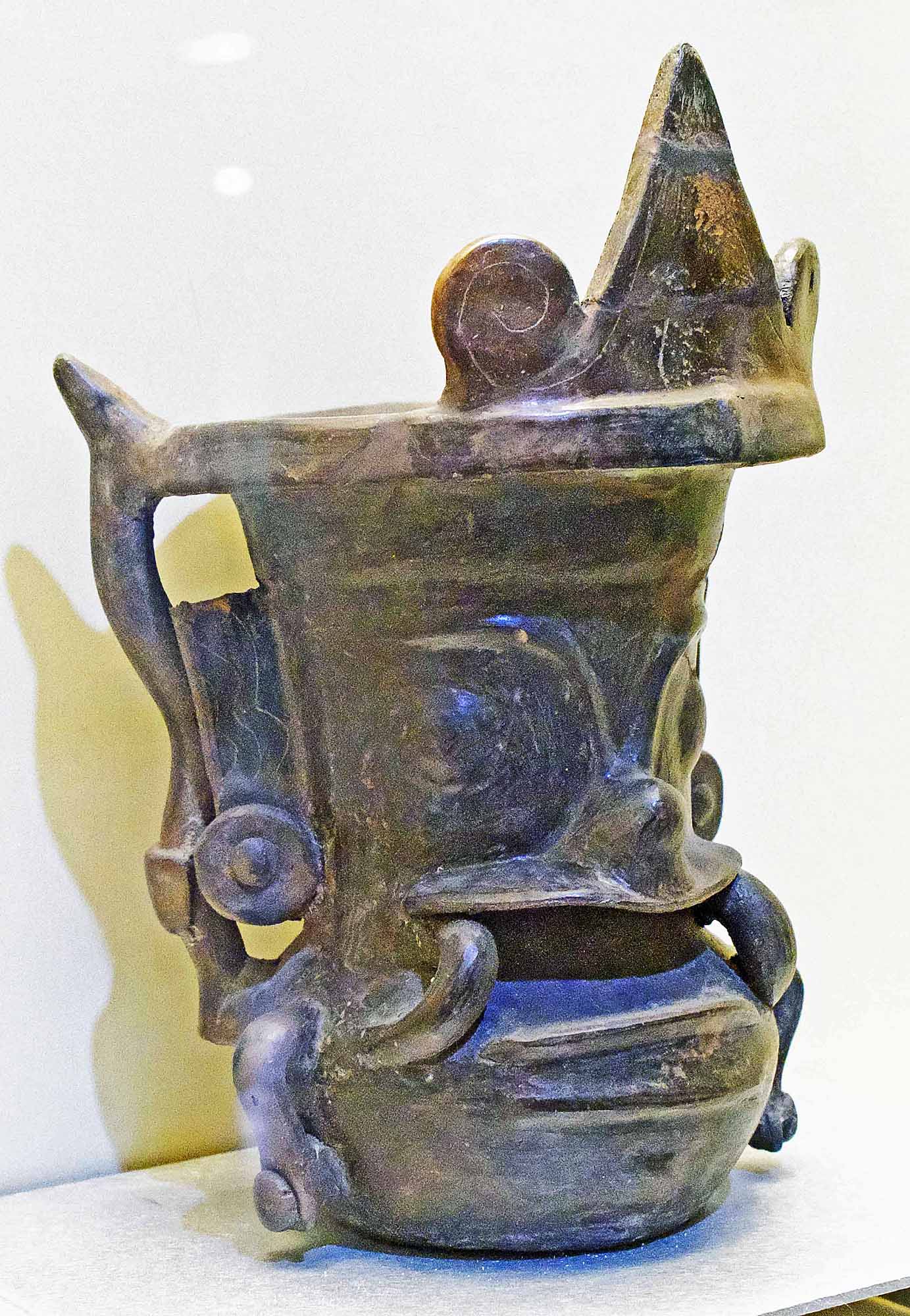
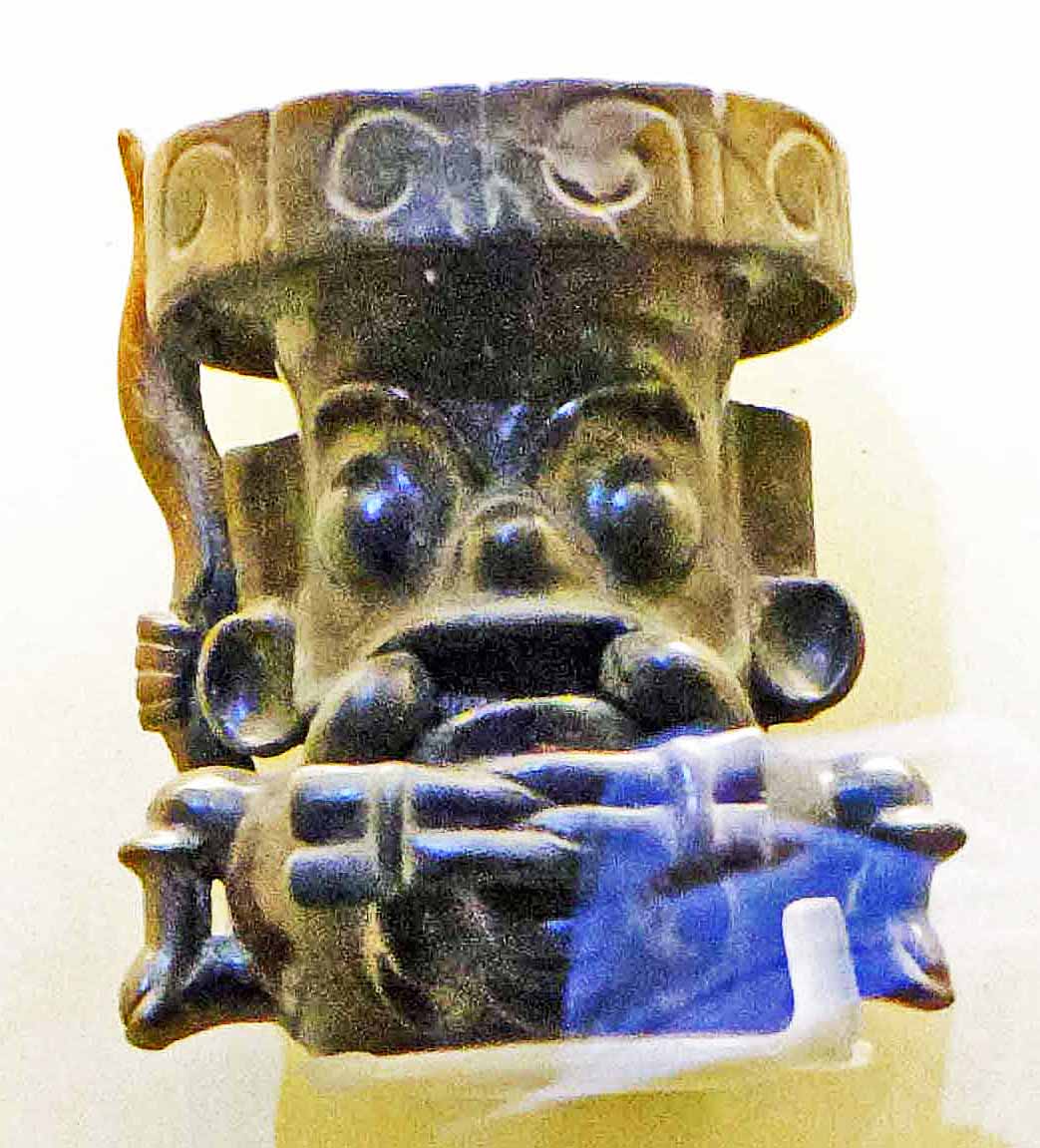
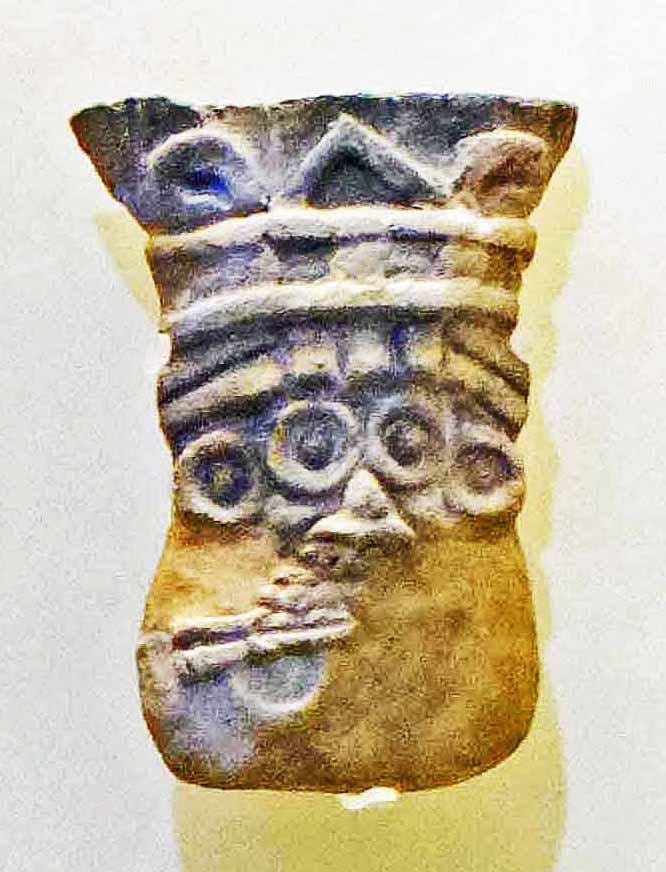
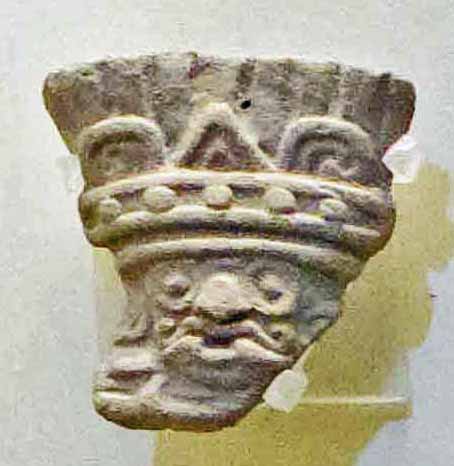
↑↑↑↑at Cultural Museum.
Part 3...After 378 AD
Complex 1E was kept as it was. D1 was added to the west, and the interior partitions were slightly altered. One theory is that this was due to the activities of the "Craftsmen's Enclosure" to the north of Ciudadela. It was a change from sacred D1 to profane D1. However, since the main product was theatrical incense burners, it can be said to be sacred in itself.
Adosada Platform
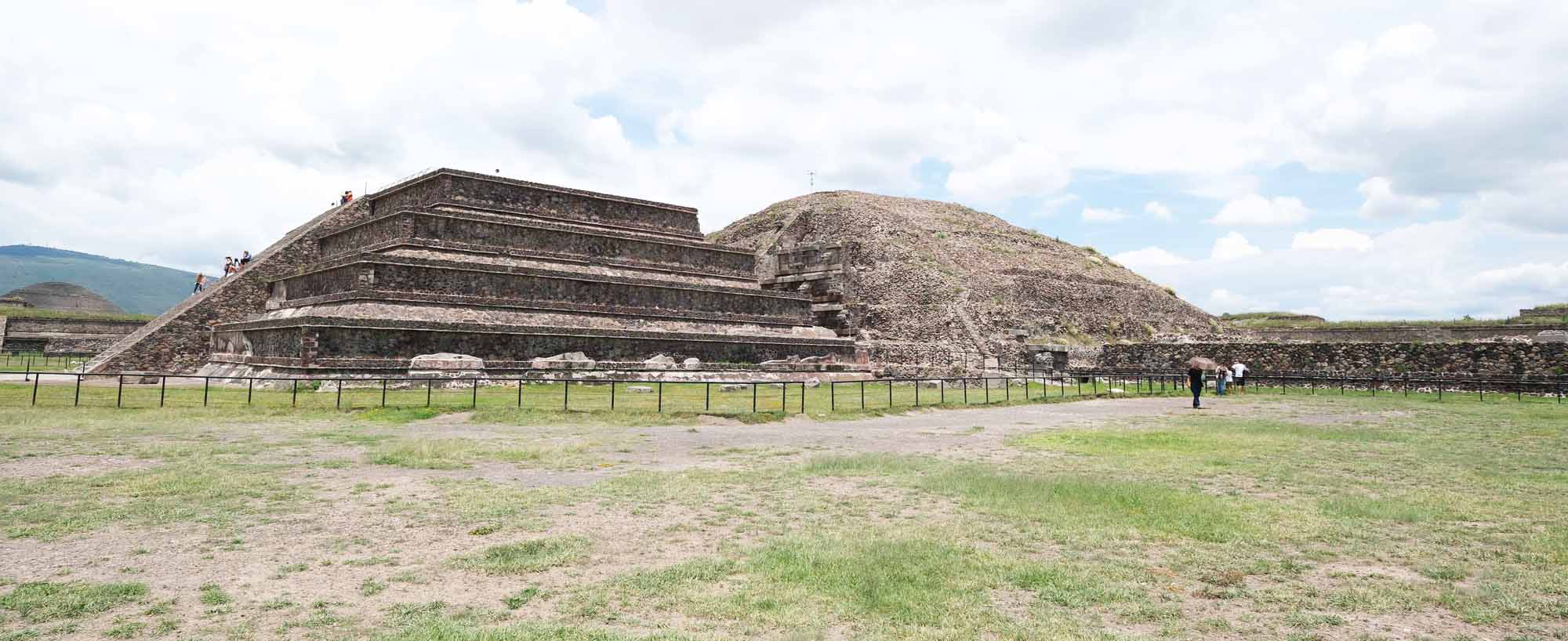
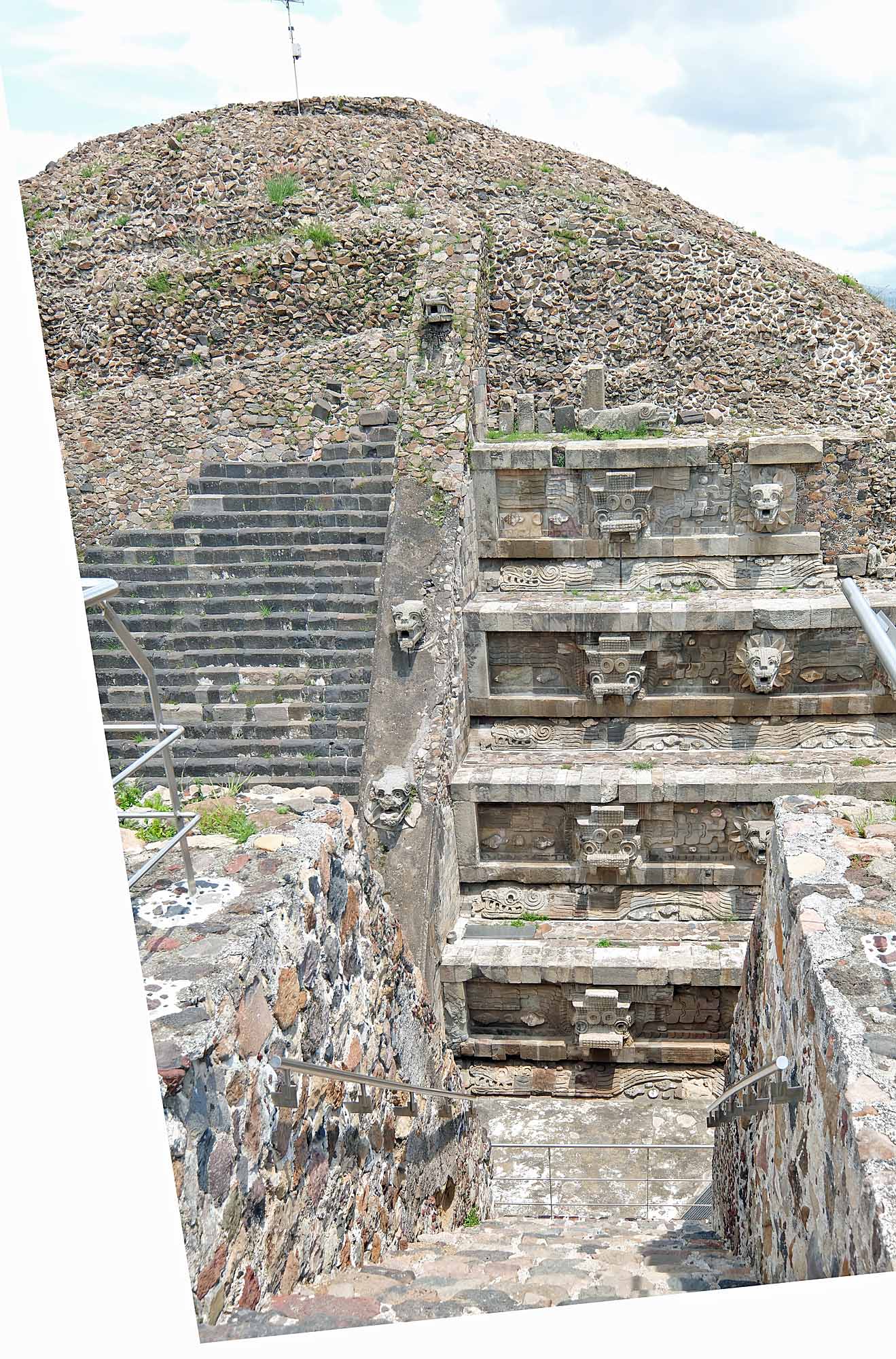
On the left is the Adosada Platform, and the flat mound on the right is the Pyramid of the Feathered Serpent. There is now a space between them, but in the 20th century this was not the case, and the four tiers of the Adosada Platform's talud tablero extended into, penetrated into, and were tightly attached to the mound on the right.
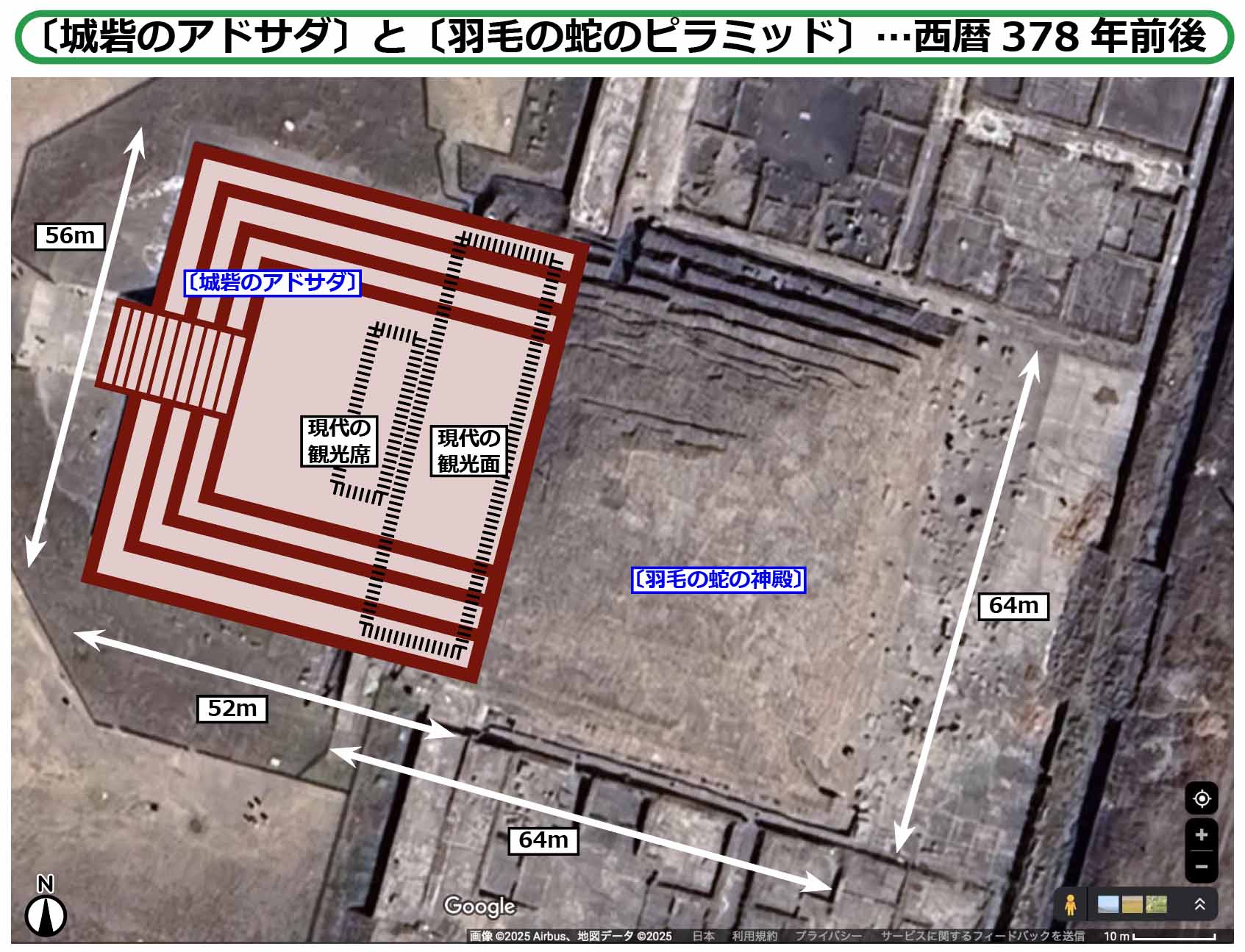
However, as can be seen from the photograph, the current state of the building is that there is nothing on the north, east, and south sides, but the west side is covered with adjoining stones and the top floor has worn away and collapsed. This was a deliberate act of destruction.
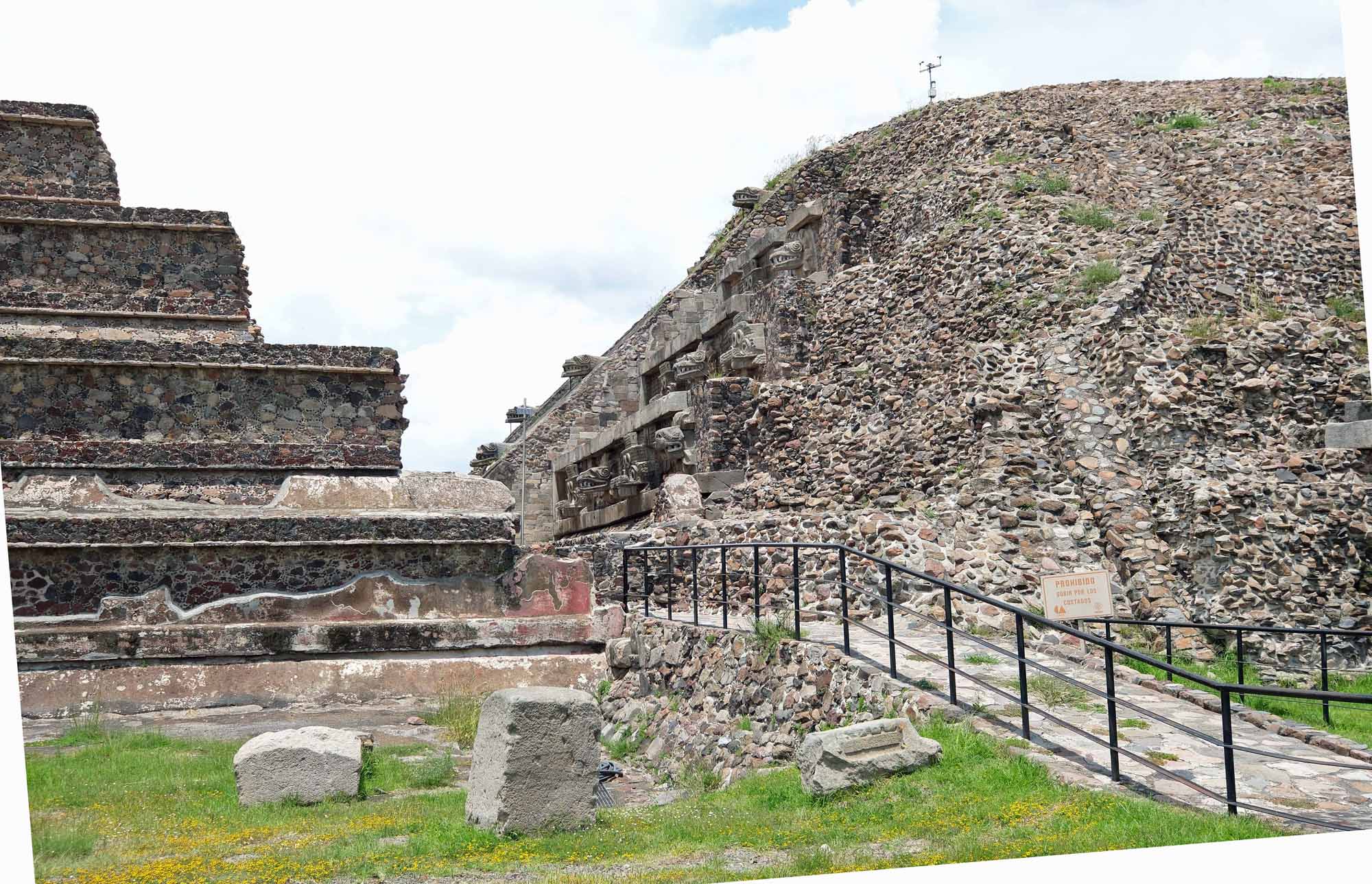
There were many snake and square carvings left there, as well as traces of being fired at a very high temperature. On the other three sides, many square holes were found where carvings had been inserted, but they had long ago been pulled out and left scattered around the Pyramid of the Feathered Serpent.
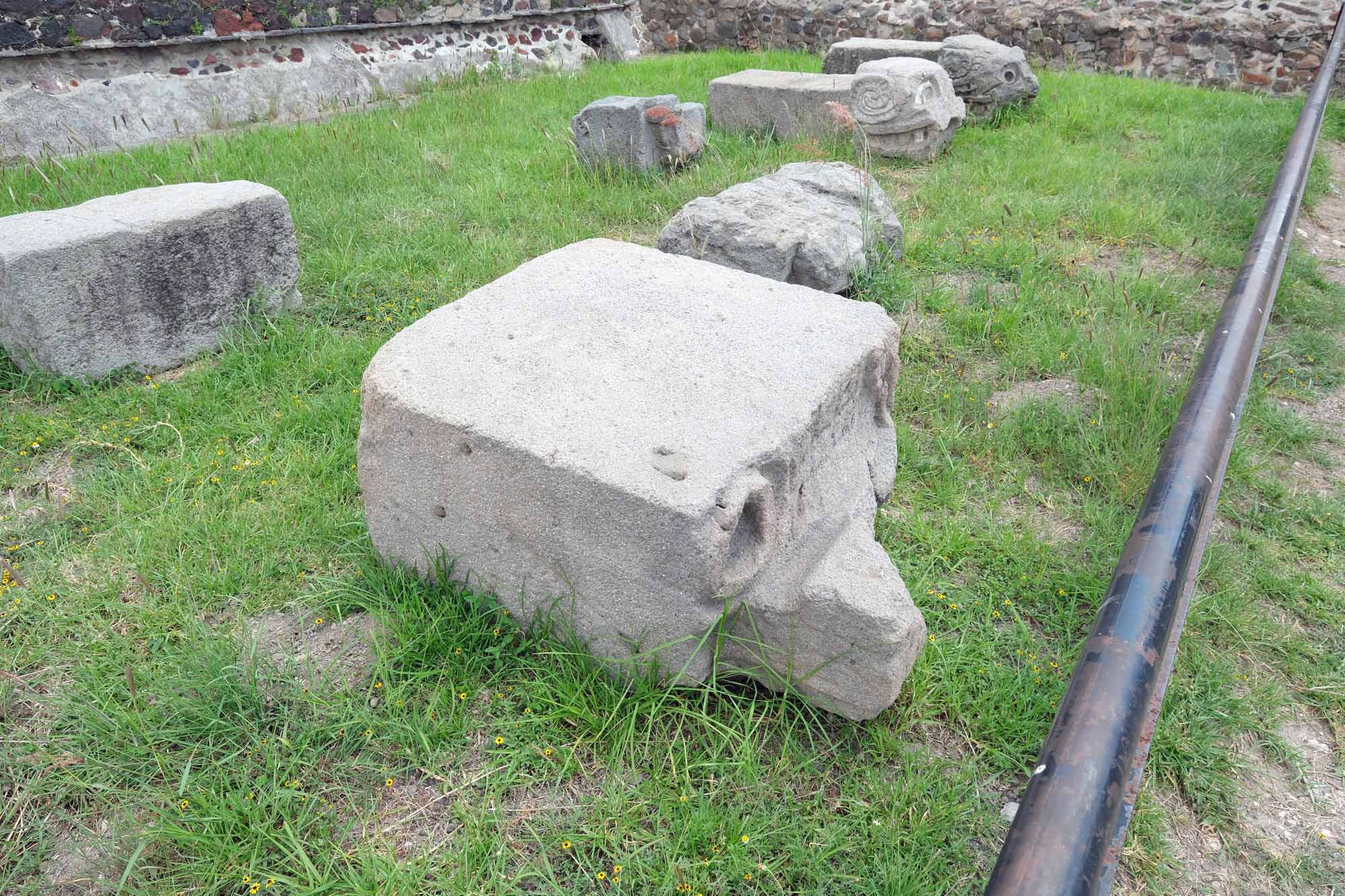
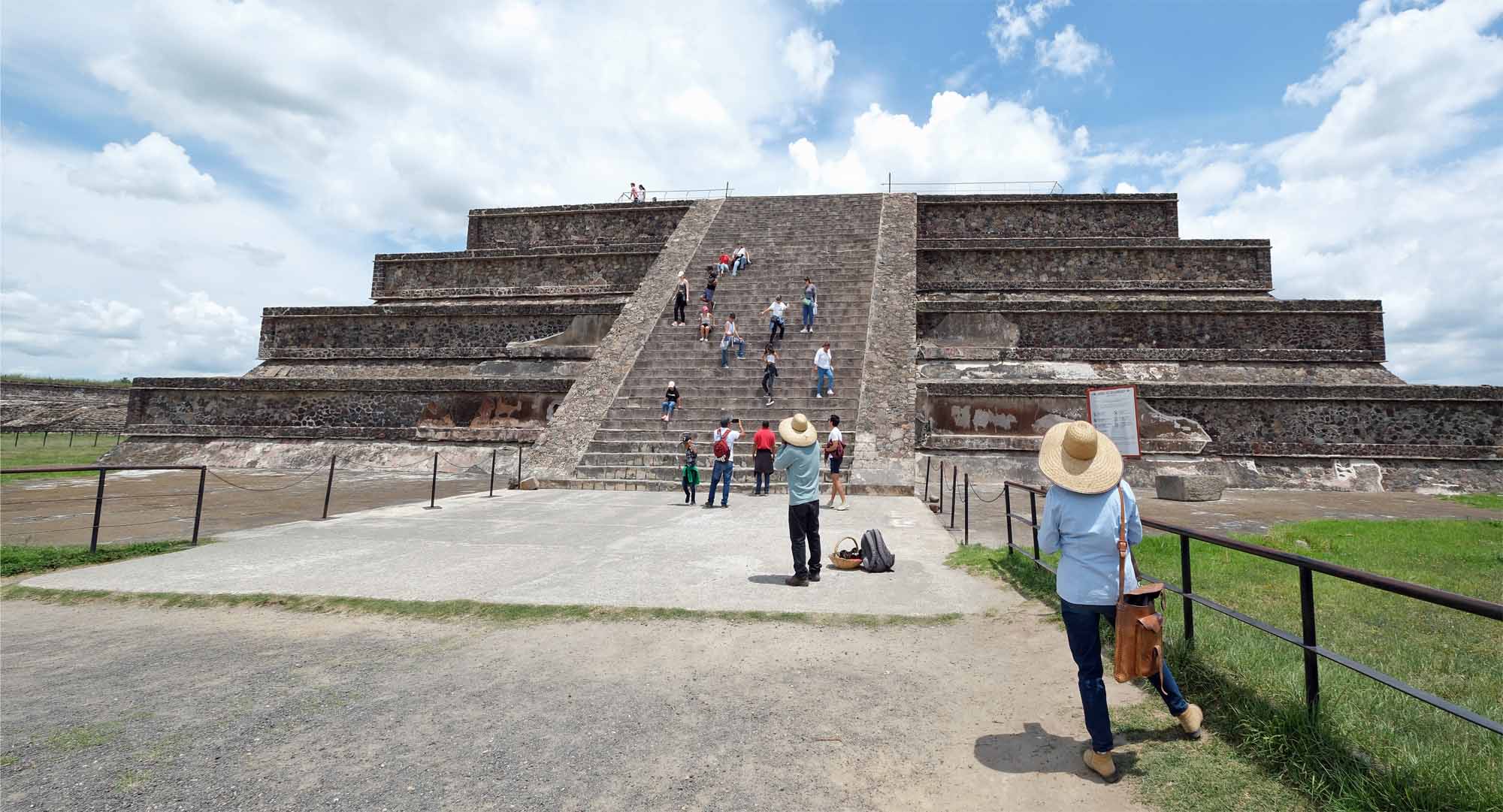
Now, let's climb the stairs from the center of the main plaza to the top of the Adosada Platform.
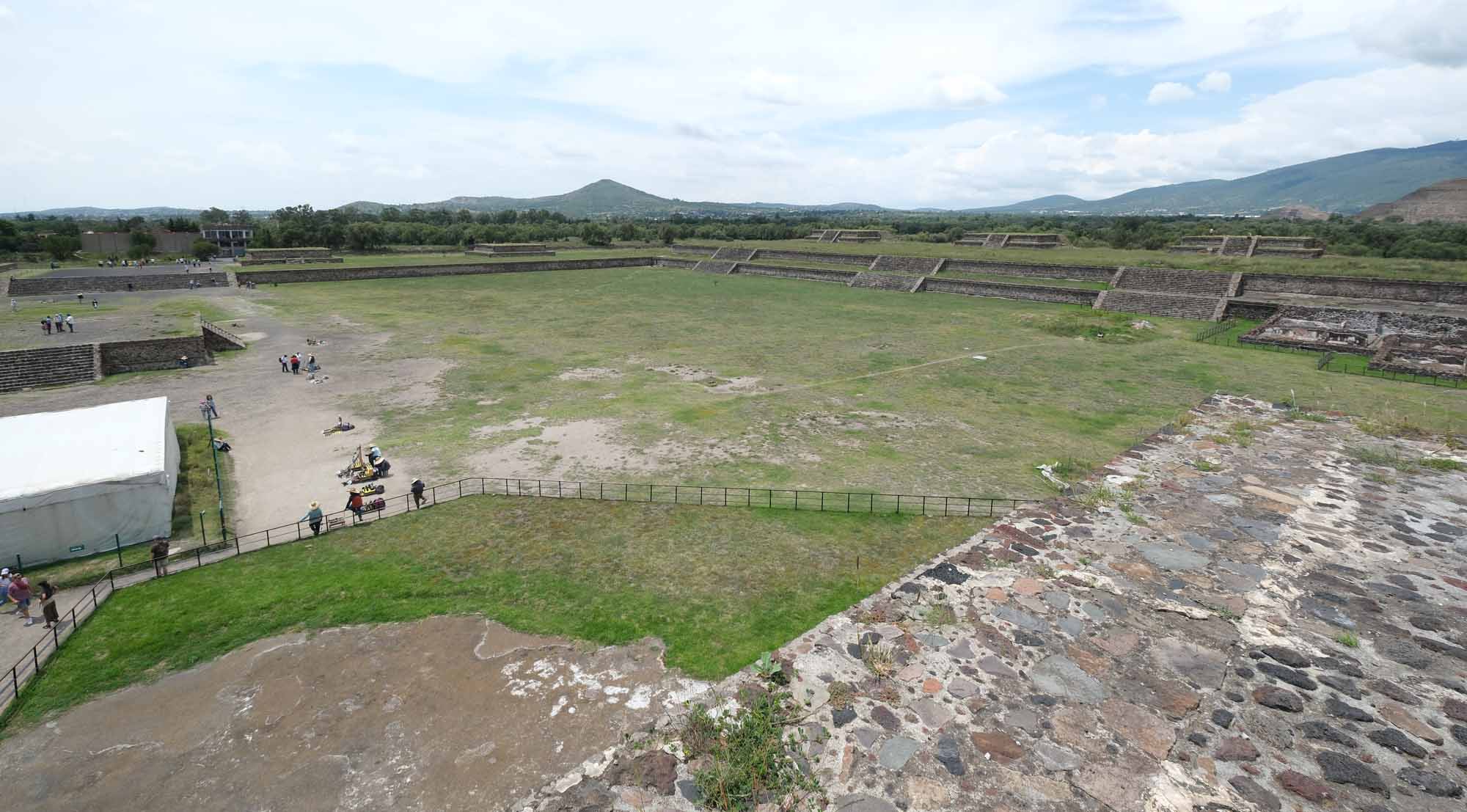
The top level is completely flat, but it is reported that there were remains of a wooden temple and remnants of red murals. This is almost the center of Ciudadela, and you can see all around.
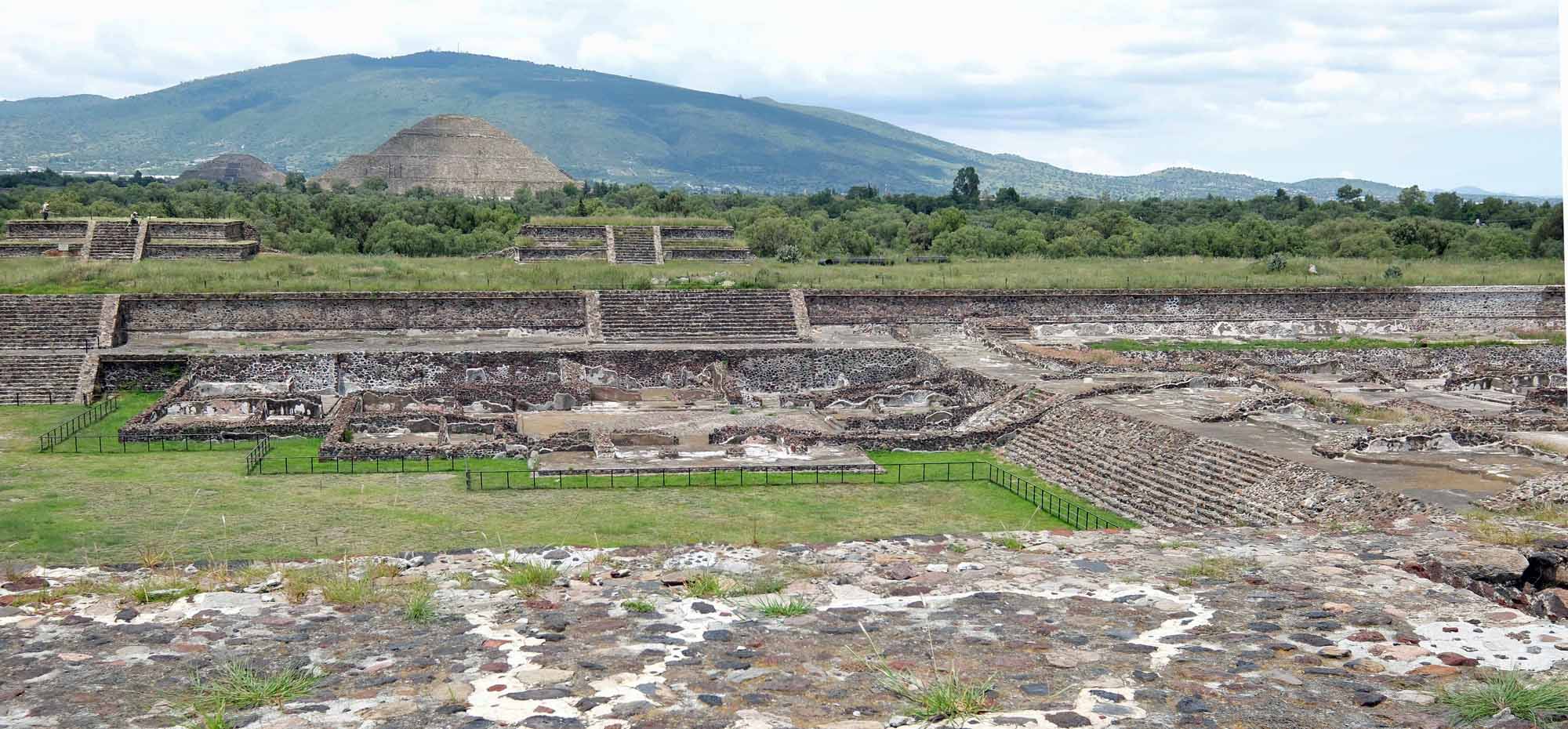
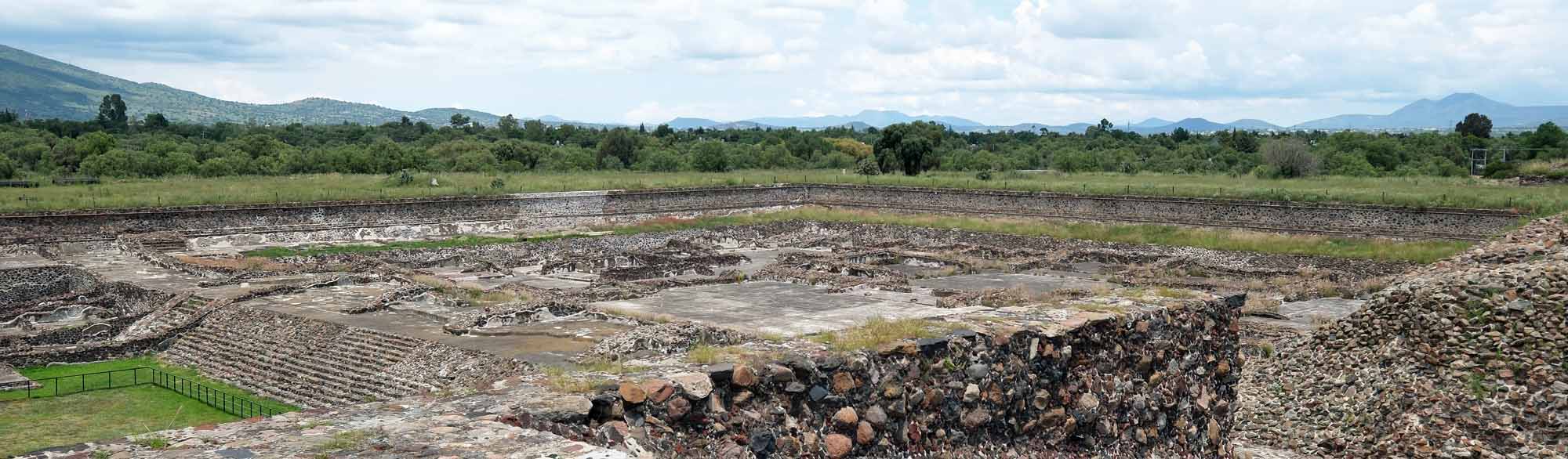
The top is the northwest direction, the bottom left is Complex 1D, and the bottom right is Complex 1E.
Go down the stone steps built on the east side of the top level. There are seats available for spectators.
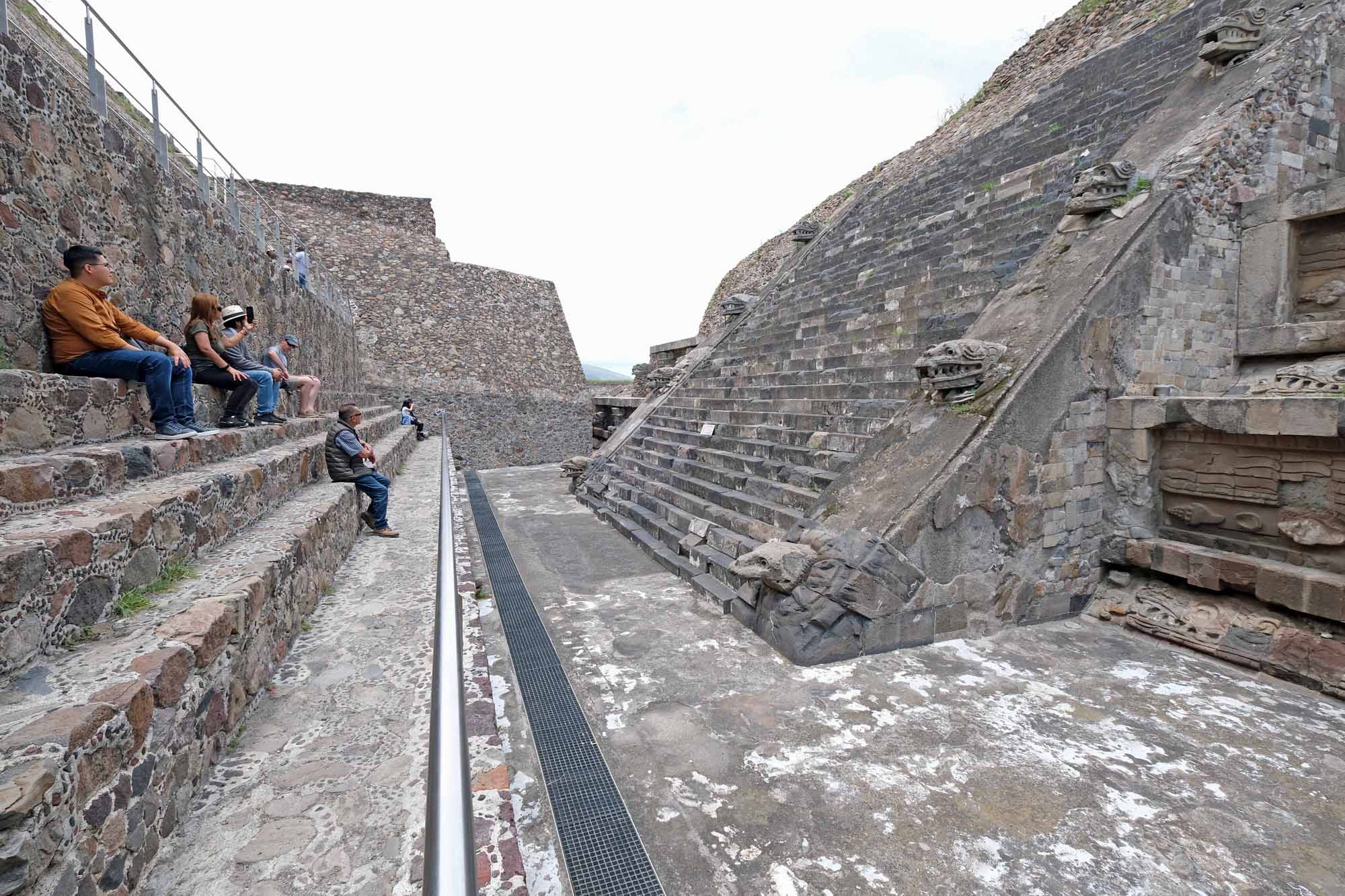
The Adosada Platform is described as follows:
1. It was built between 350 AD and 400 AD, replacing a smaller, earlier structure.
2. Its purpose was clearly to cover up the west face of the Feathered Serpent Pyramid, which had been burned.
3. The interior is filled with rubble from the Feathered Serpent Pyramid.
4. No sacrifices were made there, and no idols were erected there.
5. The building materials and design were not carefully considered, and it was hastily constructed.
6. No other structures within Ciudadela were destroyed or looted, so it was not the work of an outside force. The Teotihuacans destroyed and built again.
Complexs 1D and 1E, Craftsman's Enclosure
1D and 1E were built closely to the Pyramid of the Feathered Serpent and the circular platform. They appear to have existed before 200 AD. They were extensively renovated in conjunction with the construction of the Pyramid of the Feathered Serpent.
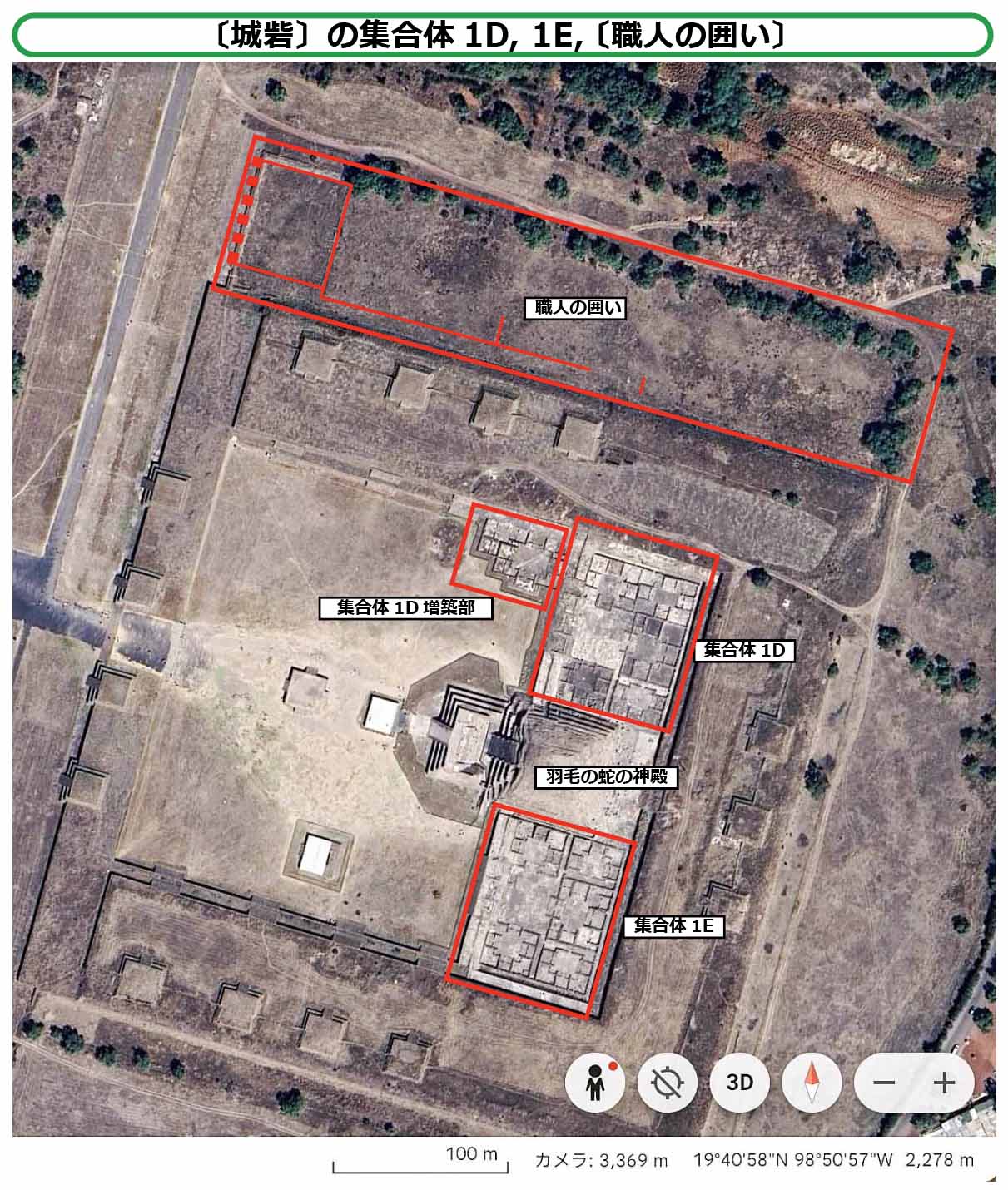
↑on Google Earth。
The layout of the southern complex 1E from 200 AD remained unchanged until 550 AD. There is a square in the center of the west side, surrounded by a group of rooms with a small square in the center.
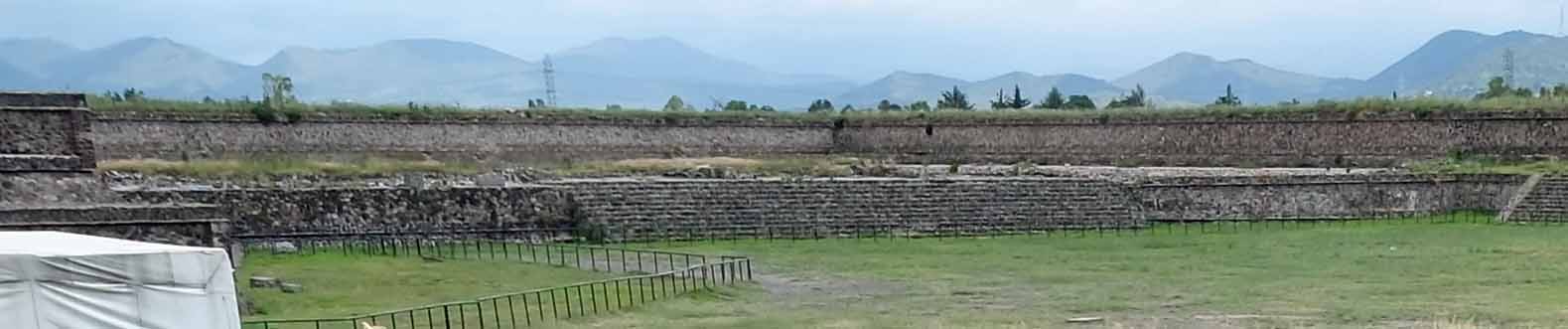

↑Complex 1E.
The northern complex 1D had the same layout as 1E, but between 350 AD and 400 AD, walls were added and the interior was divided into smaller sections. Furthermore, an extension was added to the west side. This is thought to have been done in conjunction with the construction of the "Craftsmen's Enclosure" on the north side of the base.
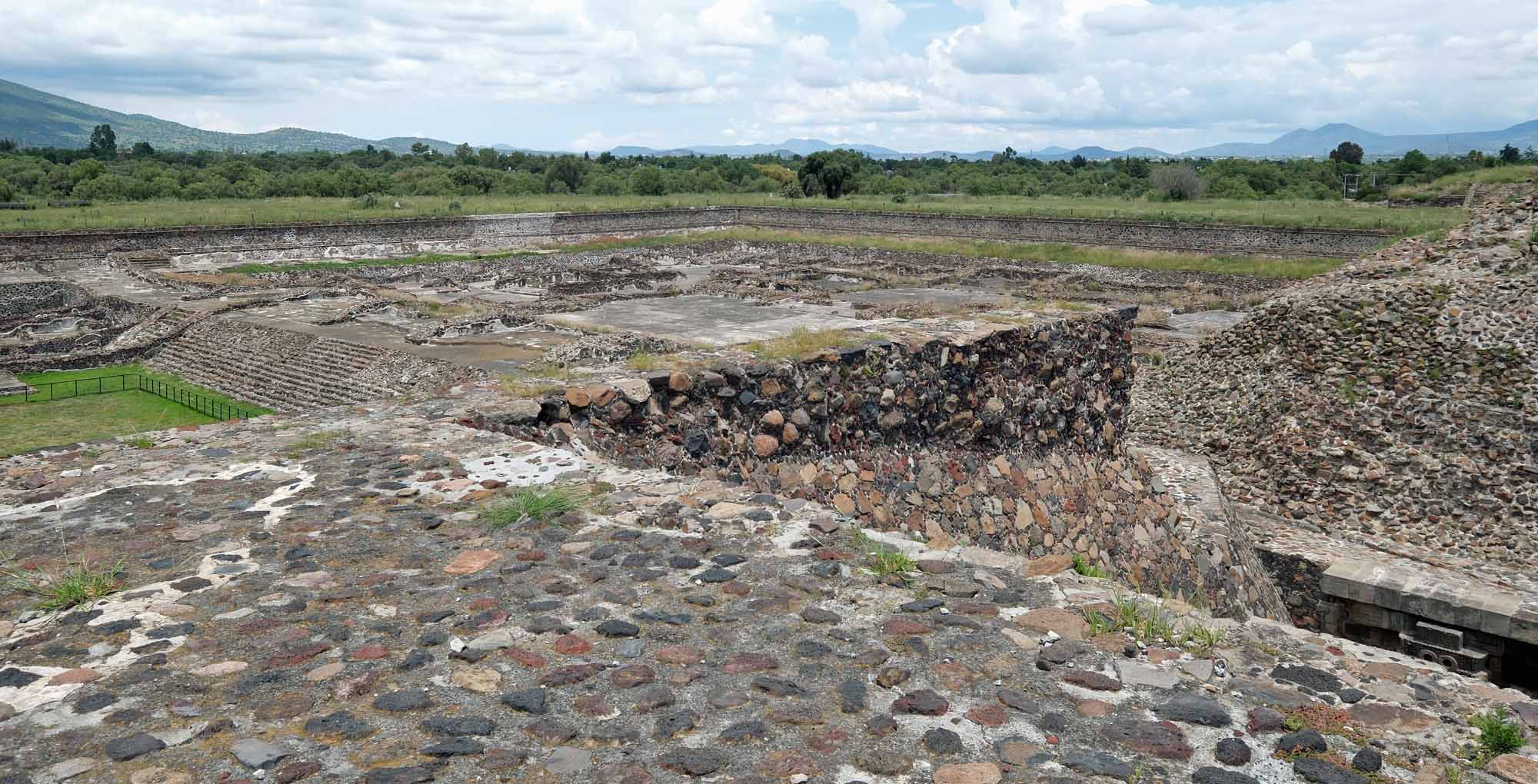
↑Complex 1D.
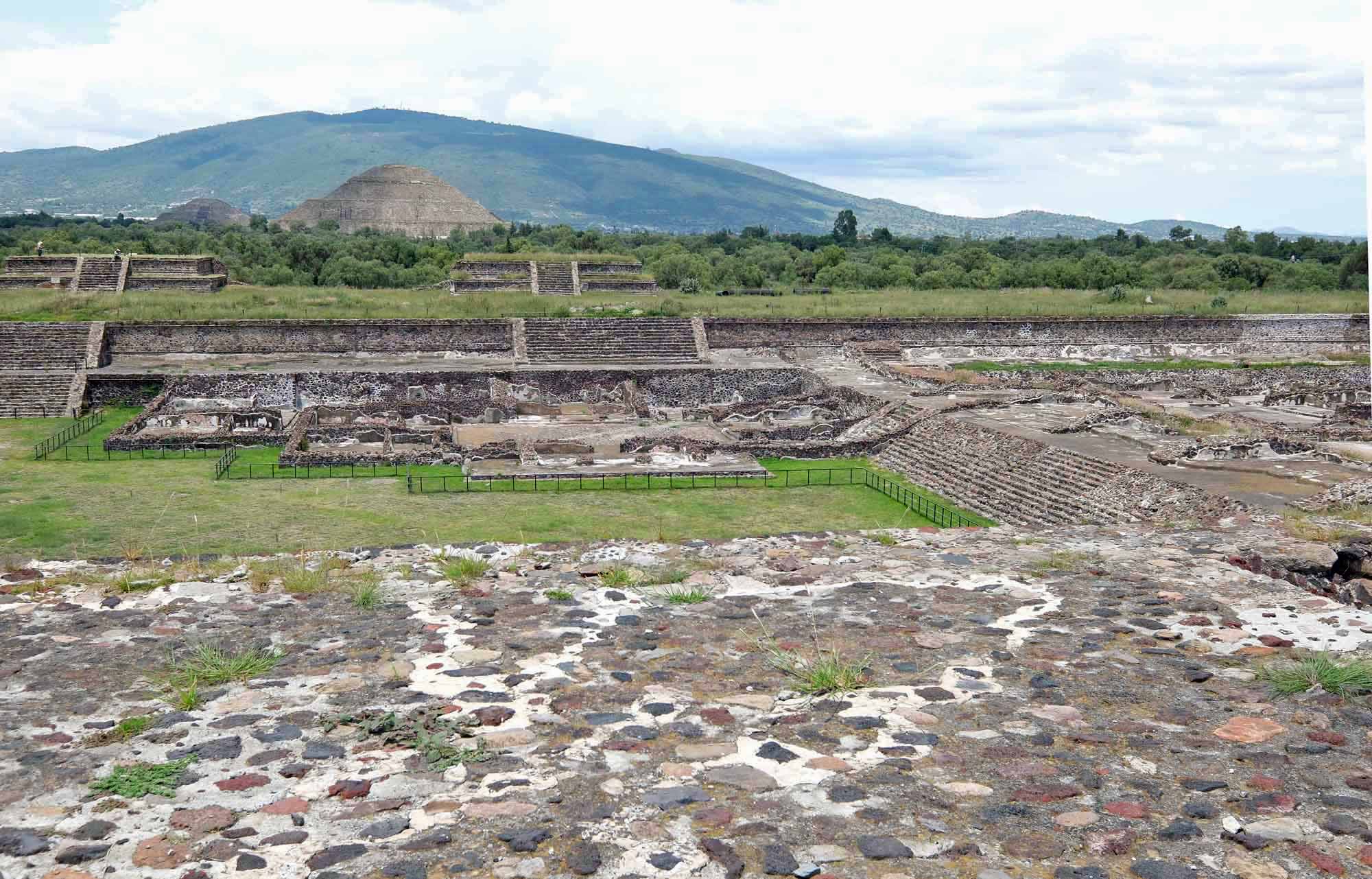
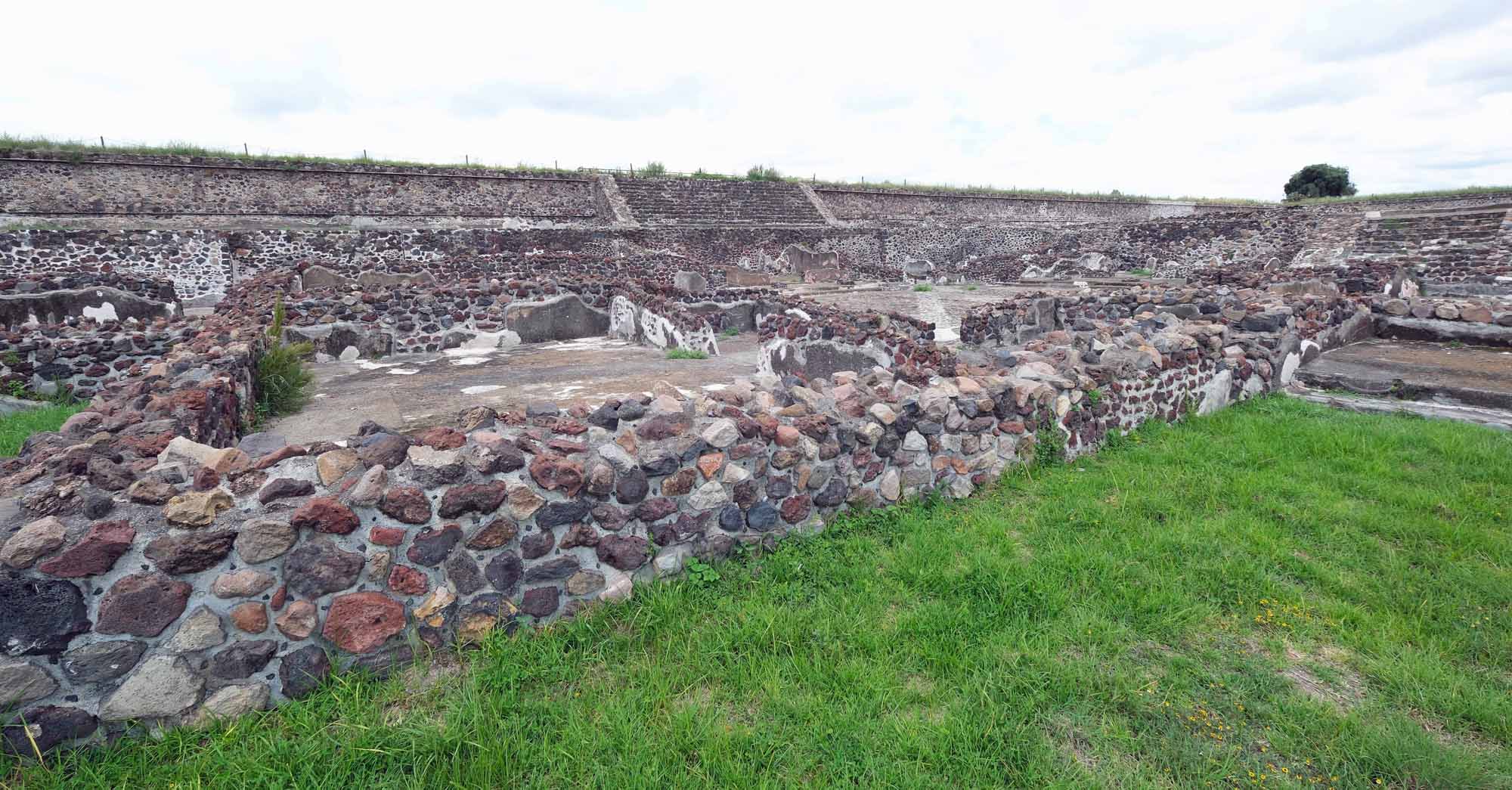
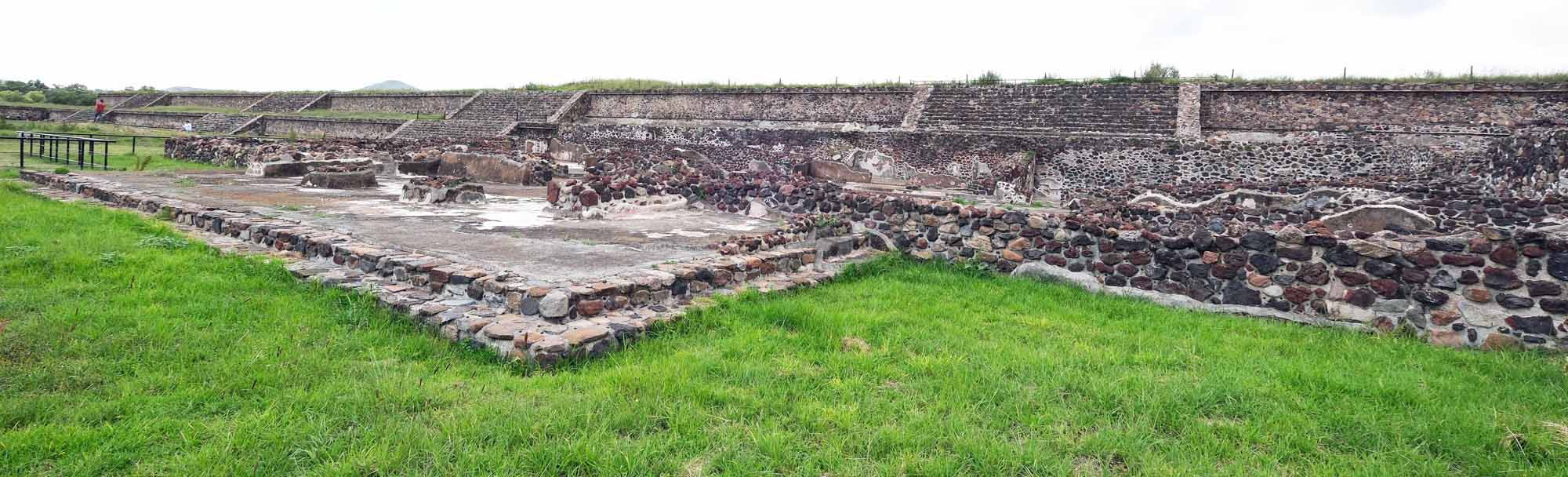
↑↑↑Complex 1D extension.
In other words, after the construction of the Adosada Platform, 1E continued to be a place for religious activities, while 1D began to function as an office to fit in with the production activities of the Craftsmen's Enclosure.
This disc was excavated from Complex 1D. It depicts the god Tlaloc. It dates to 350 AD-550 AD.
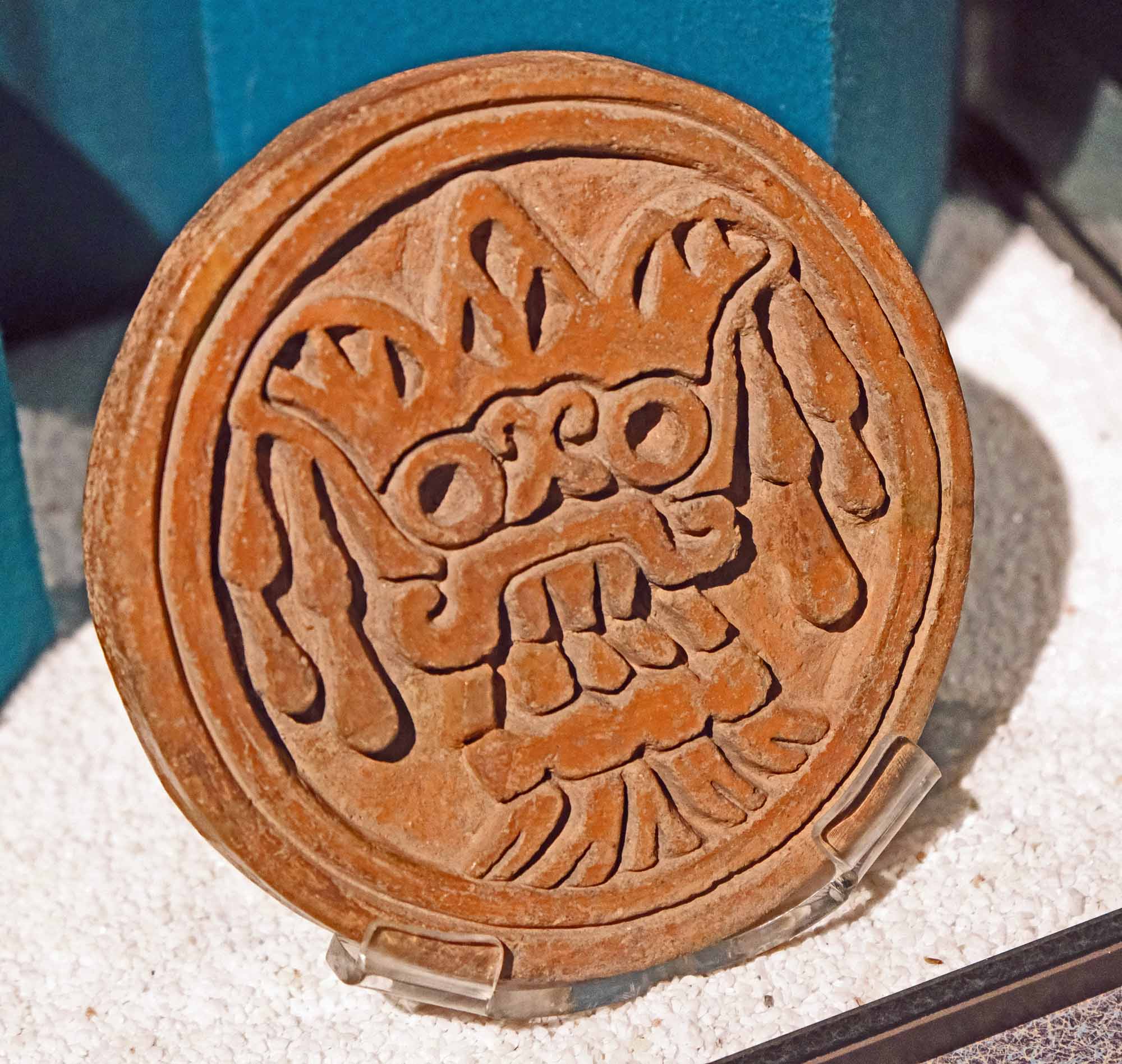
↑at Cultural Museum. 19cm.
The Craftsmen's Enclosure was established between 350 AD and 400 AD and continued until 550 AD. No notable remains remain, but small flakes and other evidence suggest that it was a workshop for making theater-style incense burners.
The following is not Ciudadela, but was found within Teotihuacan. Incense is burned on the base, and not only the scent but also the smoke rises from various parts of the decoration above. In other words, it seems that the shape and the effect of the smoke were carefully calculated when it was created.
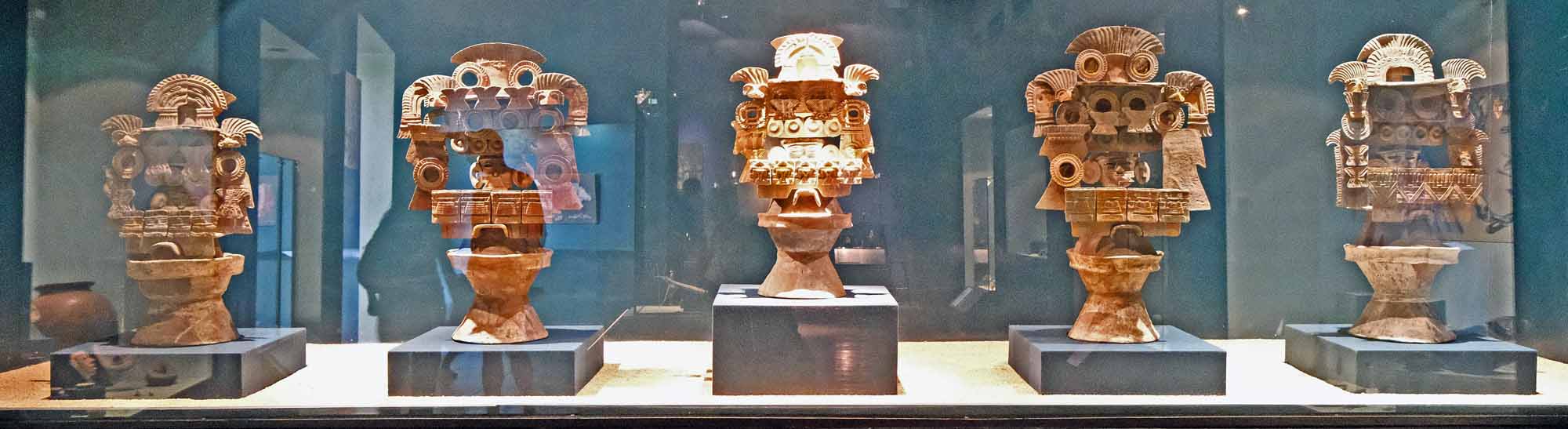
↑at Cultural Museum.
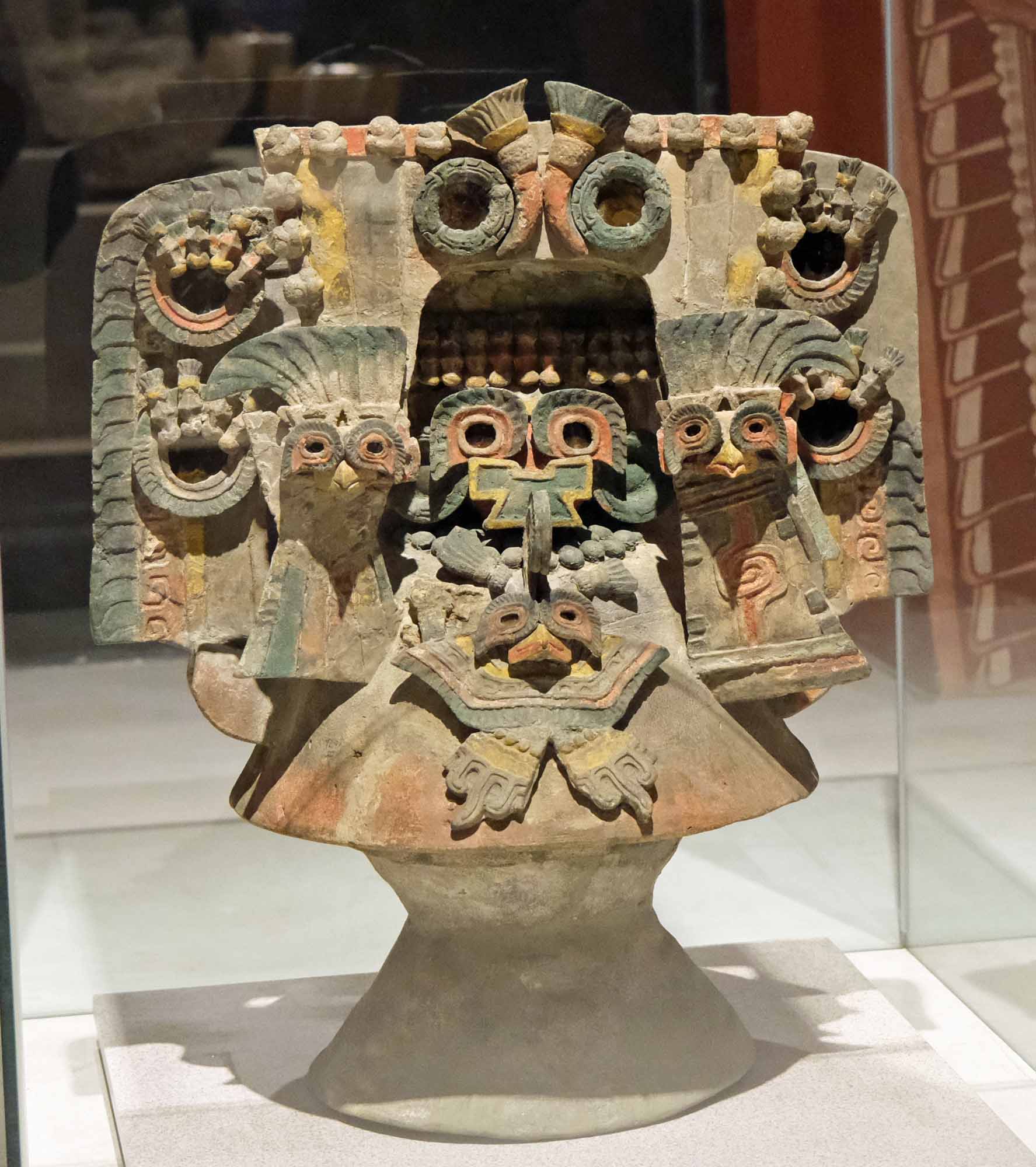
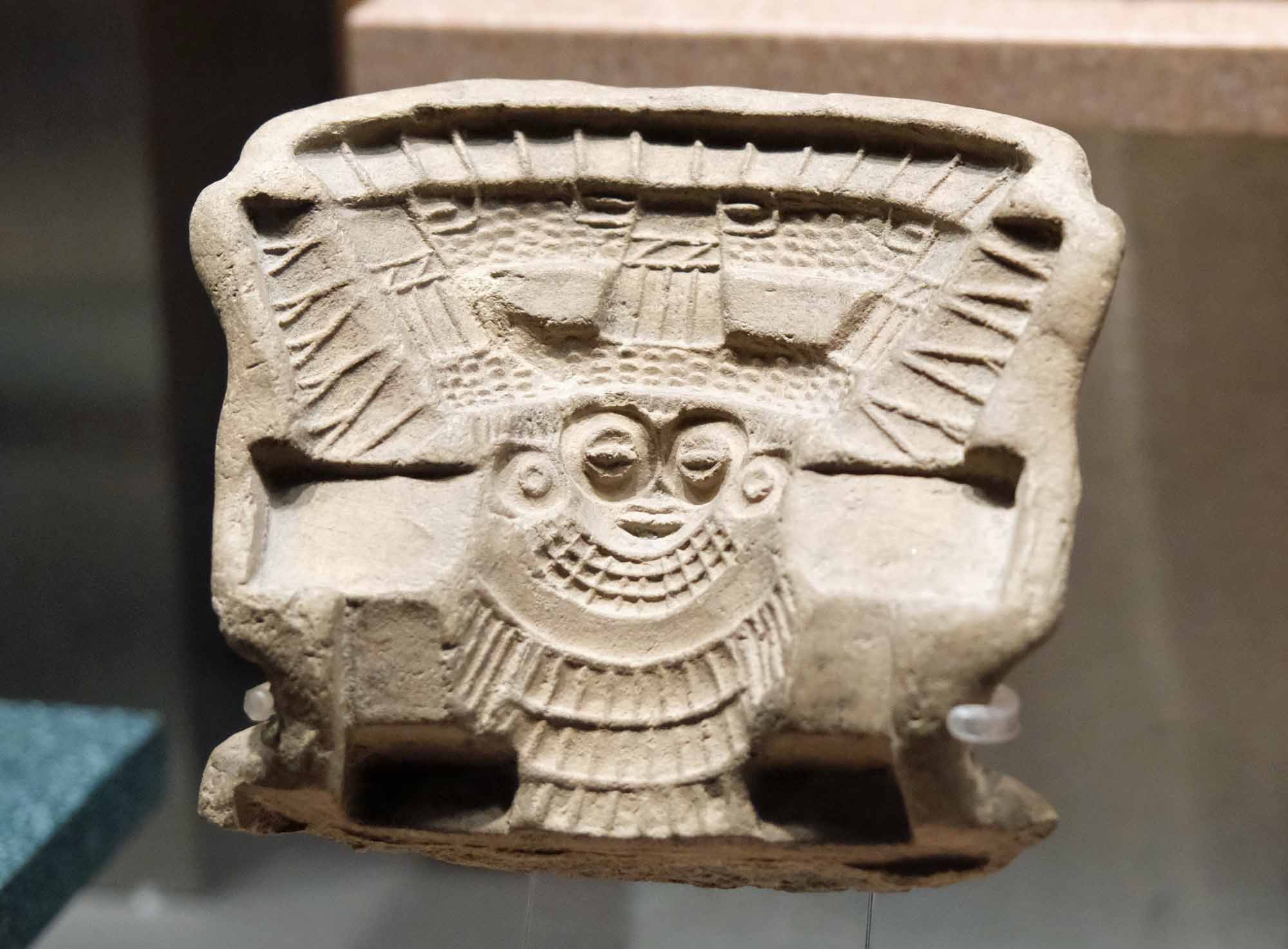
↑↑at Museum of Anthropology.
Also, the one on the top right is a template for mass production, which would have allowed for quick moulding.
Since the destruction of the Pyramid of the Feathered Serpent and the construction of the Adosada Platform, Ciudadela has been developed into a major production center for theatrical incense burners.