Architectural details
1...Talúd-Tabulero architectural style
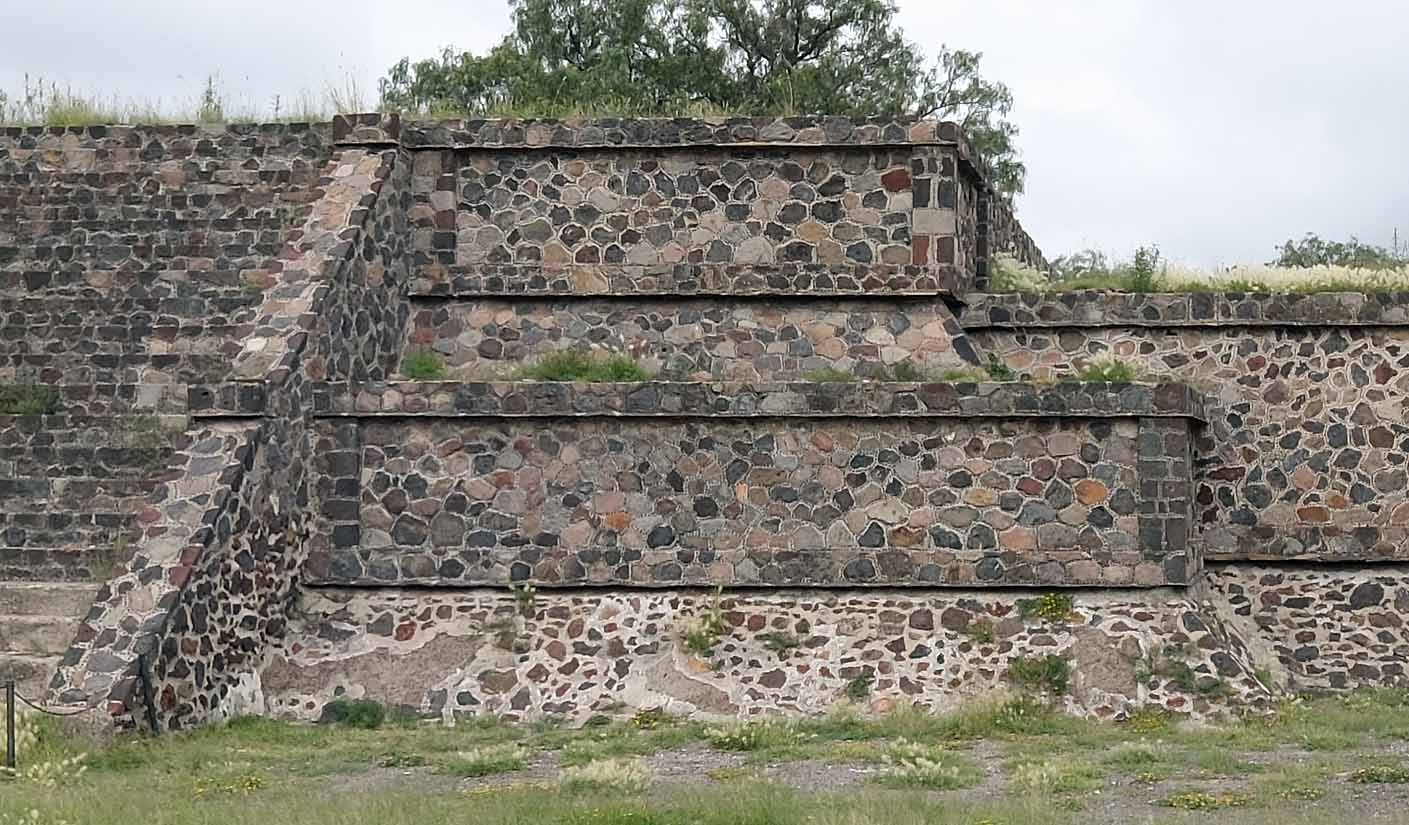
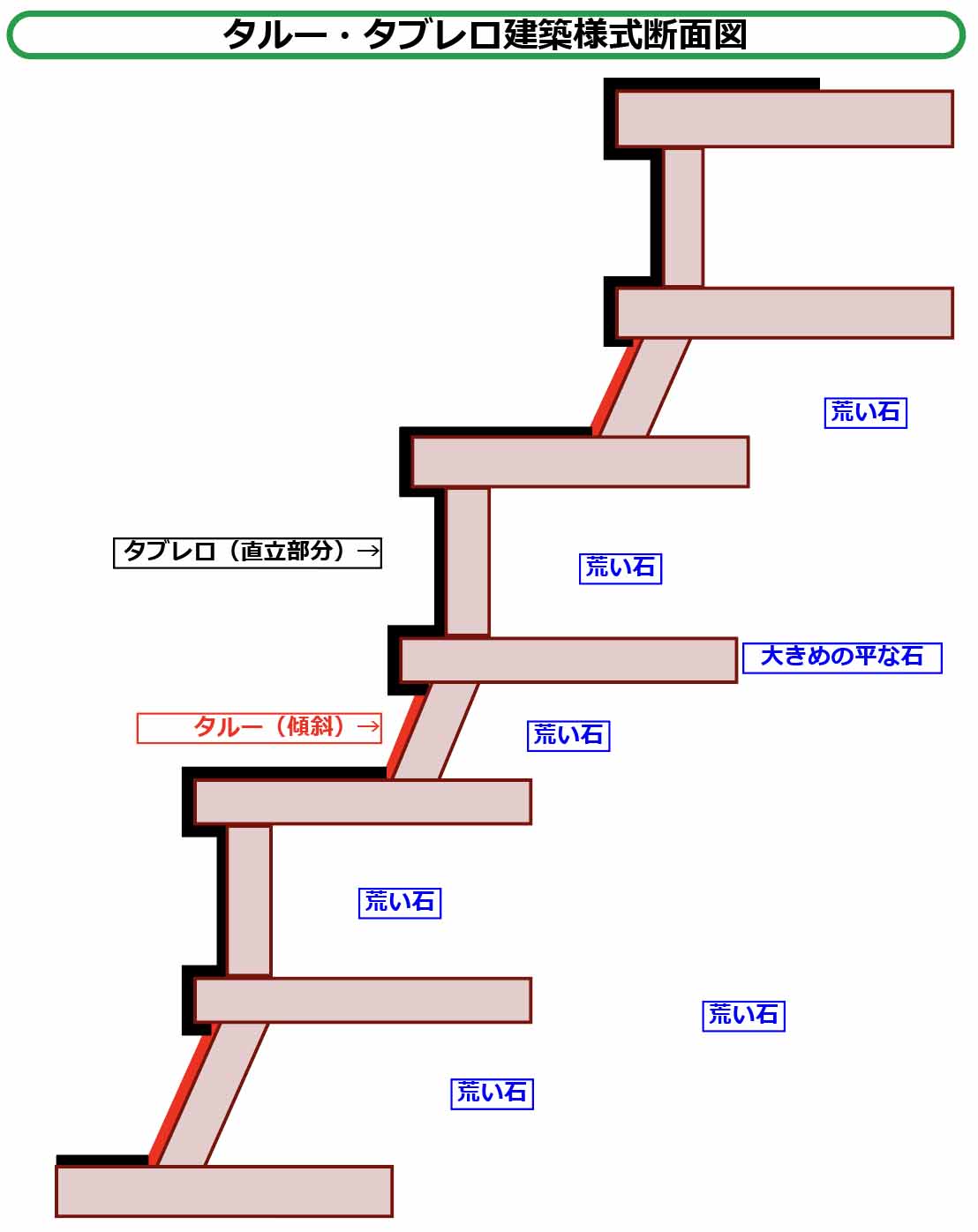
↑The square with four small temples. ↑Cross-section of the Talúd-Tablero architectural style.
The majority of Teotihuacan's buildings are built in the talud-tablero style. While the design is attractive from the outside, when viewed in cross section, the talu (sloping part) shown in red appears to make it difficult to support the weight from above. Even today, there are very few buildings with slanted exterior walls.
Below is a photo of Courtyard 2 in Tepantitla. The right half is the inside of the courtyard. The wainscoting of the interior walls is slanted, and the area above is vertical. The Talúd-Tablero style was also used for the interior.
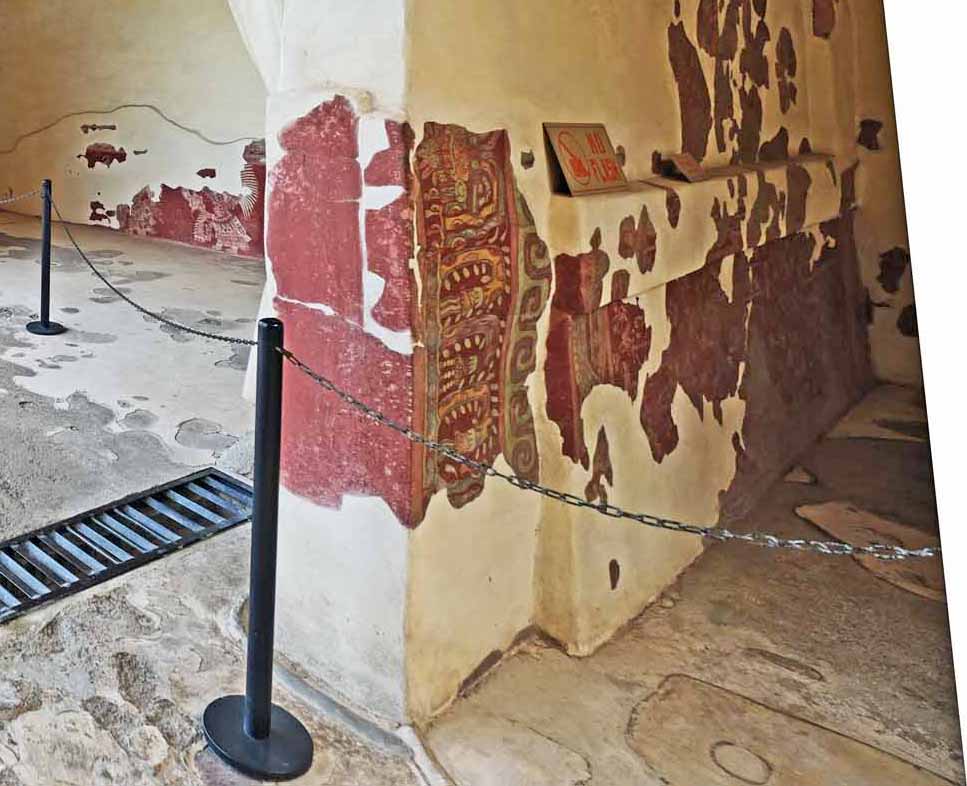
↑Tepantitla.
This style is not unique to Teotihuacan, but has been recognized throughout Mesoamerica since around 300 BC. For example, the Tetimpa ruins were excavated east of the Cholula ruins, beneath a layer of pumice from the Popocatepetl volcano.
The city's iconic Pyramid of the Moon and Pyramid of the Sun are not in the Talúd-Tablero style, as it is said they would not be able to withstand such a huge weight.
2...Are the corners of the building right angles?
Saburo Sugiyama conducted various surveys and determined that the unit of length at Teotihuacan was 83cm. He also reported that doubling the number 260, derived from the 260th day of the religious calendar, (260 x 2 x 0.83m) = 431.6m corresponds to one side of the grounds of large buildings such as the Pyramid of the Sun. Furthermore, in his book "Digging Teotihuacan," he points out that the exterior walls of many buildings are joined at angles of 89 and 91 degrees, and are not perpendicular. While it is true that, from a broad perspective, the city can be said to be perpendicular to its architectural axis, a closer look reveals subtle deviations.
Some papers have also observed that Teotihuacan's streets deviate slightly from the architectural axis and then return to it, with the exterior walls of many buildings jutting out into the streets. The degree of this varies from place to place, but it may give the building a texture reminiscent of woven cotton rather than synthetic fabric. Perhaps tourists and archaeologists alike feel a soft sensation in the gently ascending line of the Pyramid of the Sun and the slight deviation of the actual buildings from the city's architectural axis.
3...Why hasn't an updated map been published in 60 years?
The 1960s map reported by the groundbreaking Teotihuacan Mapping Project (TMP), led by archaeologist Miron, is still in use today. Even though more than 60 years have passed, no "updated" version has been published. Perhaps this is because modern scholars believe that if they were to create an "updated" version, it should be thoroughly accurate, but excavations have not progressed to the point where they could perfectly reflect the discrepancies mentioned above, and that Miron's version is no longer a major problem.