Xalla
It's a very large site. The area that is believed to be the Xalla section alone measures 314m north to south and 443m east to west. It is comparable to the Pyramid of the Moon, Moon Plaza, Pyramid of the Sun, Ciudadela, and Great Compound. Although it does not face the Street of the Dead, there is a 5m wide and 130m long causeway that connects directly to Moon Plaza.
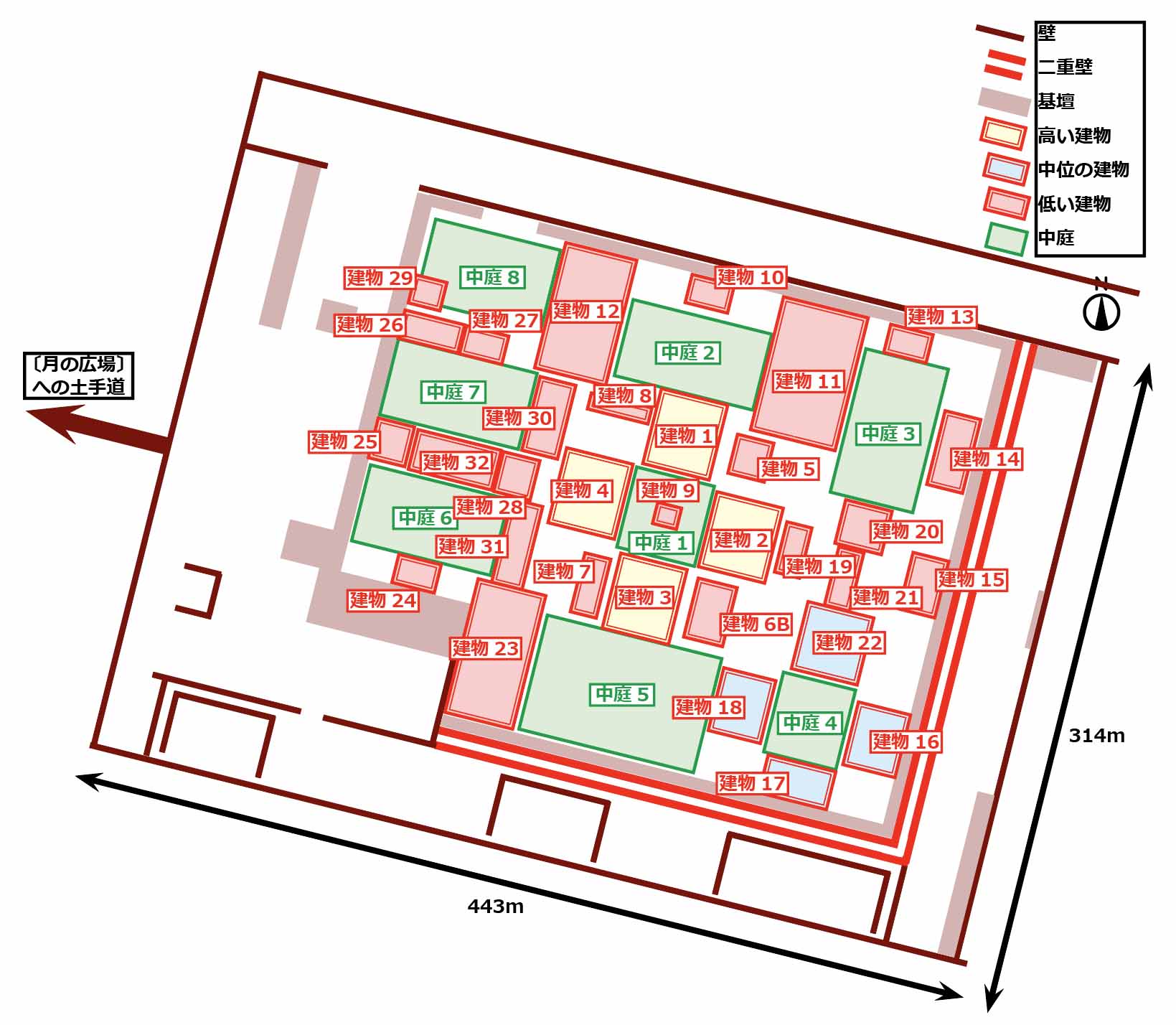
The double outer walls prevent intrusion by suspicious individuals. This is the only double wall in Teotihuacan, and the 3m-wide gap allows guards/warriors to patrol.

↑at Cultural Museum
According to the excavation report, the most substantial (i.e. tallest) buildings are 1 to 4, which form a tetrad structure surrounding a courtyard with an altar in the middle. The next most substantial buildings are 16, 17, 18, and 22, along with courtyard 4 without an altar, which also forms a medium-sized tetrad structure.
37 kg of mica from Oaxaca was found hidden in the basement of Building 4. Mica can be crushed and mixed into paint to enhance its brilliance. Red was a popular exterior and interior paint throughout Teotihuacan after 350 AD, so there must have been a large trade in it. Another 35 kg lump of mica was found in the Viking Group.
A large Olmec-style figurine and a chair back and armrest with what appears to be a jaguar design were recovered from the shattered remains of Building 3. Burn marks dating back to 550 AD were found on the shattered remains and the building.
Within the double outer walls, only religious facilities, several workshops, and eight courtyards have been identified, and there does not appear to be any room for residences for the Xalla's high-ranking officials, warriors, craftsmen, or a few farmers.
Looking at the diorama below, the square slabs are likely to be buildings of which only the foundations of the outer walls have been found. Some of the numerous buildings located to the east of the Sala may be homes or apartment complexes for the people who belonged to Xalla.

↑at Cultural Museum.
Looking at Google Maps, it looks like it's mostly been filled in.
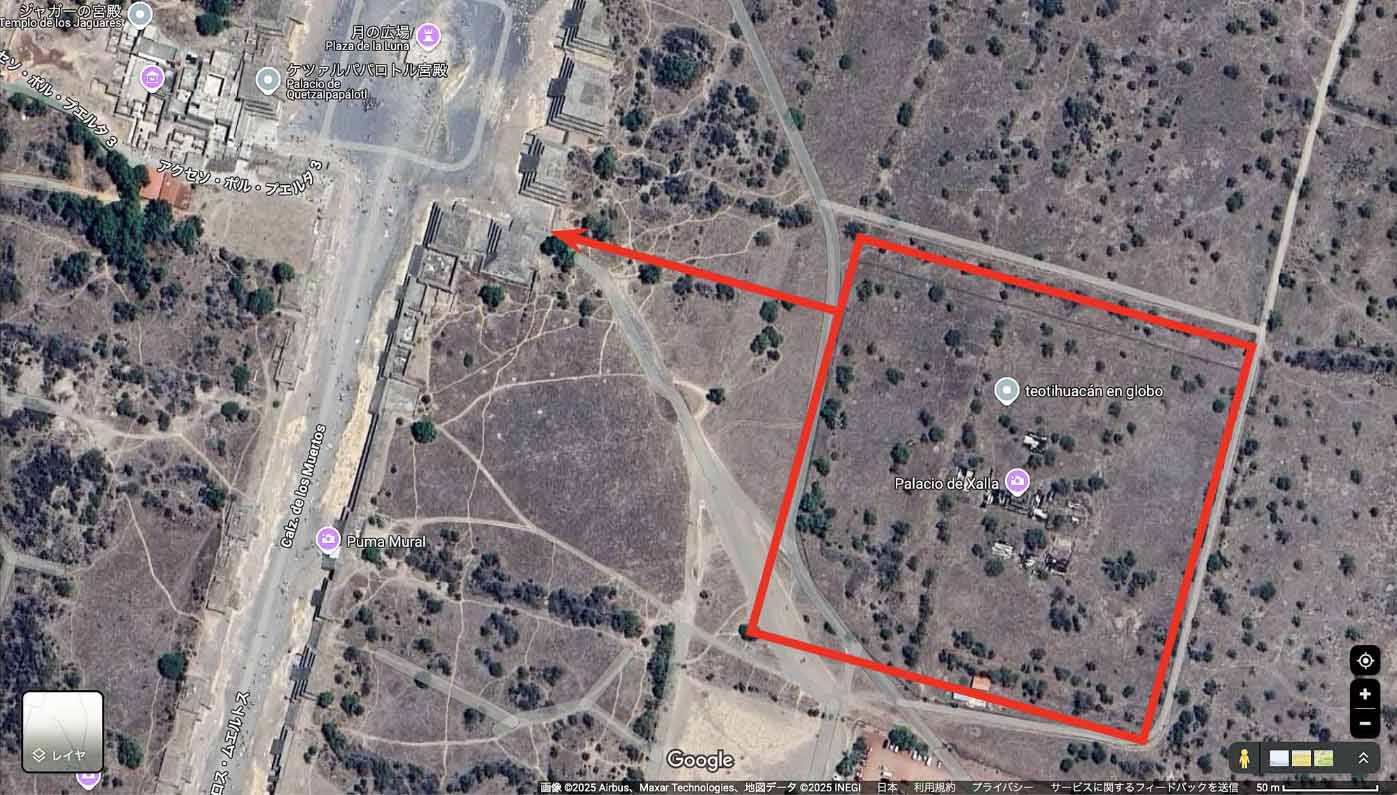
↑at Google Map。
Tourists are not allowed to enter, and there are no artifacts on display in the museum, so there are no photos. However, looking at the above, we can surmise that the Xalla was a special area.
Although we were unable to visit, we left Xalla and headed northeast to Tetinantitla.