Part 4 --- Walking tour of the ruins park
Deducing the community of 100 BC
Teotihuacan at that time had a negligible economic activity compared to Tlatilco, Cuicuilco and Tlapacoya. However, no matter how small a community is, problems can still occur. For example, it is similar to how we today create government laws and unwritten rules for neighborhoods to maintain our nation/community, such as the management of waterways leading from springs to farmland through narrow channels, the expansion of farmland and the adjustment of water rights, the preparation and operation of seasonal rituals, and the maintenance and management of wooden temples that no longer exist, but which could never have existed.
Increasing from 2,000 people to 80,000 people over 200 years means an average increase of 390 people per year, including natural increase. Every month, 33 people arrive asking for housing, whether they are fleeing their hometown due to drought or evacuating from the volcanic ash disaster. This would have been a threat to the Teotihuacan community, which had poor agricultural productivity.
Suffice it to say that there have been no reports of expulsion, slaughter, or burning of migrant invaders in this area during those 200 years.
Let's take a look at the ruins from the north.
Xochitle Temple
[Temple of Xochitl] is located on [Cerro Gordo] north of the city. Let's see satellite photo.
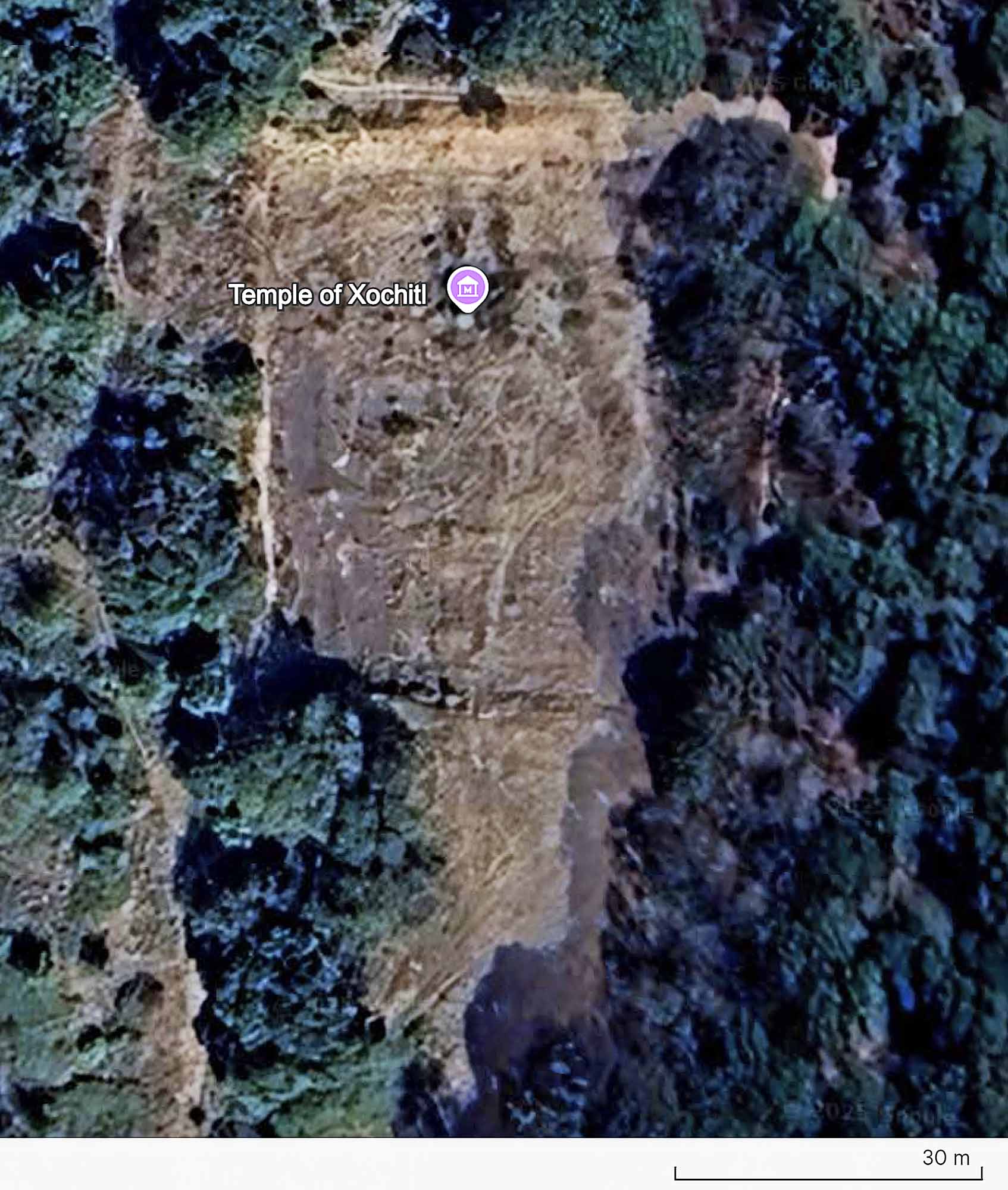
↑on Google Earth. Temple of Xochitl.
I have not seen a detailed paper. It seems that 100 x 50m was excavated. The surrounding area is covered with trees, and any supplementary architecture, if any, is not visible.
When we begin to talk about Teotihuacan, we are introduced to its extraordinary urban design, and it is essential to explain the angle of its architectural axis, the Street of the Dead.
Generally speaking, "when a person stands on [street of the Dead] and looks north, one can see [Cerro Gordo] in the background of [Pyramid of the Moon] as if it were a borrowed landscape.The silhouette of [Pyramid of the Moon] was built to resemble the ridgeline of [Cerro Gordo], which is sacred. Therefore, the angle of [Street of the Dead] is not due north, but is tilted 15.5 degrees west of it,'' it adds.
But wait a minute. Excuse me, when you stand on the Street of the Dead and look roughly north, you can see Mount Gordo directly beyond the Pyramid of the Moon, but it doesn't seem to be facing the symbolic peak of the mountain.Why don't you mention that discrepancy? I'm tempted to say.
Also, the temperature was set at 15.5 degrees when the second layer of the Pyramid of the Moon was built in 120 AD, changing from the 11.5 degrees of the first layer in 100 AD.
Going back, why was the initial 11.5 degrees? There is no archaeological proof, but let's imagine it.
This site introduces tourist spots in Teotihuacan, and you'll come across many expressions related to water, whether it's murals, sculptures, semi-subterranean courtyards, or the statues themselves. Water is brought to us by the sky, rivers, and springs. Rain slides down the mountain, becomes a river, seeps into the water, and becomes a spring.
On the other hand, the south direction of [Street of the Dead] also faces the mountains, but there are no large buildings along the way that serve as landmarks. So in 100 and 120 AD, the Teotihuacan government had only eyes on [Cerro Gordo].
In addition, the angle clockwise from due north of [Street of the Dead] is indicated as 15.5 degrees, 15.3 degrees, 15.17 degrees, 15 degrees, etc. according to literature. The numbers vary. This site uses 15.5 degrees.
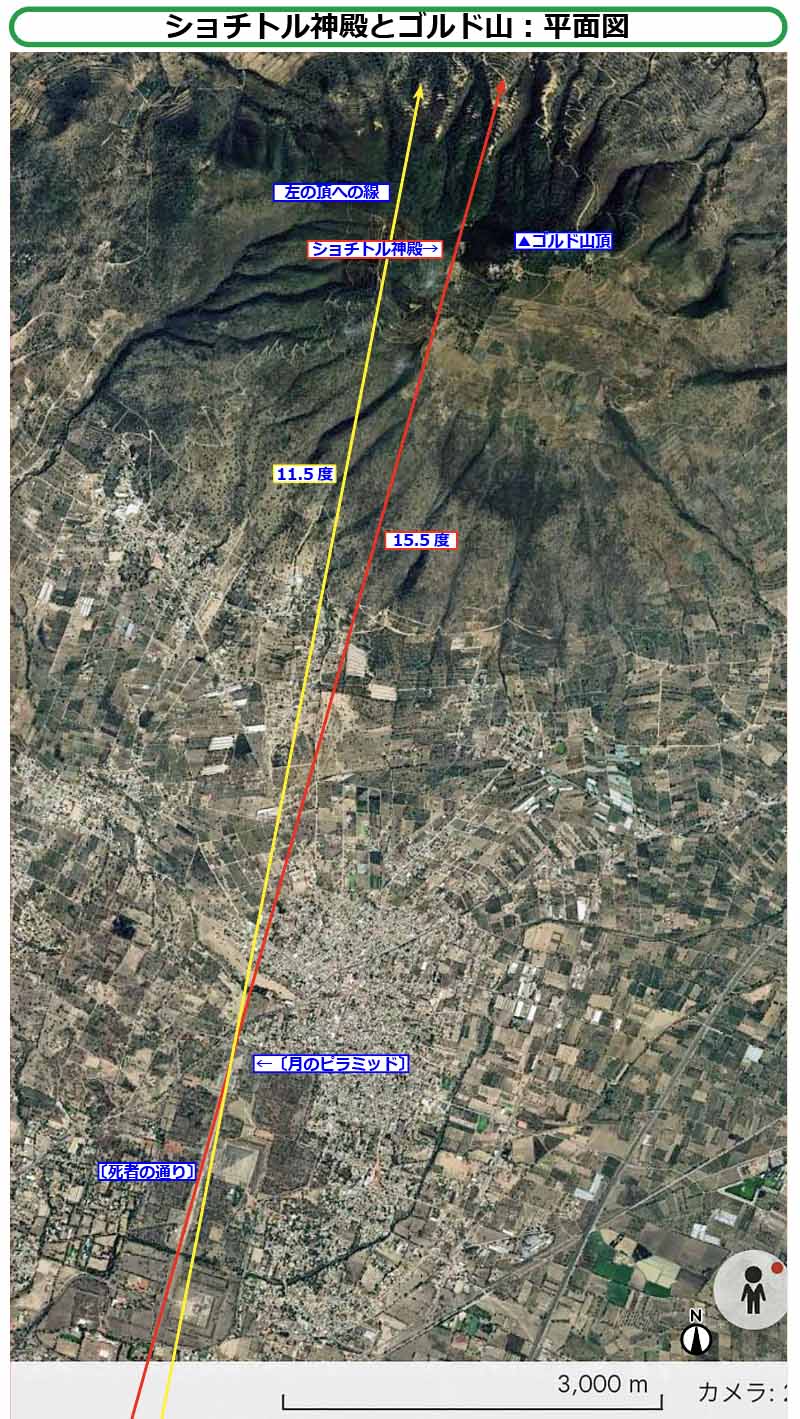
↑on Google Earth. Floor plan.
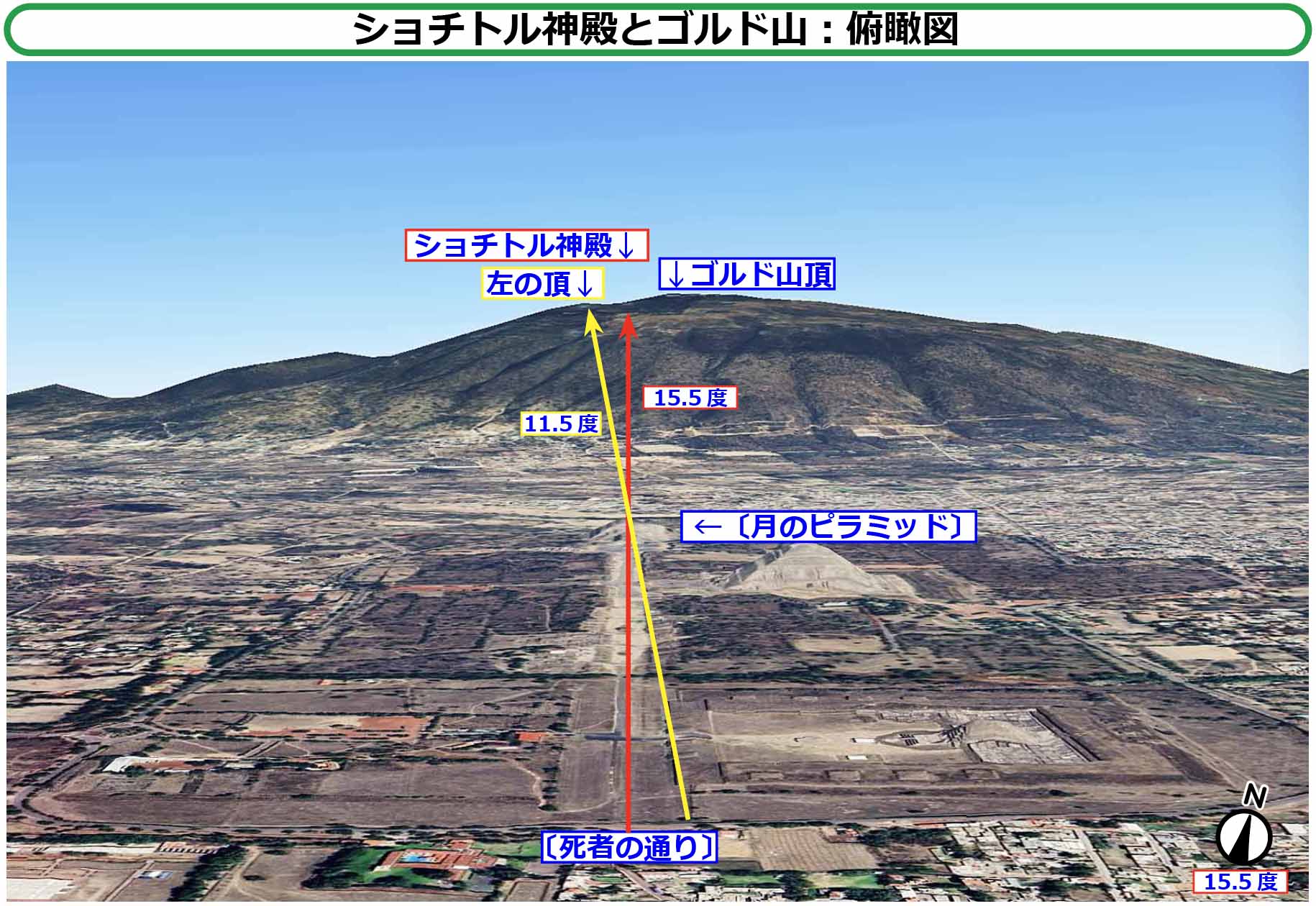
↑on Google Earth. Overhead view.
The architectural axis of the first layer of the Pyramid of the Moon in 100 A.D. faced the "left peak." There must have been a solid reason why they were facing the real mountain peak just to the right. For example, there was a spring or a cave there that could be a symbol of [Cerro Gordo] bringing rainwater and groundwater to the Teotihuacan Valley. From the point of view of bringing water, there seems to be no spring at the top of the mountain, so there is sufficient evidence.
So, why was the architectural axis of the second layer of the Pyramid of the Moon in 120 AD directed toward the area where the Temple of Xochitl remains? Is it because a new spring with abundant spring water was discovered there?
The issue wwith the spring is just my imagination. However, there is some corroborating circumstantial evidence.
1...Tow cerros in Chalcatzingo
150 km south of Teotihuacan are the ruins of Chalcatzingo, which lasted from 800 BC to 1300 AD. I won't go into details, but there were many rock paintings carved there.
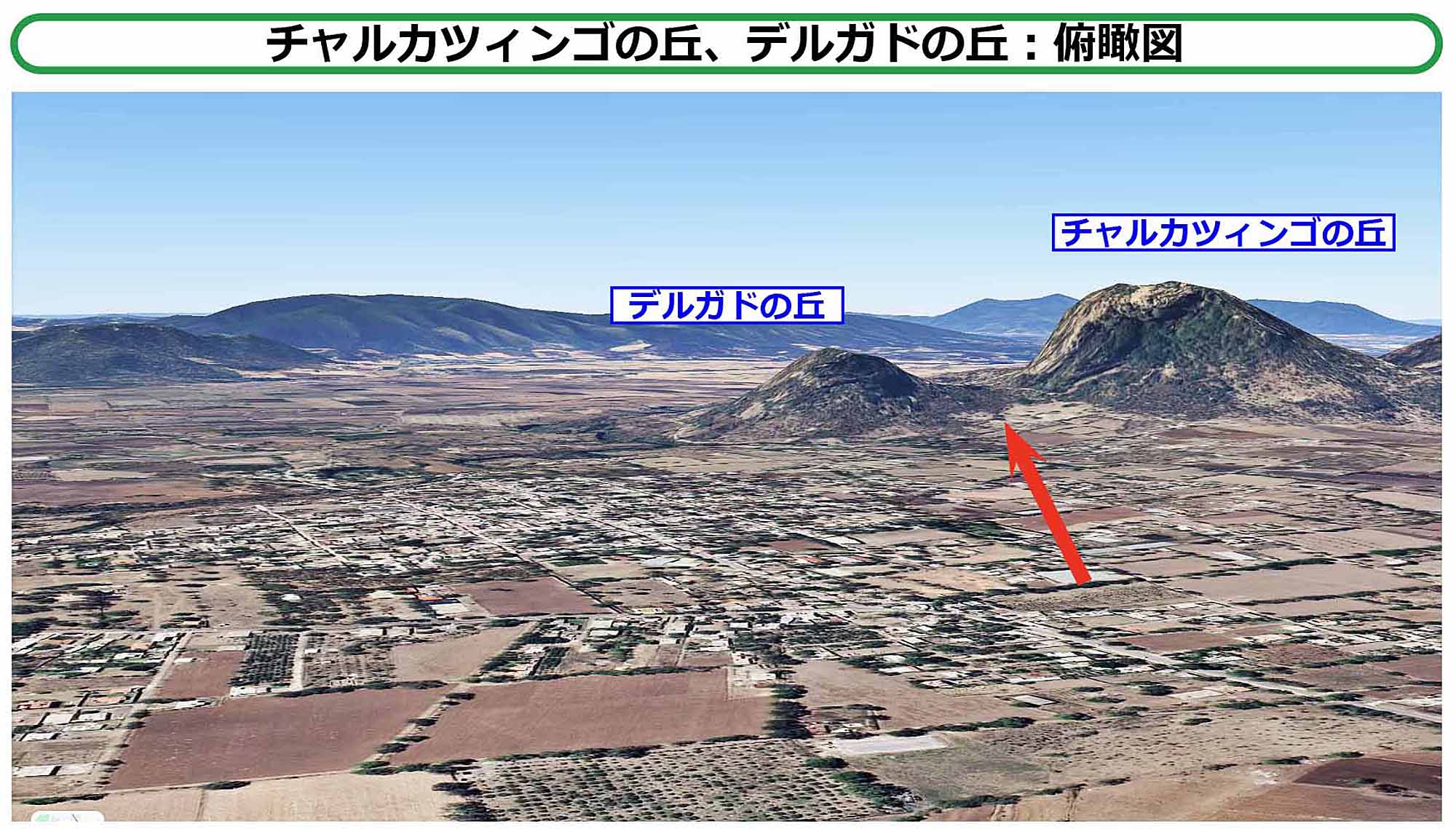
However, no rock art has been found on the surrounding mountains behind it. Hypothetically, the reason why these two hills were carved with sacred symbols is said to be that when you look up in the direction of the red arrow, water flows between the two hills, forming a river and watering the farmland.
The two hills are different in size. The difference is somewhat similar to the balance between the left and right peaks of Cerro Gordo.
2...Hollow in the headdress of the [Water Goddess]
There are mountains on both sides of the cut, and the cut is a valley, where rainwater collects and legend has it that corn was born.
Perhaps it is because of water that the leaders of 120 AD orientated the second tier of the Pyramid of the Moon and the Street of the Dead to imagine water between the left and right peaks, based on ancient Mesoamerican concepts.
Let's return to the [Temple of Xochitl] itself. It is impossible to determine whether or not someone was stationed here permanently. It is also possible that only during rituals related to Cerro Gordo, the priests traveled up a 7km straight mountain road to light a fire at night and show it to the people gathered on the Street of the Dead.
Although it is unknown what they were doing, [Temple of Xochitl] was built as a place to do something.